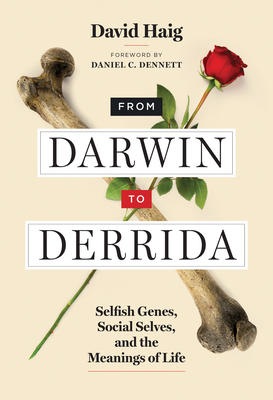
From Darwin to Derrida: Selfish Genes, Social Selves, and the Meanings of Life
暫譯: 從達爾文到德里達:自私的基因、社會的自我與生命的意義
Haig, David, Dennett, Daniel C.
- 出版商: Summit Valley Press
- 出版日期: 2026-02-17
- 售價: $1,520
- 貴賓價: 9.5 折 $1,444
- 語言: 英文
- 頁數: 512
- 裝訂: Quality Paper - also called trade paper
- ISBN: 0262057190
- ISBN-13: 9780262057196
-
相關分類:
生物資訊 Bioinformatics
海外代購書籍(需單獨結帳)
相關主題

商品描述
How the meaningless process of natural selection produces purposeful beings who find meaning in the world. In From Darwin to Derrida, evolutionary biologist David Haig explains how a physical world of matter in motion gave rise to a living world of purpose and meaning. Natural selection, a process without purpose, gives rise to purposeful beings who find meaning in the world. The key to this, Haig proposes, is the origin of mutable "texts"--genes--that preserve a record of what has worked in the world. These texts become the specifications for the intricate mechanisms of living beings. Haig draws on a wide range of sources--from Laurence Sterne's Tristram Shandy to Immanuel Kant's Critique of the Power of Judgment to the work of Jacques Derrida to the latest findings on gene transmission, duplication, and expression--to make his argument. Genes and their effects, he explains, are like eggs and chickens. Eggs exist for the sake of becoming chickens and chickens for the sake of laying eggs. A gene's effects have a causal role in determining which genes are copied. A gene (considered as a lineage of material copies) persists if its lineage has been consistently associated with survival and reproduction. Organisms can be understood as interpreters that link information from the environment to meaningful action in the environment. Meaning, Haig argues, is the output of a process of interpretation; there is a continuum from the very simplest forms of interpretation, instantiated in single RNA molecules near the origins of life, to the most sophisticated. Life is interpretation--the use of information in choice.
商品描述(中文翻譯)
無意義的自然選擇過程如何產生有目的的存在,並使其在世界中尋找意義。
在從達爾文到德里達一書中,進化生物學家大衛·海格(David Haig)解釋了如何從運動中的物質世界產生出有目的和有意義的生命世界。自然選擇是一個沒有目的的過程,但卻產生了能在世界中尋找意義的有目的存在。海格提出,這一切的關鍵在於可變的「文本」——基因——的起源,這些基因保存了在世界上有效的記錄。這些文本成為生物體複雜機制的規範。 海格引用了廣泛的來源——從勞倫斯·斯特恩(Laurence Sterne)的特里斯特拉姆·香迪到伊曼紐爾·康德(Immanuel Kant)的判斷力批判,再到雅克·德里達(Jacques Derrida)的作品,以及最新的基因傳遞、複製和表達的研究成果——來支持他的論點。他解釋說,基因及其效應就像蛋和雞。蛋的存在是為了變成雞,而雞的存在是為了產卵。基因的效應在決定哪些基因被複製方面具有因果作用。如果一個基因的系譜與生存和繁殖持續相關,那麼這個基因(被視為物質複製的系譜)就會持續存在。生物體可以被理解為解釋者,將環境中的信息與環境中的有意義行動聯繫起來。海格主張,意義是解釋過程的產出;從生命起源時期的單一RNA分子所體現的最簡單解釋形式,到最複雜的解釋形式之間存在著一個連續體。生命就是解釋——在選擇中使用信息。作者簡介
David A. Haig is George Putnam Professor of Organismic and Evolutionary Biology at Harvard University. Daniel C. Dennett is University Professor Codirector of the Center for Cognitive Studies at Tufts University. He is the author of Brainchildren: Essays on Designing Minds; Sweet Dreams: Philosophical Obstacles to a Science of Consciousness; Elbow Room The Varieties of Free Will Worth Wanting; Sweet Dreams: Philosophical Obstacles to a Science of Consciousness (all published by the MIT Press), From Bacteria to Bach and Back: The Evolution of Mind, and other books.
作者簡介(中文翻譯)
大衛·A·海格(David A. Haig)是哈佛大學有機與演化生物學的喬治·普特南教授(George Putnam Professor)。丹尼爾·C·丹尼特(Daniel C. Dennett)是塔夫茨大學(Tufts University)大學教授及認知研究中心的共同主任。他是《腦之子:設計心智的隨筆》(Brainchildren: Essays on Designing Minds)、《甜蜜的夢:意識科學的哲學障礙》(Sweet Dreams: Philosophical Obstacles to a Science of Consciousness)、《活動空間》(Elbow Room)、《值得渴望的自由意志的多樣性》(The Varieties of Free Will Worth Wanting)、《甜蜜的夢:意識科學的哲學障礙》(Sweet Dreams: Philosophical Obstacles to a Science of Consciousness)(以上均由麻省理工學院出版社出版)、《從細菌到巴赫再回來:心智的演化》(From Bacteria to Bach and Back: The Evolution of Mind)及其他書籍的作者。