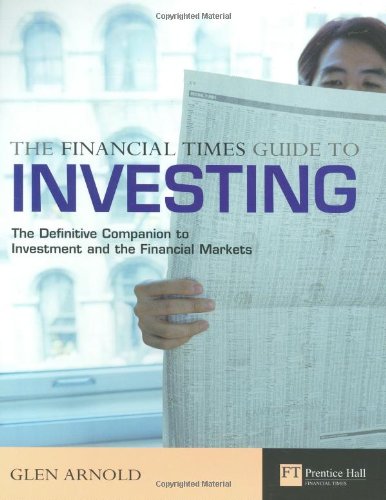
The Financial Times Guide To Investing: The Definitive Companion To Investment and The Financial Markets
Glen Arnold
- 出版商: Financial Times Mana
- 出版日期: 2003-11-26
- 售價: $2,600
- 貴賓價: 9.5 折 $2,470
- 語言: 英文
- 頁數: 432
- 裝訂: Paperback
- ISBN: 0273663097
- ISBN-13: 9780273663096
-
相關分類:
投資理財 Investment
海外代購書籍(需單獨結帳)
相關主題

商品描述
Description
No need to be baffled any longer by a flurry of information, data, facts and comments, impenetrabel waves of jargon, and the complexities of the financial markets.
The Financial Times Guide to Investing will introduce you to the complex art of investing, and how to invest successfully, whether you are actively involved in investing or just thinking about it. In addition to providing a simple guide to understanding how financial markets operate, it will allow you to follow and act on your own judgements based on case studies and worked examples, giving you the chance to experiment successfully with shares, bonds, funds and derivatives. The book is written in a clear and uncluttered manner taking many examples and case studies from the FT.
Table of Contents
CONTENTS
Introduction
PART I INVESTMENT BASICS
Chapter 1 What is investment?
Back in time
Partnerships
A company with limited liability
Ordinary shares and extraordinary returns
Shareholder rights
A money making machine
Dividends and retained earnings
What if I want to sell?
Primary and secondary markets
Bonds
Capital structure
Stocks and shares
Rights issues
Financial Institutions
Investment banks
The asset transformers
Pension funds
Insurance companies
The risk spreaders
Be proud to be a capitalist!
A note of warning – Investment and speculation
Chapter 2 The rewards of investment.
Becoming a millionaire
A little more realism
Simple and compound interest
An analogy
What investors have received in the past
Decade by decade
The importance of income
International comparison
Equity versus gilt performances
What about risk?
Closing comment
Chapter 3 Stock Markets.
What is a stock market?
Brokers and market makers
Pricing – good old supply and demand
A short history of the London Stock Exchange
Big bang
Chinese walls
Recent moves
The international scene
Variety of securities traded
The primary market
The secondary market
The Official list (the ‘Main’ market)
The Alternative Investment Market
TechMARK and the other MARKs
OFEX
Who owns UK shares?
Tasks for stock exchanges
Useful websites
Chapter 4 Buying and Selling Shares.
Stockbroker services
Choosing a stockbroker
Finding prices
What happens when I buy or sell shares?
Small or infrequently traded shares
An alternative mechanism
What happens after dealing?
Ways of paying for your shares
Internet dealing
Transferring shares without brokers
Websites
PART II THE INVESTMENT SPECTRUM
Chapter 5 Pooled investments.
Unit trusts
Pricing
Charging
Reading the FT
How do you buy or sell units?
Who looks after the unit holder’s interests?
Types of trusts available
Returns
Minimum investment
Following your units’ progress
Switching funds
Points to bear in mind when choosing a unit trust
OEICs
ETFs
Advantages of ETFs
Investment trusts (Investment companies)
Discounts and premiums
Costs for the investor
Borrowing
Tax
Split-capital investment trusts (‘Dual capital’ trusts)
Websites
With-profit policies
Taxation
The controversy over with-profit funds
Unit-linked policies
Insurance company bonds
Stock market-linked bonds
Hedge funds
Fund supermarkets
Websites
Chapter 6 Bonds.
Gilts
Prices and returns
Yield
Quotes
Buying and selling gilts
Cum-dividend and ex-dividend
Index-linked gilts
Corporate Bonds
Debentures and loan stock
Trust deeds and covenants
Repayments
Bond variations
Trading in the corporate bond market
Credit rating
High-yield (junk) bonds
Convertible bonds
Foreign bonds
Eurobonds
Chapter 7 Unusual share investment
Business angels
Venture capital
Private equity
Points for investors concerning Angel and Venture Capital
Overseas shares
Points to consider about investing abroad
Some useful websites for investors in overseas shares
Preference shares
Chapter 8 Options
What is a derivative?
A long history
What is an option?
Share options
Call option holders (call option buyer)
Call option writers
An example of an option writing strategy
LIFFE share options
Put options
Traditional options
How to trade options (and futures)
Using share options to reduce risk: hedging
Using options to reduce losses
Index options
Hedging against a decline in the market using index options
Chapter 9 Futures
Marking to market and margins
Worked example showing margins
Settlement
Worked example: hedging with a share index future
Universal Stock Futures (Single Stock Futures)
Using USFs to reduce risk
Buying and selling futures
Chapter 10 Spread betting, Contracts for difference and Warrants
Spread betting
Money up-front
Types of bet
Uses of spread betting
Further points
Contracts for difference
Additional points on contracts for difference trading
Warrants
Covered warrants
More on covered warrants
Example of covered warrant use – releasing cash while maintaining exposure to a share
PART III COMPANY ANALYSIS
Chapter 11 Company Accounts.
Oh no! Not numbers again!
How to obtain the report
The report and accounts
Profit and loss
Balance sheet
Cash flow statement
Chairman’s statement
Chief executive’s review (Operational review)
The Director’s report
Financial review
Auditor’s report
Five-year summary
Reading
Chapter 12 Key investment ratios and measures.
From the financial pages
Price-earnings ratio (PER)
Dividend yield
Dividend cover, payout ratio and retention ratio
Market capitalisation
Net asset value (NAV)
Market to book ratio
Enterprise value (EV)
Performance Ratios and measures
Profit margins
Gross profit margin
Operating profit margin
Pre-tax profit margin
Return on capital employed (ROCE)
EBITDA
Free cash flow
Owner earnings
Financial health ratios and measures
Gearing
Capital gearing
Income gearing
Current ratio
Quick ratio
Forward looking measures
Dividend valuation model (DVM)
Intrinsic value
Reading
Chapter 13 Some of the tricks of the accounting trade.
Goodwill
Fair value
What was our revenue again?
Exceptional items
Stock (inventory) valuation
Depreciation
Capitalisation
Off-balance-sheet
Share (Stock) options
Other tricks
Concluding comment
Reading
Chapter 14 Analysing the industry
The competitive floor
The five competitive forces
Threat of entry
Intensity of rivalry of existing companies
The threat from substitutes
Buyer (customer) power
Supplier power
Industry evolution
Technological change
Learning
Economic
Government
Social
Concluding comments
Reading
Chapter 15 The competitive position of the firm.
The TRRACK system
Tangible
Relationships
Reputation
Attitude
Capabilities
Knowledge
What makes resources extraordinary?
Demanded
Scarcity
Appropriable
Investment in resources
Leveraging resources and over-exploiting them
Concluding comments
Reading
PART IV MANAGING YOUR PORTFOLIO
Chapter 16 Companies issuing shares.
New issues
The sponsor
The prospectus
Finding out about new issues
Underwriting
The role of the corporate broker
After flotation
Methods of flotation
Timetable for a new issue
Under-pricing and stagging
How does an Alternative Investment Market (AIM) flotation differ from one on the Official List?
Right issues
An example
What if a shareholder does not want to take up the rights?
Ex-rights and cum-rights
The price discount decision
Information on rights issues
Other equity issues
Placings and open offers
Vendor placing
Bought deal
Information on share issues
Scrip issues
Share buy-backs and special dividends
Chapter 17 Taxation and investors.
Stamp duty
Tax on dividends
Capital gains tax
Tips on reducing CGT
Interest-bearing instruments
Inheritance tax, IHT
Individual savings accounts, ISAs
Personal Pensions
Enterprise investment scheme
Venture capital trusts
Off-shore investment
Chapter 18 Mergers and takeovers.
Merger motives
In the interests of shareholders
Managerial motives
Third party motives
Financing mergers
Cash
Shares
Other types of finance
The rules of the takeover game
The regulatory bodies
Pre-bid
The bid
Post-bid
Defence tactics
Information
Who wins from mergers?
Chapter 19 Investor protection.
Protecting investors from wayward financial service professionals
Authorisation
If you have a complaint
Compensation
Regulation of markets
Regulating companies
Self protection
Chapter 20 Measuring performance: indices and risk.
Indices
Risk
Volatility
Diversifiable risk
Correlation
Beta
Sharpe ratio
Treynor’s ratio
Different types of risk
Liquidity risk
Event risk
Political risk
Exchange rate risk
Market risk
Manager risk
Inflation risk
Websites giving risk of shares and indices
Websites giving information on risk of funds (unit trusts, investment trusts and OEICS)
Reading
Chapter 21 Investment clubs.
How to set up a club
The unit valuation system
Bank account
Brokers
Tax
Reading
Glossary.
List of useful Internet addresses.