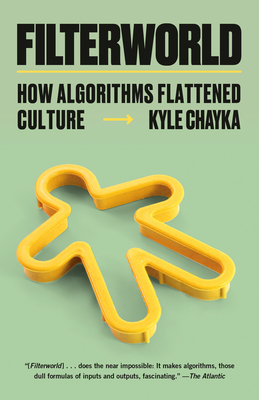
Filterworld: How Algorithms Flattened Culture
暫譯: 過濾世界:演算法如何扁平化文化
Chayka, Kyle
- 出版商: Vintage
- 出版日期: 2025-01-21
- 售價: $900
- 貴賓價: 9.5 折 $855
- 語言: 英文
- 頁數: 304
- 裝訂: Quality Paper - also called trade paper
- ISBN: 0593466799
- ISBN-13: 9780593466797
-
相關分類:
Algorithms-data-structures
海外代購書籍(需單獨結帳)
商品描述
One of Esquire's 25 Best Nonfiction Books of 2024 "[Filterworld] brings stark clarity to the formulas that guide our behaviors online...it does the near impossible: It makes algorithms, those dull formulas of inputs and outputs, fascinating."
--The Atlantic "A thought-provoking account of how Big Tech and its algorithms have rewired interests, degraded language and shaped users to 'seek out culture that embraces nothingness.'"
--The New York Times Book Review "Chilling...Evocative...Incisive."
--The Wall Street Journal New Yorker staff writer and author of The Longing for Less Kyle Chayka delivers a timely history and investigation of a world ruled by algorithms, which determine the shape of culture itself. From trendy restaurants to city grids, to TikTok and Netflix feeds the world round, algorithmic recommendations dictate our experiences and choices. The algorithm is present in the familiar neon signs and exposed brick of Internet cafes, be it in Nairobi or Portland, and the skeletal, modern furniture of Airbnbs in cities big and small. Over the last decade, this network of mathematically determined decisions has taken over, almost unnoticed--informing the songs we listen to, the friends with whom we stay in touch--as we've grown increasingly accustomed to our insipid new normal. This ever-tightening web woven by algorithms is called "Filterworld." Kyle Chayka shows us how online and offline spaces alike have been engineered for seamless consumption, becoming a source of pervasive anxiety in the process. Users of technology have been forced to contend with data-driven equations that try to anticipate their desires--and often get them wrong. What results is a state of docility that allows tech companies to curtail human experiences--human lives--for profit. But to have our tastes, behaviors, and emotions governed by computers, while convenient, does nothing short of call the very notion of free will into question. In Filterworld, Chayka traces this creeping, machine-guided curation as it infiltrates the furthest reaches of our digital, physical, and psychological spaces. With algorithms increasingly influencing not just what culture we consume, but what culture is produced, urgent questions arise: What happens when shareability supersedes messiness, innovation, and creativity--the qualities that make us human? What does it mean to make a choice when the options have been so carefully arranged for us? Is personal freedom possible on the Internet? To the last question, Filterworld argues yes--but to escape Filterworld, and even transcend it, we must first understand it.
--The Atlantic "A thought-provoking account of how Big Tech and its algorithms have rewired interests, degraded language and shaped users to 'seek out culture that embraces nothingness.'"
--The New York Times Book Review "Chilling...Evocative...Incisive."
--The Wall Street Journal New Yorker staff writer and author of The Longing for Less Kyle Chayka delivers a timely history and investigation of a world ruled by algorithms, which determine the shape of culture itself. From trendy restaurants to city grids, to TikTok and Netflix feeds the world round, algorithmic recommendations dictate our experiences and choices. The algorithm is present in the familiar neon signs and exposed brick of Internet cafes, be it in Nairobi or Portland, and the skeletal, modern furniture of Airbnbs in cities big and small. Over the last decade, this network of mathematically determined decisions has taken over, almost unnoticed--informing the songs we listen to, the friends with whom we stay in touch--as we've grown increasingly accustomed to our insipid new normal. This ever-tightening web woven by algorithms is called "Filterworld." Kyle Chayka shows us how online and offline spaces alike have been engineered for seamless consumption, becoming a source of pervasive anxiety in the process. Users of technology have been forced to contend with data-driven equations that try to anticipate their desires--and often get them wrong. What results is a state of docility that allows tech companies to curtail human experiences--human lives--for profit. But to have our tastes, behaviors, and emotions governed by computers, while convenient, does nothing short of call the very notion of free will into question. In Filterworld, Chayka traces this creeping, machine-guided curation as it infiltrates the furthest reaches of our digital, physical, and psychological spaces. With algorithms increasingly influencing not just what culture we consume, but what culture is produced, urgent questions arise: What happens when shareability supersedes messiness, innovation, and creativity--the qualities that make us human? What does it mean to make a choice when the options have been so carefully arranged for us? Is personal freedom possible on the Internet? To the last question, Filterworld argues yes--but to escape Filterworld, and even transcend it, we must first understand it.
作者簡介
KYLE CHAYKA is a staff writer at The New Yorker, where he writes a column on digital technology and the impact of the Internet and social media on culture. His debut nonfiction book, The Longing for Less, an exploration of minimalism in life and art, was published in 2020. As a journalist and critic he has contributed to many publications, including The New York Times Magazine, Harper's, The New Republic, and Vox. He was the first staff writer of the art publication Hyperallergic. Kyle is also the co-founder of Study Hall, an online community for journalists, and Dirt, a newsletter about digital culture. He lives in Washington, D.C.
作者簡介(中文翻譯)
KYLE CHAYKA 是《The New Yorker》的專欄作家,專注於數位科技以及網路和社交媒體對文化的影響。他的首部非小說類書籍《The Longing for Less》於2020年出版,探討了生活和藝術中的極簡主義。作為記者和評論家,他為許多出版物撰稿,包括《The New York Times Magazine》、《Harper's》、《The New Republic》和《Vox》。他曾是藝術出版物 Hyperallergic 的首位專欄作家。Kyle 也是 Study Hall 的共同創辦人,這是一個為記者提供的線上社群,以及 Dirt,一份關於數位文化的電子報。他目前居住在華盛頓特區。