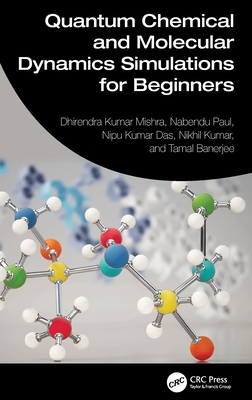
Quantum Chemical and Molecular Dynamics Simulations for Beginners
暫譯: 量子化學與分子動力學模擬入門
Mishra, Dhirendra Kumar, Paul, Nabendu, Das, Nipu Kumar
- 出版商: CRC
- 出版日期: 2025-12-23
- 售價: $5,140
- 貴賓價: 9.5 折 $4,883
- 語言: 英文
- 頁數: 236
- 裝訂: Hardcover - also called cloth, retail trade, or trade
- ISBN: 1032619287
- ISBN-13: 9781032619286
-
相關分類:
量子 Quantum
海外代購書籍(需單獨結帳)
相關主題


商品描述
This book provides an in-depth exploration of the dynamic field of computational chemistry. Spanning seven meticulously crafted chapters, it begins by laying a solid foundation in quantum chemistry and electronic structure theory, introducing essential tools and software that underpin computational chemistry calculations. The journey continues with a comprehensive examination of transition state analysis for interpreting reaction mechanisms, followed by an insightful discussion on modern solvation studies using QM/MM techniques and the practical implementation of hybrid models. The book concludes with an engaging dive into molecular dynamics simulations, enriched by real-world case studies utilizing NAMD and VMD to illustrate the complex behavior of molecular systems.
Key features
- Focuses on quantum chemical calculations performed for beginners
- Reviews the use of atomistic molecular dynamic simulations for various systems
- Presents detailed analysis of calculations and result analysis on real systems
- Includes usage of widely accepted software packages such as Gaussian and NAMD
- Explores basic parameters associated with designing a chemical system
This book is aimed at researchers and senior undergraduate students in chemical engineering, chemistry, and materials sciences.
商品描述(中文翻譯)
這本書深入探討了計算化學這一動態領域。全書共分為七個精心編寫的章節,首先奠定了量子化學和電子結構理論的堅實基礎,介紹了支撐計算化學計算的基本工具和軟體。接下來,書中全面檢視了過渡態分析,以解釋反應機制,並深入討論了使用量子力學/分子力學(QM/MM)技術的現代溶劑化研究及混合模型的實際應用。最後,書中引人入勝地探討了分子動力學模擬,並通過使用NAMD和VMD的實際案例研究,展示了分子系統的複雜行為。
主要特點
- 專注於為初學者進行的量子化學計算
- 回顧了對各種系統進行原子級分子動力學模擬的使用
- 提供對實際系統的計算和結果分析的詳細分析
- 包含使用廣泛接受的軟體包,如Gaussian和NAMD
- 探索與設計化學系統相關的基本參數
本書旨在為化學工程、化學和材料科學的研究人員及高年級本科生提供參考。
作者簡介
Dhirendra Kumar Mishra earned a Doctorate in Chemical Engineering from the Indian Institute of Technology, Guwahati, Assam, India. During his doctoral studies, he specifically concentrated on the integration of ionic liquids and eutectic solvents in the field of hydrogen storage as a catalytic solvent. His study involved utilizing experimental and computational chemistry simulations to comprehend and improve the effectiveness of ionic liquids and eutectic mixtures for practical usage. His research interests span multiple areas, including computational chemistry for energy-related applications, green and sustainable solvents, hydrogen storage, and nanofluids for thermal applications. He is currently a postdoctoral fellow at the Joint BioEnergy Institute, affiliated with Sandia National Laboratories, where his research focuses on improving the process of catalytic lignin depolymerization using solvents and heterogeneous catalysts through experimental and computational approaches. He has published more than ten research papers in journals with high impact factors, including Chemical Reviews, ACS Sustainable Chemistry and Engineering, Journal of Physical Chemistry A, International Journal of Hydrogen Energy, and the Journal of Energy Storage.
Nabendu Paul earned his Doctoral degree from the Chemical Engineering Department of the Indian Institute of Technology, Guwahati, in 2023. Subsequently, he joined the Maulana Azad National Institute of Technology (MANIT), Bhopal, and has been serving as an Assistant Professor in the Department of Chemical Engineering since January 2024. He obtained his M.Tech. and B.Tech. degrees in Chemical Engineering from the National Institute of Technology, Agartala, in 2015 and 2013, respectively. His research encompasses a wide range of interdisciplinary domains, including ionic liquids and deep eutectic solvents (DESs), extraction and recovery of pharmaceuticals and biomolecules from aqueous environments, molecular dynamics and quantum chemical calculations, and the study of non-covalent interactions. His work further extends to ionic liquid-based systems for environmental and biological applications, such as drug delivery, direct air capture (DAC) of CO2, and the development of eutectogels, ionogels, and DES-based electrolytes for supercapacitors. Recently, his group has initiated studies on the antibacterial potential of DESs in wound healing membranes. He has published over eight articles in reputed peer-reviewed journals, including Small, ACS Sustainable Chemistry and Engineering, Journal of Physical Chemistry B, and the Journal of Molecular Liquids. He has also authored a book that discusses the theoretical correlations and molecular dynamics aspects of deep eutectic solvents in environmental applications. Additionally, he has published several book chapters and conference papers. His work integrates both experimental and computational approaches and contributes to advancing sustainable and functional material systems in chemical and environmental engineering.
Nipu Kumar Das received his Doctoral degree in 2025 from the Indian Institute of Technology, Guwahati, Assam, India, in Chemical Engineering. During his Ph.D. studies, Dr. Das primarily focused on deep eutectic solvent-based thermal fluids and solubility studies of various natural deep eutectic solvents. His studies involved both experimental and computational chemistry to understand the mechanism of solvent interactions with nanoparticles. His other research interests span the areas of green nanoparticles, energy-related applications, COSMO-SAC modeling, corrosion inhibitors, and sustainable solvents. He has published more than 13 research papers in journals with high impact factors, including the Journal of Molecular Liquids, ACS Sustainable Chemistry and Engineering, AIChE Journal, Industrial Crops and Products, and the Journal of Energy Storage.
Nikhil Kumar is a postdoctoral researcher at Sandia National Laboratories who is currently working in the Predictive Deconstruction group at the Department of Energy-funded Joint BioEnergy Institute (JBEI). Dr. Kumar received his Ph.D. in 2023 from the Department of Chemical Engineering at the Indian Institute of Technology Guwahati, India. Dr. Kumar's research is primarily focused on the development of novel green solvents for aromatic compound extraction and the understanding the liquid structure of deep eutectic solvents using molecular dynamics, quantum chemical, and COSMO-RS model simulations. Dr. Kumar's research interests also include leveraging both machine learning and first-principles physics-based methods to make improved predictions for solvents for enhanced biomass conversion, utilization of CO2 for the circular economy, and thermodynamic property predictions using various machine learning and artificial intelligence models. Dr. Kumar has co-authored a book, published more than ten research articles in leading academic journals, and contributed to over ten conferences.
Tamal Banerjee is currently a Professor at the Department of Chemical Engineering, Indian Institute of Technology, Guwahati. He served as Supplemental Faculty in the Department of Chemical and Biomolecular Engineering at the University of Delaware, USA, from 2011-2012. He also held the position of University Associate at Curtin University, Perth, Australia from 2020-2024. Throughout his career, Dr. Banerjee has authored three books (published by CRC and Elsevier) and around 200 academic publications. His research group has contributed around 900 data points related to thermodynamic properties of ionic liquid (IL) and deep eutectic solvent (DES) mixtures, now available in the NIST database. He has supervised 20 doctoral students, most of whom focus on applications of green solvents in energy and environmental domains. Dr. Banerjee received the INDO-US Fellowship in 2011 in Engineering Sciences. He is currently a Fellow of the Royal Society of Chemistry, the Indian Institute of Chemical Engineers, and the Indian Chemical Society. He serves on the editorial boards of Fluid Phase Equilibria and the Journal of Solution Chemistry, and is the Associate Editor of Thermal Advances. His research uses both quantum chemical and molecular dynamics methods to predict thermodynamic and transport properties of ILs and DESs. His expertise includes the COnductor like Screening MOdel (COSMO) based methods and molecular modelling techniques, encompassing both classical molecular dynamics and reactive force field simulations (ReaxFF). His application areas span renewable energy sources (such as alcohols) and non-renewable energy sources (such as coal and chemical hydrides).
作者簡介(中文翻譯)
Dhirendra Kumar Mishra 於印度阿薩姆邦的印度理工學院古瓦哈提校區獲得化學工程博士學位。在他的博士研究中,他專注於在氫儲存領域中將離子液體和共熔溶劑作為催化溶劑的整合。他的研究涉及利用實驗和計算化學模擬來理解和改善離子液體及共熔混合物的有效性,以便於實際應用。他的研究興趣涵蓋多個領域,包括與能源相關的計算化學、綠色和可持續溶劑、氫儲存以及用於熱應用的納米流體。他目前是聯合生物能源研究所的博士後研究員,隸屬於桑迪亞國家實驗室,研究重點是通過實驗和計算方法改善催化木質素降解過程,使用溶劑和異質催化劑。他在高影響因子的期刊上發表了十多篇研究論文,包括Chemical Reviews、ACS Sustainable Chemistry and Engineering、Journal of Physical Chemistry A、International Journal of Hydrogen Energy和Journal of Energy Storage。
Nabendu Paul 於2023年在印度理工學院古瓦哈提校區的化學工程系獲得博士學位。隨後,他加入了博帕爾的馬烏拉納·阿扎德國立技術學院(MANIT),自2024年1月起擔任化學工程系的助理教授。他於2015年和2013年分別在阿加爾塔拉國立技術學院獲得化學工程的碩士和學士學位。他的研究涵蓋多個跨學科領域,包括離子液體和深共熔溶劑(DESs)、從水相環境中提取和回收藥物及生物分子、分子動力學和量子化學計算,以及非共價相互作用的研究。他的工作還擴展到基於離子液體的系統,用於環境和生物應用,如藥物傳遞、二氧化碳的直接空氣捕集(DAC)以及開發共熔凝膠、離子凝膠和基於DES的電解質以用於超級電容器。最近,他的研究小組開始研究DES在傷口癒合膜中的抗菌潛力。他在知名的同行評審期刊上發表了超過八篇文章,包括Small、ACS Sustainable Chemistry and Engineering、Journal of Physical Chemistry B和Journal of Molecular Liquids。他還撰寫了一本書,討論深共熔溶劑在環境應用中的理論關聯和分子動力學方面。此外,他還發表了幾篇書章和會議論文。他的工作結合了實驗和計算方法,為化學和環境工程中可持續和功能性材料系統的進步做出了貢獻。
Nipu Kumar Das 於2025年在印度阿薩姆邦的印度理工學院古瓦哈提校區獲得化學工程博士學位。在他的博士研究中,Das博士主要專注於基於深共熔溶劑的熱流體和各種天然深共熔溶劑的溶解度研究。他的研究涉及實驗和計算化學,以理解溶劑與納米顆粒的相互作用機制。他的其他研究興趣涵蓋綠色納米顆粒、與能源相關的應用、COSMO-SAC建模、腐蝕抑制劑和可持續溶劑。他在高影響因子的期刊上發表了超過13篇研究論文,包括Journal of Molecular Liquids、ACS Sustainable Chemistry and Engineering、AIChE Journal、Industrial Crops and Products和Journal of Energy Storage。
Nikhil Kumar 是桑迪亞國家實驗室的博士後研究員,目前在能源部資助的聯合生物能源研究所(JBEI)的預測解構小組工作。Kumar博士於2023年在印度理工學院古瓦哈提校區的化學工程系獲得博士學位。Kumar博士的研究主要集中在開發新型綠色溶劑以提取芳香化合物,以及利用分子動力學、量子化學和COSMO-RS模型模擬來理解深共熔溶劑的液體結構。Kumar博士的研究興趣還包括利用機器學習和基於第一原理的物理方法來改進溶劑的預測,以增強生物質轉化、利用二氧化碳進行循環經濟,以及使用各種機器學習和人工智慧模型進行熱力學性質預測。Kumar博士共同撰寫了一本書,在領先的學術期刊上發表了十多篇研究文章,並參加了十多個會議。
Tamal Banerjee 目前是印度理工學院古瓦哈提校區化學工程系的教授。他曾於2011年至2012年擔任美國德拉瓦州大學化學與生物分子工程系的補充教員。他還於2020年至2024年擔任澳大利亞珀斯的科廷大學的校友教授。在他的職業生涯中,Banerjee博士撰寫了三本書(由CRC和Elsevier出版)和約200篇學術出版物。他的研究小組貢獻了約900個與離子液體(IL)和深共熔溶劑(DES)混合物的熱力學性質相關的數據點,這些數據目前可在NIST數據庫中獲得。他指導了20名博士生,其中大多數專注於綠色溶劑在能源和環境領域的應用。Banerjee博士於2011年獲得印度-美國工程科學獎學金。他目前是皇家化學學會、印度化學工程師學會和印度化學學會的會員。他擔任Fluid Phase Equilibria和Journal of Solution Chemistry的編輯委員會成員,並是Thermal Advances的副編輯。他的研究使用量子化學和分子動力學方法來預測IL和DES的熱力學和傳輸性質。他的專業包括基於COnductor like Screening MOdel (COSMO)的方法和分子建模技術,涵蓋了經典分子動力學和反應力場模擬(ReaxFF)。他的應用領域包括可再生能源(如醇類)和非可再生能源(如煤和化學氫化物)。