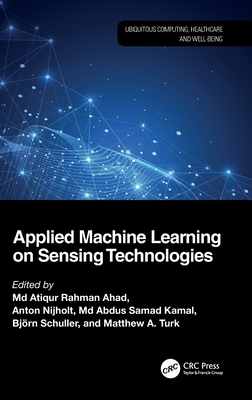
Applied Machine Learning on Sensing Technologies
暫譯: 應用機器學習於感測技術
Ahad, MD Atiqur Rahman, Nijholt, Anton, Kamal, MD Abdus Samad
- 出版商: CRC
- 出版日期: 2026-05-20
- 售價: $7,580
- 貴賓價: 9.5 折 $7,201
- 語言: 英文
- 頁數: 224
- 裝訂: Hardcover - also called cloth, retail trade, or trade
- ISBN: 1032766425
- ISBN-13: 9781032766423
-
相關分類:
Machine Learning
海外代購書籍(需單獨結帳)
相關主題

商品描述
This book explores applied machine learning and deep learning in the field of sensing, vision and sensor-based applications. It includes a series of methodologies, exploration of new applications, presentations on relevant datasets, challenging applications, guidelines, ideas and future scopes. Edited by leading experts in these arenas, the book will be of great interest to academic researchers, graduate students and industry professionals in the fields of machine learning, deep learning, AI, sensing, computer vision and sensors.
商品描述(中文翻譯)
本書探討應用機器學習和深度學習在感測、視覺及基於感測器的應用領域。內容包括一系列的方法論、新應用的探索、相關數據集的介紹、挑戰性應用、指導方針、創意及未來的發展方向。本書由這些領域的領先專家編輯,將對機器學習、深度學習、人工智慧、感測、計算機視覺及感測器領域的學術研究者、研究生及業界專業人士產生極大的興趣。
作者簡介
Md Atiqur Rahman Ahad, Ph.D. (SMIEEE, SMOPTICA) is a Professor of Artificial Intelligence (AI), University of East London (UEL); Guest Professor of Kyushu Institute of Technology (KyuTech), Japan; Visting Academic Staff of The University of Osaka, Japan; Associate Staff Member, Artificial Intelligence & Health Technologies, Rix Inclusive Research Institute, UEL; and Expert Contributor & Member, Safer Agentic AI Criteria Development Community of Practice. He has previously served at The University of Osaka, University of Dhaka (DU), Aoyama Gakuin University, and UCSI University. He works on AI on healthcare (antimicrobial resistance, Parkinson's Disease, well-being, rehabilitation, autism), AI & cyber safety, and gait-biometrics. He studied at KyuTech (Ph.D.), UNSW (MCompSc), and DU (BSc (Honors), MSc). He received 60 awards/recognitions, acquired grants from Innovate UK, UKRI, NIHR, OfS, etc. He has published 20 authored/edited books and over 240 peer-reviewed papers and book chapters. Ahad has been a keynote/invited speaker more than 170 times at various conferences and universities. He has supervised or co-supervised over 150 Ph.D. students and other researchers. He is an Associate Editor, Pattern Recognition; Editorial Board Member, Scientific Reports, Nature; General Chair, 8th Intl. Conf. on Activity & Behavior Computing (ABC), 2026. His leadership focuses on growing interdisciplinary strength, elevating REF performance, and transforming academic excellence into measurable societal benefit. More: https: //ahadVisionLab.com
Anton Nijholt is interested in non-traditional human-computer interaction issues. These issues include irrational behavior, deception, food, and humor. They are included in research on entertainment computing, augmented reality, brain-computer interfacing, multimodal interaction, affective interaction, and modelling interactions in smart environments, including human-human interaction, human-robot interaction, human-virtual agent interaction, and playable cities.
He has been program chair or general chair of the main international conferences of affective computing (ACII), entertainment computing (ACE, INTETAIN, ICEC), virtual agents (IVA), faces & gestures (FG), and some others. He organised many workshops on related topics, such as multisensorial augmented reality, humor engineering, human-food interaction, playable cities, and brain-computer interfacing. Recent edited books are Playable Cities: The City as a Digital Playground, Making Smart Cities more Playable, and Brain Art: Brain-Computer Interfaces for Artistic Expression.
Nijholt held positions at various universities in Belgium and the Netherlands. He acted as supervisor for about fifty Ph.D. students. During some years Nijholt was scientific advisor of Philips Research, Eindhoven. He has been research-fellow at McMaster University (Canada), the Netherlands Institute for Advanced Study in the Humanities and Social Sciences, the Imagineering Institute in Malaysia, and member of Microsoft's Technical Leadership Advisory Board. Nijholt is Chief Editor of the section "Human-Media Interaction" of Frontiers in Psychology and Frontiers in Computer Science, series editor of Gaming Media and Social Effects, and a member of many editorial boards.
Md Abdus Samad Kamal is working at the Cluster of Electronics and Mechanical Engineering, Graduate School of Science and Technology Gunma University, Japan. His details are in https: //www.mst.st.gunmau.ac.jp/kamal/biog.html.
Björn Schuller received his diploma, doctoral degree, and habilitation in Machine Intelligence and Signal Processing in EE/IT from Technical University of Munich. He is Full Professor of Artificial Intelligence and the Head of the Group on Language, Audio, & Music (GLAM) at Imperial College London/UK, Full Professor and Chair of Embedded Intelligence for Health Care and Wellbeing at the University of Augsburg/Germany, co-founding CEO and current CSO of audEERING - an audio intelligence company based near Munich and in Berlin, and permanent Visiting Professor at Harbin Institute of Technology/China amongst other professorships and affiliations. Previous stays include Full Professor at the University of Passau/Germany, Key Researcher at Joanneum Research in Graz/Austria, and the CNRS-LIMSI in Orsay/France. He is a Fellow of the IEEE and Golden Core Awardee of the IEEE Computer Society, Fellow of the BCS, Fellow of the ISCA, Fellow and President- Emeritus of the AAAC, and Senior Member of the ACM. He (co-)authored 1,000+ publications (40k+ citations, h-index=100+), is Field Chief Editor of Frontiers in Digital Health and was Editor-in-Chief of the IEEE Transactions on Affective Computing amongst manifold further commitments and service to the community. His 40+ awards include having been honoured as one of 40 extraordinary scientists under the age of 40 by the World Economic Forum in 2015. He has initiated and organized first-in-the-field of affective computing and sentiment analysis challenges such as AVEC, ComParE, or MuSe more than 30 times. He is an ERC Starting and DFG Reinhart-Koselleck Grantee, and consultant of companies such as Barclays, GN, Huawei, Informatics, and Samsung.
Matthew A. Turk is the third President of Toyota Technological Institute at Chicago. He earned a Ph.D. from the Massachusetts Institute of Technology, an MS from Carnegie Mellon University, and a BS from Virginia Tech. Prior to joining TTIC in 2019, Turk was a full professor at the University of California, Santa Barbara, where he continues as Professor Emeritus. His primary appointment was in the Department of Computer Science, where he served as Department Chair from 2017 to 2019, with a secondary appointment in Media Arts and Technology, where he served as Chair from 2005 to 2010. He also had affiliate appointments in Electrical and Computer Engineering and the Dynamical Neuroscience Program and was involved in several interdisciplinary organizations across campus.
Turk's primary research interests are in computer vision and machine learning, augmented and mixed reality, and human-computer interaction. He has received several best paper awards and has been general or program chair of several major conferences, including CVPR, WACV, ACM Multimedia, IEEE Face and Gesture Recognition, and International Conference on Multimodal Interaction (ICMI).
He brings a dynamic background of academic, industry, and entrepreneurial experience to the role of President. In 2000, Turk helped to found the Vision Technology Group at Microsoft Research, and he brings additional industry experience gained in working with a small Silicon Valley company and a large aerospace company. In 2014, he co-founded a startup company that spun out from NSF-funded research in his lab and was acquired in 2016. He is a Fellow of the ACM, the IEEE, and the IAPR and was the Fulbright-Nokia Distinguished Chair in Information and Communications Technologies.
作者簡介(中文翻譯)
Md Atiqur Rahman Ahad,博士(SMIEEE,SMOPTICA)是倫敦東方大學(UEL)人工智慧(AI)教授;日本九州科技大學(KyuTech)客座教授;日本大阪大學訪問學者;UEL人工智慧與健康科技的副研究人員;以及安全代理AI標準開發社群的專家貢獻者與成員。他曾在大阪大學、達卡大學(DU)、青山學院大學及UCSI大學任職。他的研究領域包括醫療保健中的AI(抗微生物抗藥性、帕金森病、福祉、康復、自閉症)、AI與網路安全,以及步態生物識別。他在KyuTech獲得博士學位,在UNSW獲得計算機科學碩士學位,並在DU獲得榮譽學士學位及碩士學位。他獲得60項獎項/認可,並從Innovate UK、UKRI、NIHR、OfS等機構獲得資助。他已出版20本著作/編輯書籍及240篇以上的同行評審論文和書章。Ahad在各種會議和大學中擔任過170多次的主題演講者或受邀演講者。他指導或共同指導超過150名博士生及其他研究人員。他是《模式識別》的副編輯;《科學報告》、《自然》的編輯委員會成員;2026年第八屆國際活動與行為計算會議(ABC)的總主席。他的領導重點在於增強跨學科的實力、提升REF表現,並將學術卓越轉化為可衡量的社會效益。更多資訊請參見:https://ahadVisionLab.com
Anton Nijholt對非傳統的人機互動問題感興趣。這些問題包括非理性行為、欺騙、食物和幽默。這些主題被納入娛樂計算、擴增實境、大腦-計算機介面、多模態互動、情感互動以及在智能環境中建模互動的研究中,包括人與人之間的互動、人與機器人之間的互動、人與虛擬代理之間的互動,以及可遊玩的城市。
他曾擔任情感計算(ACII)、娛樂計算(ACE、INTETAIN、ICEC)、虛擬代理(IVA)、面部與手勢(FG)等主要國際會議的程序主席或總主席。他組織了許多相關主題的研討會,如多感官擴增實境、幽默工程、人與食物的互動、可遊玩的城市以及大腦-計算機介面。最近編輯的書籍包括《可遊玩的城市:城市作為數位遊樂場》、《讓智慧城市更具可遊性》和《大腦藝術:用於藝術表達的大腦-計算機介面》。
Nijholt曾在比利時和荷蘭的多所大學任職。他擔任約五十名博士生的指導教授。在某些年份,他擔任飛利浦研究所(Eindhoven)的科學顧問。他曾在加拿大麥克馬斯特大學、荷蘭人文與社會科學高級研究所、馬來西亞想像工程研究所擔任研究員,並是微軟技術領導顧問委員會的成員。Nijholt是《心理學前沿》和《計算機科學前沿》“人媒互動”部分的主編,《遊戲媒體與社會影響》的系列編輯,並是多個編輯委員會的成員。
Md Abdus Samad Kamal在日本群馬大學科學與技術研究所電子與機械工程群工作。他的詳細資訊可參見:https://www.mst.st.gunmau.ac.jp/kamal/biog.html。
Björn Schuller在慕尼黑工業大學獲得機器智能和信號處理的文憑、博士學位和資格認證。他是倫敦帝國學院人工智慧的全職教授,並擔任語言、音頻與音樂(GLAM)小組的負責人;德國奧格斯堡大學健康與福祉嵌入式智能的全職教授及主席;audEERING的共同創始人兼現任首席科學官,這是一家位於慕尼黑和柏林的音頻智能公司;以及哈爾濱工業大學的常駐訪問教授等多個職位。他曾擔任德國帕紹大學的全職教授、奧地利格拉茨的Joanneum Research的主要研究員,以及法國奧爾塞的CNRS-LIMSI的研究員。他是IEEE的會士,IEEE計算機學會的金獎獲得者,BCS的會士,ISCA的會士,AAAC的會士及名譽主席,以及ACM的高級會員。他(共同)撰寫了超過1000篇出版物(超過4萬次引用,h-index=100+),是《數位健康前沿》的領域首席編輯,並曾擔任IEEE《情感計算學報》的主編,還有許多其他社區服務和承諾。他獲得的40多項獎項中,包括2015年被世界經濟論壇評選為40位40歲以下的傑出科學家之一。他發起並組織了超過30次情感計算和情感分析領域的挑戰賽,如AVEC、ComParE或MuSe。他是ERC起始資助者和DFG Reinhart-Koselleck獎學金獲得者,並擔任巴克萊銀行、GN、華為、資訊科技和三星等公司的顧問。
Matthew A. Turk是芝加哥豐田技術學院的第三任院長。他在麻省理工學院獲得博士學位,在卡內基梅隆大學獲得碩士學位,在維吉尼亞理工大學獲得學士學位。在2019年加入TTIC之前,Turk是加州大學聖塔芭芭拉分校的全職教授,並繼續擔任名譽教授。他的主要任職是在計算機科學系,並於2017年至2019年擔任系主任,還在媒體藝術與技術系擔任過主席(2005年至2010年)。他還在電氣與計算機工程系和動態神經科學計劃中擔任附屬職位,並參與校園內的多個跨學科組織。
Turk的主要研究興趣包括計算機視覺和機器學習、擴增和混合實境,以及人機互動。他獲得了幾個最佳論文獎,並擔任過多個主要會議的總主席或程序主席,包括CVPR、WACV、ACM Multimedia、IEEE面部與手勢識別會議,以及國際多模態互動會議(ICMI)。
他帶著學術、產業和創業的豐富背景擔任院長一職。2000年,Turk幫助創立了微軟研究的視覺技術小組,並在與一家小型矽谷公司和一家大型航空公司合作中獲得了額外的產業經驗。2014年,他共同創立了一家從其實驗室的NSF資助研究中衍生出的初創公司,並於2016年被收購。他是ACM、IEEE和IAPR的會士,並曾擔任富布賴特-諾基亞信息與通信技術傑出講座教授。