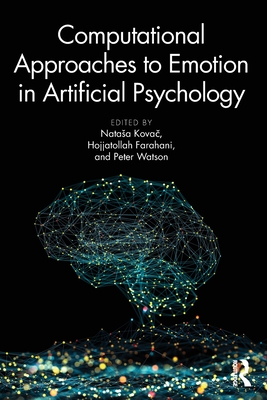
Computational Approaches to Emotion in Artificial Psychology
暫譯: 人工心理學中的情緒計算方法
Kovač, Natasa, Farahani, Hojjatollah, Watson, Peter
- 出版商: Routledge
- 出版日期: 2026-10-16
- 售價: $1,930
- 貴賓價: 9.5 折 $1,833
- 語言: 英文
- 頁數: 372
- 裝訂: Quality Paper - also called trade paper
- ISBN: 1032795867
- ISBN-13: 9781032795867
-
相關分類:
Machine Learning、DeepLearning、Natural Language Processing
尚未上市,無法訂購
商品描述
Computational Approaches to Emotion in Artificial Psychology provides readers with a comprehensive introduction to how emotions can be processed by AI systems. It offers theoretical and practical guidance on data preprocessing and emotion analysis techniques, explores diverse real-world applications, and bridges the gap between AI and psychology.
Beginning with an introduction to the emerging field of artificial psychology, it explores the study, understanding, and recognition of emotions in various bodily signals, including facial expressions, voice, heart rate, and neural mechanisms. The book delves into data preprocessing for embodied emotion analysis, encompassing multiple data modalities like text, audio, visual, and gaze data, with a focus on Python basics for emotional AI. Additionally, it discusses EEG-based emotion decoding, emotional insights from medical imaging, affective image analysis, text-based emotion recognition, multimodal data integration, unsupervised learning for embodied emotion discovery, reinforcement learning, emotion elicitation, and predicting personality and emotional abilities using machine learning. The book concludes by examining the close relationship between cognition and emotion from the perspective of the universal structure of language and describing the use of deep fuzzy cognitive maps in diagnosing coronary artery disease. By promoting research and innovation through case studies and experiments, it addresses the current lack of comprehensive resources in this interdisciplinary field, making it an essential reference for researchers, practitioners, students, and professionals seeking to navigate the intersection of AI and emotions.商品描述(中文翻譯)
《人工心理學中的情緒計算方法》為讀者全面介紹 AI 系統如何處理情緒。本書提供資料前處理與情緒分析技術的理論及實務指引,探討多元的真實世界應用,並搭起 AI 與心理學之間的橋梁。
本書首先介紹新興的人工心理學領域,探討如何從各種身體訊號中研究、理解與辨識情緒,包括臉部表情、聲音、心率與神經機制。接著深入說明具身情緒分析的資料前處理,涵蓋文字、音訊、視覺與注視資料等多種資料模態,並著重介紹情緒 AI 所需的 Python 基礎。此外,本書也討論以 EEG 為基礎的情緒解碼、從醫學影像取得情緒洞見、情感影像分析、文字情緒辨識、多模態資料整合、運用非監督式學習探索具身情緒、強化學習、情緒誘發,以及使用機器學習預測人格與情緒能力。最後,本書從語言普遍結構的觀點探討認知與情緒之間的密切關係,並說明如何運用深度模糊認知圖診斷冠狀動脈疾病。
本書透過案例研究與實驗,推動此跨學科領域的研究與創新,回應目前缺乏完整資源的問題,因此是研究人員、實務工作者、學生,以及希望深入探索 AI 與情緒交集之專業人士不可或缺的參考書。
作者簡介
Natasa Kovač is Associate Professor at the Faculty of Applied Sciences, University of Donja Gorica. She defended her PhD thesis entitled "Metaheuristic approach to solving a class of optimization problems in transport" in 2018 at the Faculty of Mathematics, University of Belgrade, and at the same time acquired the title of Doctor of Mathematics. She was employed as an assistant at the Faculty of Technical Sciences in Novi Sad and the Faculty of Maritime Studies in Kotor. She worked as a lecturer at the Mediterranean University in Podgorica, and she also taught as a professor at the Gymnasium in Kotor. She is currently employed at the Faculty of Applied Sciences in Podgorica where she teaches euclidean and analytical geometry, stochastic processes and probability and mathematical statistics. Her research interests are statistical analysis, metaheuristics, optimization, algorithm development and applied mathematics in engineering sciences. She has specializations in data science and was awarded the following certifications: Certified Data Collection and Processing with Python (University of Michigan), Statistics with Python specialization (University of Michigan), Introduction to Data Science specialization (IBM), Applied Data Science specialization (IBM), and IBM Data Science specialization (IBM). She has published more than 60 scientific papers and has been involved in more than 10 international projects. She is one of the founders of the SME "MoDrone" supported by the Montenegrin government, which is dedicated to the development and promotion of innovative solutions. She is a full member of the Scientific Research Honor Society Sigma Xi.
Hojjatollah Farahani is Associate Professor at the Tarbiat Modares University (TMU), Iran. He received his PhD from Isfahan University in 2009, and he was a postdoctoral researcher in Fuzzy inference at the Victoria University in Australia (2014-2015), where he started working on Fuzzy Cognitive Maps (FCMs) under the supervision of Professor Yuan Miao. He is the author or co-author of more than 200 research papers and a reviewer in numerous scientific journals. He has supervised and advised many theses and dissertations in psychological sciences. His research interests and directions include psychometrics, advanced behavioral statistics, fuzzy psychology, artificial intelligence and machine learning algorithms in psychology. His recent book entitled An Introduction to Artificial Psychology: Application Fuzzy Set Theory and Deep Machine Learning in Psychological Research using R was published in 2023.
Peter Watson holds three degrees in Mathematical Statistics, including a PhD (Manchester). He has been providing statistical support to the research at CBSU, the Cognition and Brain Sciences Unit in Cambridge (and its predecessor, the Applied Psychology Unit) since 1994 (and prior to that fulfilling a similar role at the MRC Age and Cognitive Performance Research Centre in Manchester). He is the co-author of over 100 papers and lectures at the University of Cambridge. He is a statistical referee for several journals including BMJ Open and the Journal of Affective Disorders. He has also been a major contributor to the online CBSU statswiki web pages which receive upwards of 100,000 visits annually. He has also been Secretary of the Cambridge Statistics Discussion Group and chair since 1996 and has been a meetings organiser for the SPSS users' group (ASSESS) since 2001 and has also been a member of the Clinical Trials Advisory Panel for Alzheimer's Research UK.
Alessandro Grecucci is a prominent figure in the field of affective neuroscience and neurotechnology. He received his PhD in Neuroscience from the International School for Advanced Studies (I.S.A.S. - S.I.S.S.A.)
and is currently the Principal Investigator of the Clinical and Affective Neuroscience Lab www.alessandrogrecucci.it), within the Department of Education, Psychology and Communication Sciences (For.Psi.Com.), University of Bari, Italy. His research focuses on the psychological and neural mechanisms of normal emotion generation and regulation, as well as the development of biomarkers of psychological syndromes. Grecucci's work has been recognized with various awards and has been presented at international conferences, showcasing his significant contributions to the field.
Dionéia Motta Monte-Serrat is a distinguished researcher with a diverse academic background. Collaborating Researcher at the Department of Physics of the University of Sao Paulo, USP (2025- ), having previously collaborated with the Department of Computing and Mathematics at USP and the Language Institute of the University of Campinas, UNICAMP, Brazil. She holds a Direct Doctoral degree in Psychology from FFCLRP-USP, Brazil, and has completed a doctoral degree programme partly at Université Paris III, Sorbonne Nouvelle. Her research interests span across various fields, including Neuroscience, Neurolinguistics, Brain Impairment, Artificial Intelligence, Neurophysiology and Natural Language. She has contributed to the National Science Network for Education (Brazil), is a member of the British Wittgenstein Society, member of the Center for Artificial Intelligence, C4AI-USP-IBM-FAPESP, leader of a research group registered with the Ministry of Science and Technology, CNPq, Brazil, to promote best practices and evidence-based educational policies. Her work has been recognized with an ORCID iD and a ResearcherID, reflecting her significant contributions to the field of research.
Carlo Cattani is recognized as one of the top Italian scientists in the field of mathematics. His academic contributions span various subfields, including wavelets, fractals, fractional calculus and nonlinear dynamics. Cattani has authored over 150 scientific articles and has co-authored multiple books. His research has been published in prestigious journals and has been recognized with an H-Index of 59 and 11,377 citations. He is affiliated with the University of Tuscia in Italy and has held various academic positions, including honorary professorships in Russia. Cattani's work has been influential in advancing the understanding of complex systems and has been recognized with numerous awards and honors.
Mirela C. C. Ramacciotti is a distinguished professional with a rich academic background and extensive experience in education, particularly in neuroscience, language acquisition and pedagogical practices. She holds multiple advanced degrees, including two PhDs, and specializes in the transdisciplinary area of Mind, Brain and Education. Her professional experience spans decades, and she is recognized for her contributions to the field through her research and publications. Ramacciotti is also involved in various educational initiatives and has been a consultant and trainer for schools in learning and education management. She is an Adjunct Coordinator for the National Science for Education Network (CpE Network) that promotes best practices and evidence-based educational policies.
Elpiniki Papageorgiou is a distinguished academic and researcher with a PhD in Electrical Engineering and Computer Science from the University of Patras. She has been involved in numerous research projects and has authored several publications in the field of artificial intelligence and decision support systems. Her work has been recognized with multiple citations and she has been involved in various European and Greek projects. For six consecutive years (2020-2025), she has been ranked among the world's top 2% most influential scientists in the field of Artificial Intelligence, according to the Stanford University study by Prof. John Ioannidis. In addition, she has been listed among the top Computer Science researchers by Guide2Research. Papageorgiou is also the Editor of the book Fuzzy Cognitive Maps for Applied Sciences and Engineering: From Fundamentals to Extensions and Learning Algorithms.
作者簡介(中文翻譯)
Natasa Kovač 是 Donja Gorica University 應用科學學院的副教授。她於 2018 年在 Belgrade University 數學學院完成題為〈以後設啟發式方法解決一類運輸最佳化問題〉的博士論文,並同時取得數學博士學位。她曾任職於 Novi Sad Technical Sciences Faculty 及 Kotor Maritime Studies Faculty,擔任助理;也曾在 Podgorica Mediterranean University 擔任講師,並於 Kotor Gymnasium 擔任教授。目前她任職於 Podgorica 應用科學學院,教授歐幾里得幾何與解析幾何、隨機過程與機率,以及數理統計。她的研究興趣包括統計分析、後設啟發式方法、最佳化、演算法開發,以及工程科學中的應用數學。她專精於資料科學,並取得以下認證:Certified Data Collection and Processing with Python(University of Michigan)、Statistics with Python specialization(University of Michigan)、Introduction to Data Science specialization(IBM)、Applied Data Science specialization(IBM),以及 IBM Data Science specialization(IBM)。她已發表超過 60 篇科學論文,並參與超過 10 項國際計畫。她是由蒙特內哥羅政府支持、致力於開發與推廣創新解決方案的中小企業 MoDrone 創辦人之一。她也是 Scientific Research Honor Society Sigma Xi 的正式會員。
Hojjatollah Farahani 是伊朗 Tarbiat Modares University(TMU)的副教授。他於 2009 年取得 Isfahan University 博士學位,並於 2014 至 2015 年在澳洲 Victoria University 擔任模糊推論博士後研究員;期間在 Yuan Miao 教授指導下開始研究模糊認知圖(Fuzzy Cognitive Maps,FCMs)。他是超過 200 篇研究論文的作者或共同作者,並擔任多本科學期刊的審稿人。他曾指導及提供諮詢給許多心理科學領域的碩博士論文。他的研究興趣與方向包括心理計量學、高等行為統計、模糊心理學,以及應用於心理學的人工智慧與機器學習演算法。他近期出版的著作《An Introduction to Artificial Psychology: Application Fuzzy Set Theory and Deep Machine Learning in Psychological Research using R》於 2023 年出版。
Peter Watson 擁有數理統計領域的三個學位,其中包括 Manchester University 的博士學位。自 1994 年起,他一直為 Cambridge 的 Cognition and Brain Sciences Unit(CBSU,認知與腦科學單位)研究工作提供統計支援;在此之前,他也曾於 Manchester 的 MRC Age and Cognitive Performance Research Centre 擔任類似職務。他是超過 100 篇論文的共同作者,並在 Cambridge University 授課。他擔任多本期刊的統計審稿人,包括《BMJ Open》與《Journal of Affective Disorders》。此外,他也是線上 CBSU statswiki 網頁的重要貢獻者之一,該網站每年瀏覽量超過 100,000 次。自 1996 年起,他一直擔任 Cambridge Statistics Discussion Group 的秘書及主席;自 2001 年起擔任 SPSS 使用者團體(ASSESS)的會議主辦人,並曾擔任 Alzheimer’s Research UK 臨床試驗諮詢小組成員。
Alessandro Grecucci 是情感神經科學與神經科技領域的知名人物。他取得 International School for Advanced Studies(I.S.A.S.-S.I.S.S.A.)神經科學博士學位,目前擔任義大利 Bari University 教育、心理學與傳播科學系(For.Psi.Com.)Clinical and Affective Neuroscience Lab 的首席研究員(Principal Investigator),相關網站為 www.alessandrogrecucci.it。他的研究聚焦於正常情緒產生與調節的心理及神經機制,以及心理症候群生物標記的開發。Grecucci 的研究成果曾獲得多項獎項肯定,並於國際會議中發表,展現他對該領域的重要貢獻。
Dionéia Motta Monte-Serrat 是一位學術背景多元的傑出研究人員。她自 2025 年起擔任 University of Sao Paulo(USP)物理系的合作研究員;此前也曾與 USP 計算與數學系,以及巴西 University of Campinas(UNICAMP)語言研究所合作。她於巴西 FFCLRP-USP 取得心理學直攻博士學位,並曾在 Université Paris III, Sorbonne Nouvelle 部分修讀博士學位課程。她的研究興趣涵蓋多個領域,包括神經科學、神經語言學、腦部損傷、人工智慧、神經生理學與自然語言。她曾參與巴西 National Science Network for Education,是 British Wittgenstein Society 會員,也是 Center for Artificial Intelligence(C4AI-USP-IBM-FAPESP)成員;此外,她還領導一個向巴西科學與科技部國家科學技術發展委員會(CNPq)註冊的研究團隊,致力於推廣最佳實務與以證據為基礎的教育政策。她的研究貢獻獲得 ORCID iD 與 ResearcherID 認可。
Carlo Cattani 被譽為義大利數學領域最頂尖的科學家之一。他的學術貢獻涵蓋多個子領域,包括小波、碎形、分數微積分與非線性動力學。Cattani 已發表超過 150 篇科學論文,並合著多本書籍。他的研究成果發表於多本知名期刊,並獲得 H-Index 59 及 11,377 次引用。他隸屬於義大利 University of Tuscia,並曾擔任多項學術職務,包括在俄羅斯擔任名譽教授。Cattani 的研究對增進複雜系統的理解具有重要影響,並曾獲得多項獎項與榮譽。
Mirela C. C. Ramacciotti 是一位傑出的專業人士,具備深厚的學術背景與豐富的教育經驗,尤其專精於神經科學、語言習得及教育實務。她擁有多個高階學位,包括兩個博士學位,並專精於心智、腦與教育(Mind, Brain and Education)跨學科領域。她的專業經歷長達數十年,並透過研究與出版成果,對該領域作出重要貢獻。Ramacciotti 也參與各項教育倡議,並曾擔任學校學習與教育管理方面的顧問及培訓講師。她是推廣最佳實務與以證據為基礎之教育政策的 National Science for Education Network(CpE Network)兼任協調人。
Elpiniki Papageorgiou 是一位傑出的學者與研究人員,擁有 University of Patras 電機工程與電腦科學博士學位。她參與過許多研究計畫,並在人工智慧與決策支援系統領域發表多篇論文。她的研究成果獲得多次引用,並參與多項歐洲及希臘研究計畫。根據 Stanford University John Ioannidis 教授的研究,她已連續六年(2020 至 2025 年)名列全球人工智慧領域最具影響力的前 2% 科學家。此外,她也獲 Guide2Research 列為頂尖電腦科學研究人員。Papageorgiou 同時擔任《Fuzzy Cognitive Maps for Applied Sciences and Engineering: From Fundamentals to Extensions and Learning Algorithms》一書的編輯。


![Jump Start HTML5 [Paperback]-cover](https://cf-assets2.tenlong.com.tw/products/images/000/082/450/medium/51Yom4I3lSL.jpg?1525643135)
