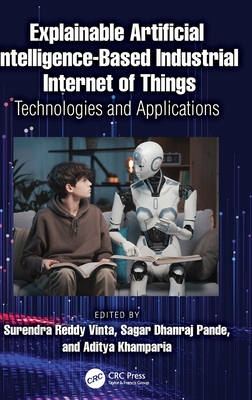
Explainable Artificial Intelligence-Based Industrial Internet of Things: Technologies and Applications
暫譯: 可解釋的人工智慧基礎工業物聯網:技術與應用
Vinta, Surendra Reddy, Pande, Sagar Dhanraj, Khamparia, Aditya
相關主題


商品描述
The text explains how explainable artificial intelligence impacts problem-solving and aims to provide practical suggestions across various emerging industries. It further discusses important topics such as the strategic utilization of explainable artificial intelligence in supply chain enhancement, the integral role of explainable artificial intelligence in smart farming and smart cities with the industrial Internet of Things integration.
Features:
- Discusses local interpretable model-agnostic explanations, and Shapley additive explanations for transparent data analysis, modeling, and prediction.
- Highlights the importance of using artificial intelligence (AI) in optimizing processes by studying decision-making interpretability in supply chain optimization.
- Explains the use of explainable artificial intelligence to optimize supply chains by predicting demand, identifying bottlenecks, and making informed decisions about inventory management.
- Illustrates the benefit of employing explainable artificial intelligence in optimizing resource utilization, improving decision-making, and creating more efficient and sustainable ecosystems.
- Explores the integration of explainable artificial intelligence into smart appliances to provide insights into their operations and improve user experience.
It is primarily written for senior undergraduates, graduate students, and academic researchers in the fields of electrical engineering, electrical and communications engineering, computer science and engineering, and information technology.
商品描述(中文翻譯)
這段文字解釋了可解釋的人工智慧如何影響問題解決,並旨在為各種新興產業提供實用建議。它進一步討論了重要主題,例如在供應鏈增強中的可解釋人工智慧的策略性利用,以及可解釋人工智慧在智慧農業和智慧城市中與工業物聯網整合的關鍵角色。
特色:
- 討論本地可解釋的模型無關解釋和 Shapley 加法解釋,以實現透明的數據分析、建模和預測。
- 強調在供應鏈優化中研究決策解釋性以優化流程時使用人工智慧 (AI) 的重要性。
- 解釋如何利用可解釋的人工智慧通過預測需求、識別瓶頸以及對庫存管理做出明智決策來優化供應鏈。
- 說明在優化資源利用、改善決策以及創造更高效和可持續生態系統中,使用可解釋的人工智慧的好處。
- 探索將可解釋的人工智慧整合到智慧家電中,以提供其運作的見解並改善用戶體驗。
本書主要針對電機工程、電機與通訊工程、計算機科學與工程以及資訊科技領域的高年級本科生、研究生和學術研究人員撰寫。
作者簡介
Surendra Reddy Vinta is currently working as the Associate Professor of the School of Computer Science and Engineering, VIT-AP University, Amaravathi (India). His area of interests includes Image Processing, Machine Learning, Deep Learning, NLP, Computer Vision, Features extraction, and Programming, such as Digital Image Processing, Feature Extraction, Machine Learning, Deep Learning, NLP, Computer Vision, C, Python, Data Structure, C++, C# and Java.
Sagar Dhanraj Pande is working as an Assistant Professor Senior Grade at VIT-AP University, Amaravati, Andhra Pradesh, India. His research interest is Deep Learning, Machine Learning, Network Attacks, Cyber Security, and the Internet of Medical Things (IoMT).
Aditya Khamparia is currently working as an Assistant Professor and Coordinator of Department of Computer Science, Babasaheb Bhimrao Ambedkar University, Satellite Centre, Amethi, India. His research interest includes machine learning, deep learning, educational technologies, computer vision.
作者簡介(中文翻譯)
Surendra Reddy Vinta 目前擔任印度阿馬拉瓦提 VIT-AP 大學計算機科學與工程學院的副教授。他的研究興趣包括影像處理、機器學習、深度學習、自然語言處理 (NLP)、計算機視覺、特徵提取以及程式設計,涵蓋數位影像處理、特徵提取、機器學習、深度學習、自然語言處理、計算機視覺、C、Python、資料結構、C++、C# 和 Java。
Sagar Dhanraj Pande 擔任印度安得拉邦阿馬拉瓦提 VIT-AP 大學的高級助理教授。他的研究興趣包括深度學習、機器學習、網路攻擊、網路安全以及醫療物聯網 (IoMT)。
Aditya Khamparia 目前擔任印度巴巴薩赫布·比姆拉奧·安貝德卡大學衛星中心計算機科學系的助理教授及協調員。他的研究興趣包括機器學習、深度學習、教育科技和計算機視覺。




-cover](https://cf-assets2.tenlong.com.tw/products/images/000/223/967/medium/9786263339965_bc.jpg?1728467024)