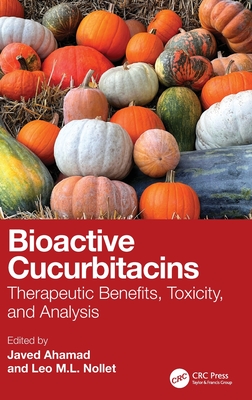
Bioactive Cucurbitacins: Therapeutic Benefits, Toxicity, and Analysis
暫譯: 生物活性苦瓜素:療效、毒性與分析
Ahamad, Javed, Nollet, Leo M. L.
- 出版商: CRC
- 出版日期: 2026-01-28
- 售價: $5,580
- 貴賓價: 9.5 折 $5,301
- 語言: 英文
- 頁數: 258
- 裝訂: Hardcover - also called cloth, retail trade, or trade
- ISBN: 1032951400
- ISBN-13: 9781032951409
-
相關分類:
生物資訊 Bioinformatics
海外代購書籍(需單獨結帳)
相關主題


商品描述
Vegetables and fruits are an important part of the diet, and they provide nutrition and have several health benefits. Cucurbitacins are tetracyclic triterpenoid compounds mainly distributed in the Cucurbitaceae family. Cucurbitacins are bitter compounds produced in plants as defense chemicals and they protect plants from herbivores, insects, and parasites. Cucurbitacin-containing plants are making an important part of the human diet in the form of vegetables and fruits. Plants containing cucurbitacins have a great role in disease prevention and treatment, and traditionally they are used for the treatment of infections, cancer, diabetes, and heart and liver diseases. The book Bioactive Cucurbitacins: Therapeutic Benefits, Toxicity, and Analysis provides an important guideline for the extraction, isolation, identification, and characterization of bioactive cucurbitacins present in vegetables and fruits. This book emphasizes recent preclinical and clinical studies on cucurbitacins role as a lead molecule for the prevention and treatment of various types of cancers. It also encompasses the role of cucurbitacins in the prevention of treatment of various human infection, metabolic syndrome, and their role as antioxidants and anti-inflammatory agents. This book also addresses the oral bioavailability issues and the role of nanotechnology in solving them. The book summarizes the current state of knowledge in the key research areas and provides ideas for future scientific research to identify lead molecules "cucurbitacins" from vegetables and fruits and to use them in drug discovery and development.
Key Features
- Provides a detailed overview of different cucurbitacins found in vegetables and fruits, chemistry, extraction, isolation, and identification methods.
- Describes their health benefits, toxicity, and nutritional importance.
- Discusses the role of cucurbitacins in the treatment of various types of cancers.
- Describes the applicability of sophisticated analytical techniques such as HPLC, LC-MS, and HPTLC for the analysis of cucurbitacins.
- Emphasizes the use of nanotechnology in improving oral bioavailability of cucurbitacins.
商品描述(中文翻譯)
蔬菜和水果是飲食中重要的一部分,提供營養並具有多種健康益處。苦瓜苷(Cucurbitacins)是四環三萜化合物,主要分佈在葫蘆科(Cucurbitaceae)植物中。苦瓜苷是植物產生的苦味化合物,作為防禦化學物質,保護植物免受草食性動物、昆蟲和寄生蟲的侵害。含有苦瓜苷的植物在蔬菜和水果的形式中,成為人類飲食的重要組成部分。含有苦瓜苷的植物在疾病預防和治療中扮演著重要角色,傳統上用於治療感染、癌症、糖尿病以及心臟和肝臟疾病。書籍《生物活性苦瓜苷:治療益處、毒性與分析》提供了提取、分離、鑑定和特徵化蔬菜和水果中生物活性苦瓜苷的重要指導。這本書強調了最近的臨床前和臨床研究,探討苦瓜苷作為預防和治療各類癌症的主要分子的角色。它還涵蓋了苦瓜苷在預防和治療各種人類感染、代謝症候群中的作用,以及它們作為抗氧化劑和抗炎劑的角色。這本書還討論了口服生物利用度的問題及納米技術在解決這些問題中的作用。該書總結了關鍵研究領域的當前知識狀態,並提供了未來科學研究的想法,以識別來自蔬菜和水果的主要分子「苦瓜苷」,並將其用於藥物發現和開發。
主要特點
- 提供了不同蔬菜和水果中苦瓜苷的詳細概述,包括化學、提取、分離和鑑定方法。
- 描述了它們的健康益處、毒性和營養重要性。
- 討論了苦瓜苷在治療各類癌症中的作用。
- 描述了高效能液相色譜(HPLC)、液相色譜-質譜聯用(LC-MS)和高效薄層色譜(HPTLC)等複雜分析技術在苦瓜苷分析中的應用。
- 強調了納米技術在提高苦瓜苷口服生物利用度方面的應用。
作者簡介
Dr. Javed Ahamad is an Assistant Professor at the Department of Pharmacognosy, Faculty of Pharmacy, Tishk International University, Erbil, Iraq. He received his Doctorate in Pharmacognosy & Phytochemistry from the School of Pharmaceutical Education and Research, Jamia Hamdard, New Delhi (India). After his PhD, he joined Mettu University, Mettu, Ethiopia as an Assistant Professor. He has more than 13 years of experience in academia and industry. He has worked as a Junior Research Fellow (JRF) and Senior Research Fellow (SRF). He has published more than 95 high-quality research and reviewed articles in peer-reviewed journals of international repute. His current h-index is 20 with the total number of citations of his publications >1600. He is the author/editor of 4 books (Bioactive Phytochemicals: Drug Discovery to Product Development, Bentham Science Publisher, 2021; Analysis of Food Spices: Identification and Authentication, CRC Press, 2023; Bioactive Compounds of Edible Oils and Fats: Health Benefits, Risks, and Analysis, CRC Press, 2024; and Bioactive Compounds of Edible Fruits and Berries: Health Benefits, Nutritional Importance, and Analysis, CRC Press, 2025) and published 57 book chapters for edited books and book series. He is a reviewer of many peer-reviewed journals of international repute. His current research interest lies in the quality control, isolation, and characterization of potential drug candidates from food products, traditional medicinal plants, fruits, and berries.
Leo M. L. Nollet earned an MS (1973) and PhD (1978) in biology from the Katholieke Universiteit Leuven, Belgium. He is an editor and associate editor of numerous books. He edited for M. Dekker, New York--now CRC Press of Taylor & Francis Publishing Group--the first, second, and third editions of Food Analysis by HPLC and Handbook of Food Analysis. The last edition is a two-volume book. Dr. Nollet also edited the Handbook of Water Analysis (first, second, and third editions) and Chromatographic Analysis of the Environment, third and fourth editions (CRC Press). With F. Toldrá, he coedited two books published in 2006, 2007, and 2017: Advanced Technologies for Meat Processing (CRC Press) and Advances in Food Diagnostics (Blackwell Publishing--now Wiley). With M. Poschl, he coedited the book Radionuclide Concentrations in Foods and the Environment, also published in 2006 (CRC Press). Dr. Nollet has also coedited with Y. H. Hui and other colleagues on several books: Handbook of Food Product Manufacturing (Wiley, 2007), Handbook of Food Science, Technology, and Engineering (CRC Press, 2005), Food Biochemistry and Food Processing (first and second editions; Blackwell Publishing--now Wiley--2006 and 2012), and the Handbook of Fruits and Vegetable Flavors (Wiley, 2010). In addition, he edited the Handbook of Meat, Poultry, and Seafood Quality, first and second editions (Blackwell Publishing--now Wiley--2007 and 2012). From 2008 to 2011, he published five volumes on animal product-related books with F. Toldrá Handbook of Muscle Foods Analysis, Handbook of Processed Meats and Poultry Analysis, Handbook of Seafood and Seafood Products Analysis, Handbook of Dairy Foods Analysis (2nd edition in 2021), and Handbook of Analysis of Edible Animal By-Products. Also, in 2011, with F. Toldrá, he coedited two volumes for CRC Press: Safety Analysis of Foods of Animal Origin and Sensory Analysis of Foods of Animal Origin. In 2012, they published the Handbook of Analysis of Active Compounds in Functional Foods. In a coedition with Hamir Rathore, Handbook of Pesticides: Methods of Pesticides Residues Analysis was marketed in 2009; Pesticides: Evaluation of Environmental Pollution in 2012; Biopesticides Handbook in 2015; and Green Pesticides Handbook: Essential Oils for Pest Control in 2017. Other finished book projects include Food Allergens: Analysis, Instrumentation, and Methods (with A. van Hengel; CRC Press, 2011) and Analysis of Endocrine Compounds in Food (Wiley-Blackwell, 2011). Dr. Nollet's recent projects include Proteomics in Foods with F. Toldrá (Springer, 2013) and Transformation Products of Emerging Contaminants in the Environment: Analysis, Processes, Occurrence, Effects, and Risks with D. Lambropoulou (Wiley, 2014). In the series Food Analysis & Properties, he edited (with C. Ruiz-Capillas) Flow Injection Analysis of Food Additives (CRC Press, 2015) and Marine Microorganisms: Extraction and Analysis of Bioactive Compounds (CRC Press, 2016). With A.S. Franca, he coedited Spectroscopic Methods in Food Analysis (CRC Press, 2017), and with Horacio Heinzen and Amadeo R. Fernandez-Alba he coedited Multiresidue Methods for the Analysis of Pesticide Residues in Food (CRC Press, 2017). Further volumes in the series Food Analysis & Properties are Phenolic Compounds in Food: Characterization and Analysis (with Janet Alejandra Gutierrez-Uribe, 2018), Testing and Analysis of GMO-containing Foods and Feed (with Salah E. O. Mahgoub, 2018), Fingerprinting Techniques in Food Authentication and Traceability (with K. S. Siddiqi, 2018), Hyperspectral Imaging Analysis and Applications for Food Quality (with N.C. Basantia, Leo M.L. Nollet, Mohammed Kamruzzaman, 2018), Ambient Mass Spectroscopy Techniques in Food and the Environment (with Basil K. Munjanja, 2019), Food Aroma Evolution: During Food Processing, Cooking, and Aging (with M. Bordiga, 2019), Mass Spectrometry Imaging in Food Analysis (2020), Proteomics in Food Authentication (with S. Ötleş, 2020), Analysis of Nanoplastics and Microplastics in Food (with K.S. Siddiqi, 2020), Chiral Organic Pollutants, Monitoring and Characterization in Food and the Environment (with Edmond Sanganyado and Basil K. Munjanja, 2020), Sequencing Technologies in Microbial Food Safety and Quality (with Devarajan Thangardurai, Saher Islam, Jeyabalan Sangeetha, 2021), Nanoemulsions in Food Technology: Development, Characterization, and Applications (with Javed Ahmad, 2021), Mass Spectrometry in Food Analysis (with Robert Winkler, 2022), Bioactive Peptides from Food: Sources, Analysis, and Functions (with Semih Ötles, 2022), and Nutriomics: Well-being through Nutrition (with Devarajan Thangadurai, Saher IslamJuliana Bunmi Adetunji, 2022). In 2023 he published with Javed Ahmad Analysis of Naturally Occurring Food Toxins of Plant Origin.
The last published books are: Biopesticides Handbook 2nd Ed. (with S. Mir), Handbook of Seafood and Seafood Products Analysis (with F. Toldrá), Flavoromics, an Integrated to Flavor and Sensory Assessment (with M. Bordiga), Analysis of Food Sices (with J. Ahmad and J. Ahamad), Global Regulations of Medicinal, Pharmaceutical, and Food Products (with F. Ali), Bioactive Compounds from Food-Benefits and Analysis (with J. Ahmad), and Bioactive Compounds of Edible Oils and Fats - Health Benefits, Risks, and Analysis (with J. Ahamad).
作者簡介(中文翻譯)
賈維德·阿哈馬德博士是伊拉克埃爾比勒Tishk國際大學藥學院藥用植物學系的助理教授。他在印度新德里的Jamia Hamdard藥學教育與研究學院獲得藥用植物學與植物化學的博士學位。獲得博士學位後,他加入了埃塞俄比亞梅圖大學擔任助理教授。他在學術界和產業界擁有超過13年的經驗,曾擔任初級研究員(JRF)和高級研究員(SRF)。他在國際知名的同行評審期刊上發表了超過95篇高品質的研究和評論文章。他目前的h指數為20,出版物的總引用次數超過1600次。他是4本書的作者/編輯(《生物活性植物化學物質:從藥物發現到產品開發》,Bentham Science Publisher,2021年;《食品香料分析:識別與驗證》,CRC Press,2023年;《可食用油脂的生物活性化合物:健康益處、風險與分析》,CRC Press,2024年;以及《可食用水果和漿果的生物活性化合物:健康益處、營養重要性與分析》,CRC Press,2025年),並為編輯書籍和書系發表了57章書。 他是多本國際知名同行評審期刊的審稿人。他目前的研究興趣在於從食品產品、傳統藥用植物、水果和漿果中進行潛在藥物候選物的質量控制、分離和特徵分析。
萊奧·M·L·諾萊特於1973年獲得比利時魯汀大學生物學碩士學位,1978年獲得博士學位。他是多本書籍的編輯和副編輯。他為M. Dekker(現為Taylor & Francis Publishing Group的CRC Press)編輯了《HPLC食品分析》和《食品分析手冊》的第一、第二和第三版。最後一版是兩卷本。諾萊特博士還編輯了《水分析手冊》(第一、第二和第三版)和《環境的色譜分析》第三和第四版(CRC Press)。與F. Toldrá合作,他共同編輯了2006年、2007年和2017年出版的兩本書:《肉類加工的先進技術》(CRC Press)和《食品診斷的進展》(Blackwell Publishing,現為Wiley)。與M. Poschl合作,他共同編輯了2006年出版的《食品和環境中的放射性核素濃度》(CRC Press)。諾萊特博士還與Y. H. Hui及其他同事共同編輯了幾本書籍:《食品產品製造手冊》(Wiley,2007年)、《食品科學、技術與工程手冊》(CRC Press,2005年)、《食品生物化學與食品加工》(第一和第二版;Blackwell Publishing,現為Wiley,2006年和2012年)以及《水果和蔬菜風味手冊》(Wiley,2010年)。此外,他編輯了《肉類、家禽和海鮮質量手冊》的第一和第二版(Blackwell Publishing,現為Wiley,2007年和2012年)。從2008年到2011年,他與F. Toldrá共同出版了五卷與動物產品相關的書籍:《肌肉食品分析手冊》、《加工肉類和家禽分析手冊》、《海鮮及海鮮產品分析手冊》、《乳製品分析手冊》(2021年第二版)以及《可食用動物副產品分析手冊》。此外,在2011年,他與F. Toldrá共同編輯了兩卷CRC Press的書籍:《動物來源食品的安全分析》和《動物來源食品的感官分析》。在2012年,他們出版了《功能性食品中活性化合物的分析手冊》。與哈米爾·拉索爾共同編輯的《農藥手冊:農藥殘留分析方法》於2009年上市;《農藥:環境污染評估》於2012年;《生物農藥手冊》於2015年;以及《綠色農藥手冊:害蟲控制的精油》於2017年。其他已完成的書籍項目包括《食品過敏原:分析、儀器和方法》(與A. van Hengel合作;CRC Press,2011年)和《食品中內分泌化合物的分析》(Wiley-Blackwell,2011年)。諾萊特博士最近的項目包括與F. Toldrá合作的《食品中的蛋白質組學》(Springer,2013年)和與D. Lambropoulou合作的《環境中新興污染物的轉化產物:分析、過程、出現、影響和風險》(Wiley,2014年)。在《食品分析與性質》系列中,他編輯了(與C. Ruiz-Capillas合作)《食品添加劑的流動注射分析》(CRC Press,2015年)和《海洋微生物:生物活性化合物的提取與分析》(CRC Press,2016年)。與A.S. Franca合作,他共同編輯了《食品分析中的光譜方法》(CRC Press,2017年),並與Horacio Heinzen和Amadeo R. Fernandez-Alba共同編輯了《食品中農藥殘留的多殘留分析方法》(CRC Press,2017年)。在《食品分析與性質》系列中的進一步卷冊包括《食品中的酚類化合物:特徵化與分析》(與Janet Alejandra Gutierrez-Uribe,2018年)、《含GMO食品和飼料的測試與分析》(與Salah E. O. Mahgoub,2018年)、《食品驗證與可追溯性的指紋技術》(與K. S. Siddiqi,2018年)、《食品質量的高光譜成像分析與應用》(與N.C. Basantia、Leo M.L. Nollet、Mohammed Kamruzzaman,2018年)、《食品和環境中的環境質量質譜技術》(與Basil K. Munjanja,2019年)、《食品香氣演變:在食品加工、烹飪和老化過程中》(與M. Bordiga,2019年)、《食品分析中的質譜成像》(2020年)、《食品驗證中的蛋白質組學》(與S. Ötleş,2020年)、《食品中納米塑料和微塑料的分析》(與K.S. Siddiqi,2020年)、《食品和環境中的手性有機污染物的監測與特徵化》(與Edmond Sanganyado和Basil K. Munjanja,2020年)、《微生物食品安全與質量中的測序技術》(與Devarajan Thangardurai、Saher Islam、Jeyabalan Sangeetha,2021年)、《食品技術中的納米乳液:開發、特徵化與應用》(與Javed Ahmad,2021年)、《食品分析中的質譜》(與Robert Winkler,2022年)、《食品中的生物活性肽:來源、分析與功能》(與Semih Ötles,2022年)以及《營養基因組學:通過營養促進健康》(與Devarajan Thangadurai、Saher Islam、Juliana Bunmi Adetunji,2022年)。在2023年,他與賈維德·阿哈馬德共同出版了《植物來源的天然食品毒素分析》。
最近出版的書籍包括:生物農藥手冊第二版(與S. Mir合作)、海鮮及海鮮產品分析手冊(與F. Toldrá合作)、Flavoromics:風味與感官評估的綜合(與M. Bordiga合作)、食品香料分析(與J. Ahmad和J. Ahamad合作)、藥用、製藥和食品產品的全球法規(與F. Ali合作)、食品中的生物活性化合物-益處與分析(與J. Ahmad合作)以及可食用油脂的生物活性化合物-健康益處、風險與分析(與J. Ahamad合作)。