Principles of Portfolio Choice: An Information-Theoretic, Likelihood-Based Perspective
暫譯: 投資組合選擇原理:資訊理論與概似法觀點
Vecer, Jan
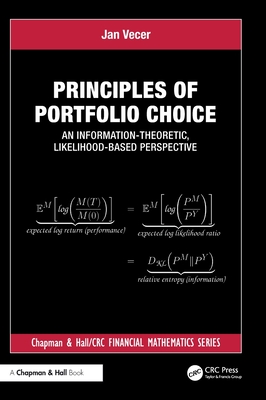
- 出版商: CRC
- 出版日期: 2026-11-27
- 售價: $5,170
- 貴賓價: 9.5 折 $4,911
- 語言: 英文
- 頁數: 396
- 裝訂: Hardcover - also called cloth, retail trade, or trade
- ISBN: 1032951982
- ISBN-13: 9781032951980
-
相關分類:
投資理財 Investment
尚未上市,無法訂購
相關主題

商品描述
Principles of Portfolio Choice: An Information-Theoretic, Likelihood-Based Perspective develops a scenario-level theory of portfolio selection. Its starting point is simple but powerful: market prices assign values to future scenarios, and once normalized these state prices define a market-implied probability measure. An investor who disagrees with the market is therefore not merely choosing portfolio weights; she is choosing a different likelihood model over the same scenarios.
The book's central translation is that a budget-normalized nonnegative payoff is a likelihood ratio. It compares the probability measure implied by a portfolio with the probability measure implied by market prices. Thus a portfolio is not only a financial object but also a statistical object: it expresses a scenario distribution. Conversely, a desired scenario distribution determines the payoff that would implement it, whenever that payoff can be replicated.
From this perspective, portfolio choice becomes a form of likelihood-model selection under market constraints. The investor first specifies the scenario probabilities she wishes to express; the financial problem is then to find the attainable payoff whose implied distribution best matches that view.
This scenario-by-scenario viewpoint connects portfolio theory to statistics and information theory. At the Kelly optimum, expected log return becomes relative entropy. Realized wealth becomes a likelihood score. Long-run performance becomes accumulated statistical evidence. Constrained portfolio selection becomes the problem of choosing a desired scenario distribution and finding the closest attainable market payoff.
The book translates Kelly growth, utility maximization, mean-variance analysis, martingale pricing, option payoffs, hedging, Bayesian averaging, and model selection into this likelihood-based language. It shows that many classical methods can be understood as approximations, transformations, or constrained versions of a single payoff-measure dictionary.
Written for quantitative analysts, portfolio managers, researchers, and graduate students, the book offers a new foundation for thinking about prices, beliefs, payoffs, and evidence in financial markets.
Features:
- Presents portfolio choice at the level of individual market scenarios.
- Shows that normalized payoffs are likelihood ratios between portfolio-implied and market-implied probability measures.
- Interprets portfolio choice as the selection of likelihood models over future scenarios.
- Interprets returns as likelihood scores and Kelly growth as relative entropy.
- Translates classical portfolio methods into the language of statistics and information theory.
- Develops applications to option-induced densities, Gaussian mixtures, hedging, Bayesian averaging, and adaptive portfolios.
- Includes exercises designed to test and enhance understanding of the topics.
商品描述(中文翻譯)
《投資組合選擇原理:資訊理論與基於似然的觀點》建立了一套以情境層級為核心的投資組合選擇理論。其出發點簡單卻十分有力:市場價格為未來情境賦予價值,而這些狀態價格經過正規化後,便定義出一個市場隱含的機率測度。因此,不同意市場觀點的投資人,並不只是選擇投資組合權重;她其實是在相同的情境集合上,選擇一個不同的似然模型。
本書的核心轉換是:經預算正規化的非負報酬,是一個似然比(likelihood ratio)。它比較由投資組合所隱含的機率測度,以及由市場價格所隱含的機率測度。因此,投資組合不僅是金融物件,也是統計物件:它表達了一種情境分布。反過來說,當一個期望的情境分布能夠由某項報酬複製時,該情境分布便會決定實現它所需的報酬。
從這個觀點來看,投資組合選擇成為市場限制下的一種似然模型選擇問題。投資人首先指定她希望表達的情境機率;接著,金融問題便是找出一項可達成的報酬,使其隱含的分布最符合這項觀點。
這種逐一情境分析的觀點,將投資組合理論與統計學及資訊理論連結起來。在 Kelly 最適解下,預期對數報酬會成為相對熵(relative entropy)。實現財富會成為似然分數(likelihood score)。長期績效則會成為累積的統計證據。受限投資組合選擇也會轉化為:選擇一個期望的情境分布,並找出與其最接近的可達成市場報酬。
本書以這套基於似然的語言,重新詮釋 Kelly 成長、效用最大化、均值—變異數分析、鞅定價(martingale pricing)、選擇權報酬、避險、貝葉斯平均,以及模型選擇。書中說明,許多經典方法都可以理解為同一套「報酬—測度」對照表的近似、轉換或受限版本。
本書適合量化分析師、投資組合經理人、研究人員及研究所學生閱讀,並為思考金融市場中的價格、信念、報酬與證據提供一套全新的基礎。
特色:
• 從個別市場情境的層級呈現投資組合選擇。
• 說明正規化報酬是投資組合隱含機率測度與市場隱含機率測度之間的似然比。
• 將投資組合選擇詮釋為對未來情境之似然模型的選擇。
• 將報酬詮釋為似然分數,並將 Kelly 成長詮釋為相對熵。
• 以統計學與資訊理論的語言重新詮釋經典投資組合方法。
• 探討選擇權誘導的密度、Gaussian mixtures、避險、貝葉斯平均及自適應投資組合等應用。
• 收錄設計用來檢驗並深化讀者對相關主題理解的習題。
作者簡介
Jan Vecer teaches and conducts research in quantitative finance and statistics at Charles University in his native Prague. He received his PhD in Mathematical Finance from Carnegie Mellon University in 2000. From 2001 to 2010 he was a faculty member in the Department of Statistics at Columbia University. He later joined the Frankfurt School of Finance & Management, where he served as professor of finance from 2010 to 2015 and has continued as a visiting professor since 2015. His work combines mathematical finance, statistics, portfolio theory, and practical trading applications. Through consulting projects, he developed market-making and trading algorithms used by major betting bookmakers. He also worked in a senior algorithmic-trading consulting role for energy markets, including gas, oil, power, and carbon trading, at ČEZ, the major Czech power company. He is the author of Stochastic Finance: A Numeraire Approach, published by CRC Press in 2011.
作者簡介(中文翻譯)
Jan Vecer 在其家鄉布拉格的 Charles University 教授量化金融與統計,並從事相關研究。他於 2000 年取得 Carnegie Mellon University 的數理金融學博士學位。2001 年至 2010 年間,他任教於 Columbia University 統計學系。之後,他加入 Frankfurt School of Finance & Management,於 2010 年至 2015 年擔任金融學教授,並自 2015 年起持續擔任客座教授。他的研究結合數理金融、統計學、投資組合理論與實務交易應用。透過顧問專案,他開發了供主要博彩業者使用的造市與交易演算法。他也曾在捷克主要電力公司 ČEZ 擔任能源市場演算法交易資深顧問,負責涵蓋天然氣、石油、電力與碳交易等領域。他著有《Stochastic Finance: A Numeraire Approach》,由 CRC Press 於 2011 年出版。