Quantum-Inspired Neural Networks: Future Perspectives and Challenges
暫譯: 量子啟發的神經網絡:未來展望與挑戰
Sharma, Moolchand, Bacanin, Nebojsa, Rashid, Tarik Ahmed
商品描述
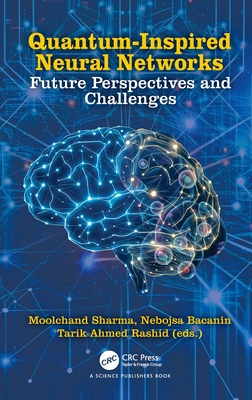
The rapid development in AI and quantum computing has resulted in a new domain termed Quantum-Inspired Neural Networks (QINNs). These models utilize ideas from quantum mechanics, including superposition, entanglement, and quantum probability, to improve the efficiency and performance of classical neural networks. This book examines the theoretical underpinnings, frameworks, and practical implementations of QINNs, rendering it an essential resource for scholars, academics, and industry experts. It examines mathematical frameworks behind quantum-inspired models, their implementation methodologies, and their relevance in diverse fields, including healthcare, finance, cybersecurity, and natural language processing. It serves as a comprehensive guide for individuals seeking to comprehend and apply QINNs in practical situations, utilizing theoretical insights, algorithmic frameworks, and case examples. The book is distinct due to its emphasis on the present and future of quantum-inspired deep learning. It integrates discussions on hybrid quantum-classical architectures, optimization strategies, and scalability difficulties, addressing the gap between quantum computing and classical AI, which are often treated separately in previous literature. Furthermore, it examines the constraints and future potential of QINNs, providing a framework for the shift from traditional deep learning to quantumaugmented models. Readers will acquire a profound comprehension of how quantum-inspired methodologies might transform the AI domain and propel innovation in nascent technologies.
Key Features:
-Investigates the integration of quantum computing concepts with neural networks, a dynamically advancing domain with transformational capabilities.
- Connects quantum computing, artificial intelligence, and machine learning, making it applicable across several fields.
- Appeals to both academic researchers and industry professionals by addressing theoretical advancements and practical applications.
- Explores the security implications of quantum AI and ethical concerns, making it relevant for policymakers and tech leaders.
-Caters to researchers, academics, AI practitioners, and students looking to explore next-gen AI technologies.
商品描述(中文翻譯)
快速發展的人工智慧(AI)和量子計算導致了一個新的領域,稱為量子啟發神經網絡(Quantum-Inspired Neural Networks, QINNs)。這些模型利用量子力學的概念,包括疊加、糾纏和量子概率,以提高傳統神經網絡的效率和性能。本書探討了QINNs的理論基礎、框架和實際實施,成為學者、學術界和行業專家的重要資源。它研究了量子啟發模型背後的數學框架、實施方法及其在醫療、金融、網絡安全和自然語言處理等多個領域的相關性。這本書是希望理解和應用QINNs於實際情境的個人的綜合指南,利用理論見解、算法框架和案例示例。本書的特點在於強調量子啟發深度學習的現在與未來。它整合了混合量子-經典架構、優化策略和可擴展性挑戰的討論,填補了量子計算與傳統AI之間的鴻溝,這在以往文獻中通常被分開處理。此外,它還探討了QINNs的限制和未來潛力,提供了從傳統深度學習轉向量子增強模型的框架。讀者將深入理解量子啟發方法如何改變AI領域並推動新興技術的創新。
主要特點:
- 探討量子計算概念與神經網絡的整合,這是一個動態發展的領域,具有變革能力。
- 連結量子計算、人工智慧和機器學習,使其在多個領域中適用。
- 通過探討理論進展和實際應用,吸引學術研究者和行業專業人士。
- 探索量子AI的安全影響和倫理問題,使其對政策制定者和科技領導者具有相關性。
- 針對希望探索下一代AI技術的研究者、學者、AI從業者和學生。
作者簡介
Dr. Moolchand Sharma is an Assistant Professor at the Maharaja Agrasen Institute of Technology, GGSIPU Delhi. He has several publications in reputed international journals and conferences, including SCI-indexed and Scopus-indexed journals. He has authored/edited four books, and also has authored/co-authored chapters with in publications from reputed global publishers. His research areas include Artificial Intelligence, Nature-Inspired Computing, Security in Cloud Computing, Machine Learning, and Search Engine Optimization. He is associated with various professional bodies like IEEE, ISTE, IAENG, ICSES, UACEE, Internet Society, and a life member of the Universal Innovators research laboratory, etc. He possesses almost 10 years of teaching experience. He is the co-convener of the ICICC, DOSCI, ICDAM & ICCCN Springer Scopus-indexed conference series and ICCRDA-2020 Scopus-indexed Material Science & Engineering conference series. He is also the organizer and co-convener of the International Conference on Innovations and Ideas towards Patents (ICIIP) series. He is also the advisory and TPC committee member of the ICCIDS-2022 SSRN Conference. He is also the reviewer of many reputed journals. He has also served as a session chair in many international springer conferences. He has completed a PhD from DCR University of Science & Technology, Haryana. He completed his postgraduate studies in 2012 at SRM University, NCR/Ghaziabad, India and he graduated in 2010 from KNGD Modi Engineering College, Gautam Buddha Technical University.
Dr. Nebojsa Bacanin has a PhD from Faculty of Mathematics, University of Belgrade in 2015 (study program Computer Science, average grade 10,00). He was the vice-dean of the Graduate School of Computer Science and Faculty of Informatics and Computing in Belgrade, Serbia. He currently works as a Full Professor and as a Vice-Rector for Scientific Research at Singidunum University, Belgrade, Serbia. He is involved in scientific research in the field of computer science and his specialty includes artificial intelligence, machine learning, deep learning, stochastic optimization algorithms, swarm intelligence, soft-computing, optimization and modeling, image processing, computer vision and cloud and distributed computing. He actively works in the domain of novel and prospective research field, hybrid methods between machine learning and metaheuristics, where metaheuristics are applied for addressing non-deterministic polynomial hard (NP-hard) challenges from machine learning domain such as hyper-parameters optimization (tuning), training and feature selection. Besides improving machine learning/deep learning models for tackling various practical tasks for classification and regression, his research also involves optimized deep learning models for univariate and multivariate time-series forecasting. Moreover, he is an expert from the area of metaheuristics, and he has been actively doing research in enhancing swarm intelligence, as well as other types of metaheuristics, by incorporating minor changes (e.g., modification in exploitation/exploration expressions, parameters' adjustments, etc.) and/or major modifications by performing hybridization with other methods (e.g., low-level and high-level hybrid metaheuristics methods). He has been applying his methods to wide variety of practical research areas, e.g., cloud computing scheduling, wireless sensor networks (WSNs) localization, coverage and energy consumption, X-ray images classification, stock price forecasting, portfolio optimization, as well as many others.
Dr. Tarik Ahmed Rashid is a Principal Fellow for the Higher Education Authority (PFHEA-UK) and a professor in the Department of Computer Science and Engineering at the University of Kurdistan Hewlêr, Iraq. He pursued his Post-Doctoral Fellowship at the Computer Science and Informatics School, College of Engineering, Mathematical and Physical Sciences, University College Dublin, Ireland. His research areas cover Artificial Intelligence, Nature Inspired Algorithms, Swarm Intelligence, Computational Intelligence, Machine Learning, and Data Mining. Tarik is among the Top 4 researchers in Iraq in the Web of Science-indexed published documents in engineering research filed over 5 years (2019-2023). He is on the prestigious Stanford University list of Top 2% of scientists in the world for 2021, 2022, 2023 and 2024. Tarik is also on the list of top 10 researchers in the Al-Ayen Iraqi Researchers Ranking (2022). AIR-Ranking 2022 is a national ranking organized by Al-Ayen University. His team has designed some single and multi-objective optimization algorithms, such as Fitness Dependent Optimizer (FDO), Child Drawing Development Optimization (CDDO), Donkey and smuggler optimization (DSO), Ant Nesting Algorithm (ANA), FOX Algorithm (FOX), Learner Performance based Behavior (LPB), Goose Algorithm (Goose), Lagrange Elementary Optimization (Leo), Shrike Optimization Algorithm (SHOA), Evolutionary Clustering Algorithm Star (ECA*), and Improved Evolutionary Clustering Algorithm Star (iECA*). His team also has designed several multi objective optimization algorithms, such as Multi-Objective Fitness Dependent Optimizer (MOFDO), Multi-objective Learner Performance based Behavior (MOLPB), and Multi-objective Ant Nesting Algorithm (ANA), and Grid Multi-objective Cat Swarm Optimization (GMOCSO).
作者簡介(中文翻譯)
穆爾昌德·沙瑪博士是德里GGSIPU的馬哈拉賈·阿格拉森技術學院的助理教授。他在多個知名國際期刊和會議上發表了多篇論文,包括SCI和Scopus索引的期刊。他已經編著或編輯了四本書,並與知名全球出版商的出版物共同撰寫了多個章節。他的研究領域包括人工智慧、自然啟發計算、雲計算安全、機器學習和搜尋引擎優化。他與多個專業機構有關聯,如IEEE、ISTE、IAENG、ICSES、UACEE、互聯網協會等,並且是全球創新者研究實驗室的終身會員等。他擁有近10年的教學經驗。他是ICICC、DOSCI、ICDAM和ICCCN斯普林格Scopus索引會議系列的共同召集人,以及ICCRDA-2020斯普林格Scopus索引材料科學與工程會議系列的共同召集人。他還是國際專利創新與理念會議(ICIIP)系列的組織者和共同召集人。他是ICIDS-2022 SSRN會議的顧問和TPC委員會成員,也是多個知名期刊的審稿人。他曾在多個國際斯普林格會議中擔任會議主席。他在哈里亞納邦DCR科學與技術大學獲得博士學位,並於2012年在印度NCR/加濟阿巴德的SRM大學完成研究生學業,於2010年從高塔姆·布達技術大學的KNGD莫迪工程學院畢業。
內博伊沙·巴卡寧博士於2015年在貝爾格萊德大學數學系獲得博士學位(計算機科學專業,平均成績10.00)。他曾擔任塞爾維亞貝爾格萊德計算機科學研究生院和信息與計算系的副院長。目前,他在塞爾維亞貝爾格萊德的辛吉杜努姆大學擔任全職教授及科學研究副校長。他參與計算機科學領域的科學研究,專長包括人工智慧、機器學習、深度學習、隨機優化算法、群體智慧、軟計算、優化與建模、圖像處理、計算機視覺以及雲計算和分佈式計算。他積極從事新穎和前瞻性的研究領域,研究機器學習與元啟發式之間的混合方法,將元啟發式應用於解決機器學習領域中的非確定性多項式困難(NP-hard)挑戰,如超參數優化(調整)、訓練和特徵選擇。除了改善機器學習/深度學習模型以應對各種分類和回歸的實際任務外,他的研究還涉及針對單變量和多變量時間序列預測的優化深度學習模型。此外,他是元啟發式領域的專家,並積極研究通過小幅變更(例如,修改開採/探索表達式、參數調整等)和/或通過與其他方法進行混合來進行重大修改(例如,低層次和高層次的混合元啟發式方法)來增強群體智慧及其他類型的元啟發式。他已將其方法應用於各種實際研究領域,例如雲計算調度、無線傳感器網絡(WSNs)定位、覆蓋和能耗、X光圖像分類、股票價格預測、投資組合優化等。
塔里克·艾哈邁德·拉希德博士是英國高等教育機構的首席研究員(PFHEA-UK),並且是伊拉克庫爾德斯坦赫維勒大學計算機科學與工程系的教授。他在愛爾蘭都柏林大學學院的計算機科學與信息學學校追求博士後研究。他的研究領域涵蓋人工智慧、自然啟發算法、群體智慧、計算智能、機器學習和數據挖掘。塔里克在過去五年(2019-2023)中是伊拉克Web of Science索引的工程研究領域前四名研究人員之一。他在2021、2022、2023和2024年被列入斯坦福大學全球前2%科學家的名單。塔里克還在2022年阿爾艾延伊拉克研究人員排名中名列前10名。AIR-Ranking 2022是由阿爾艾延大學組織的全國排名。他的團隊設計了一些單目標和多目標優化算法,如健身依賴優化器(FDO)、兒童繪畫發展優化(CDDO)、驢子與走私者優化(DSO)、蟻巢算法(ANA)、狐狸算法(FOX)、基於學習者表現的行為(LPB)、鵝算法(Goose)、拉格朗日基本優化(Leo)、嘲鵰優化算法(SHOA)、進化聚類算法星(ECA*)和改進的進化聚類算法星(iECA*)。他的團隊還設計了幾個多目標優化算法,如多目標健身依賴優化器(MOFDO)、多目標基於學習者表現的行為(MOLPB)和多目標蟻巢算法(ANA),以及網格多目標貓群優化(GMOCSO)。