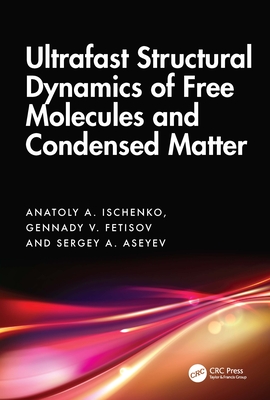
Ultrafast Structural Dynamics of Free Molecules and Condensed Matter
暫譯: 自由分子與凝聚態的超快結構動力學
Ischenko, Anatoly A., V. Fetisov, Gennady, A. Aseyev, Sergey
- 出版商: CRC
- 出版日期: 2025-12-02
- 售價: $8,890
- 貴賓價: 9.5 折 $8,445
- 語言: 英文
- 頁數: 444
- 裝訂: Hardcover - also called cloth, retail trade, or trade
- ISBN: 1041110847
- ISBN-13: 9781041110842
-
相關分類:
物理學 Physics
海外代購書籍(需單獨結帳)
商品描述
It is the dream of every natural scientist to directly observe the motion of atoms and molecules in real time as they interact. The natural sciences by definition involve structural dynamics and the observation of molecules interconverting from one structure to another or other structures, which is, after all, the very essence of science. Each area of the natural sciences has unique intellectual goals; however, they are all united by the thought experiment in which we try to understand how molecules interconvert between different structures by passing through a reaction barrier, a transition state.
This concept of a "moment," an ultra-short time interval in the natural sciences, forces us to think about the relative positions of the atoms that define the barrier to the process of their interaction. It is the control of the barrier height that allows one of many possible atomic rearrangements to occur, since it occurs faster than competing processes. That is, the process of molecular transformation during interaction is inherently a "race against time." Manipulating the barrier height gives effective, exponential control over the yield of the reaction product. The problem of visualizing transition state structures is akin to finding a way from one valley to another in a very rugged mountainous area during an earthquake, where the mountains and the landscape change as you move across the terrain: suddenly a crack appears and the shaking takes you to a more stable valley. Without a detailed understanding of how fluctuations - in this analogy, shaking - affect the potential energy landscape, it would be difficult to guess where and when the crack will form or the path to the next valley.
At its most fundamental, chemistry is the study of structural dynamics, discussed both for synthetic purposes and for physical methods with the explicit goal of controlling the transformation of matter from one form/property to another. We now have tools to observe chemical reactions at the atomic level.
This monograph presents a picture of the development and evolution of methods for detecting ultrafast structural dynamics processes. It describes the theoretical foundations and principles of the relevant experimental techniques, as well as prospects for their improvement for application in the latest existing and developing technologies. The book presents the achievements of ultrafast methods of spectroscopy, electron diffraction, X-ray diffraction and electron microscopy for diagnostics of the structural dynamics of matter in states far from equilibrium and extreme states of matter. In general, the information obtained is of particular value for understanding the relationship between the elements of the structure-dynamics-function triad. In the future, this will ensure control over the functional capabilities of various materials far from equilibrium and the creation of new atomic and molecular technologies.
The monograph is recommended for a wide range of readers interested in the problems of the structure of matter, ultrafast structural dynamics, including the study of the structure and dynamics of nanomaterials: scientists, graduate students and students specializing in this interesting and rapidly developing area of modern natural science, which is now called "ultrafast science".
- Ultrafast transmission electron microscopy uncover structure-function relationships
- Ultra-short photoelectron pulses opened up the studying of structural dynamics
- One electron femtosecond pulses prevents damage of biological objects
- Ultrafast electron microscopy uncover simultaneous real space and diffraction imaging
- Ultrafast diffraction and tomography holds complete information of the quantum state
商品描述(中文翻譯)
每位自然科學家的夢想是能夠直接觀察原子和分子在相互作用過程中的運動,並且是即時的。自然科學的定義涉及結構動力學以及觀察分子如何從一種結構轉換為另一種或其他結構,這畢竟是科學的本質。每個自然科學領域都有其獨特的智識目標;然而,它們都被一個思想實驗所聯結,即我們試圖理解分子如何通過反應障礙、過渡態在不同結構之間相互轉換。
這個「瞬間」的概念,即自然科學中的超短時間間隔,迫使我們思考定義其相互作用過程障礙的原子相對位置。障礙高度的控制使得眾多可能的原子重排之一得以發生,因為它的發生速度快於其他競爭過程。也就是說,分子在相互作用過程中的轉變本質上是一場「與時間賽跑」。操控障礙高度能有效且指數地控制反應產物的產率。可視化過渡態結構的問題類似於在地震期間,從一個山谷找到通往另一個山谷的路徑,在這個過程中,山脈和地形隨著你的移動而改變:突然出現一條裂縫,震動將你帶到一個更穩定的山谷。如果沒有對波動(在這個比喻中是震動)如何影響潛能能量景觀的詳細理解,將很難猜測裂縫會在何時何地形成或通往下一個山谷的路徑。
從根本上講,化學是結構動力學的研究,無論是為了合成目的還是物理方法,明確的目標是控制物質從一種形式/性質轉變為另一種。我們現在擁有觀察化學反應在原子層面上進行的工具。
本專著呈現了檢測超快結構動力學過程的方法發展與演變的全貌。它描述了相關實驗技術的理論基礎和原則,以及在最新現有和發展技術中的應用前景。該書展示了超快光譜學、電子衍射、X射線衍射和電子顯微鏡在診斷遠離平衡狀態和物質極端狀態的結構動力學方面的成就。一般而言,所獲得的信息對於理解結構-動力學-功能三元組之間的關係具有特別的價值。未來,這將確保對各種遠離平衡的材料功能能力的控制,以及新原子和分子技術的創造。
本專著推薦給對物質結構、超快結構動力學問題感興趣的廣大讀者,包括納米材料的結構和動力學研究:科學家、研究生和專注於這一有趣且快速發展的現代自然科學領域的學生,這一領域現在被稱為「超快科學」。
- 超快傳輸電子顯微鏡揭示結構-功能關係
- 超短光電子脈衝開啟了結構動力學的研究
- 單電子飛秒脈衝防止生物物體的損傷
- 超快電子顯微鏡揭示同時的實空間和衍射成像
- 超快衍射和斷層攝影持有量子狀態的完整信息
作者簡介
Prof., Dr. Sci. Anatoly A. Ischenko is a Head of the Department of Analytical Chemistry named after I. P. Alimarin of the Institute of Fine Chemical Technologies named after M. V. Lomonosov, MIREA-Russian Technological University, Moscow, Russian Federation. Main area of research: ultrafast processes in free molecules and condensed matter, chemical reaction dynamics and instrumental methods of analysis. In 1976-1977 was a scholar and in 1979 research associate at the electron diffraction laboratory at Oslo University, Norway and a long period of joint research work since 1992 with electron diffraction group at the University of Arkansas at Fayetteville, USA as invited professor. Published about 300 scientific papers, 7 monographs and 4 textbooks on analytical chemistry and instrumental methods of analysis for students of higher educational institutions and colleges; 29 patents for inventions. Have Russian and International awards for achievements in the field of Structural Chemistry and Nanotechnology.
Prof., Dr. Sci. Gennady V. Fetisov is a Leading scientific researcher in the Laboratory of Structural Chemistry of the Department of Chemistry of Moscow State University named after M. V. Lomonosov, Moscow, Russian Federation. Main area of research: the development of new instrumental methods and experimental techniques for X-ray crystal structure analysis, including X-ray diffraction methods of crystal structure data collection for precision crystal structure analysis using laboratory and synchrotron radiation sources; studying structure of nanocrystals; methods for X-ray diffraction studies of crystals in external fields. Published about 100 scientific papers, 7 monographs and 4 textbooks on analytical chemistry and instrumental methods of analysis for students of higher educational institutions and colleges; 8 patents for inventions. Have Russian and International awards for achievements in the field of Materials Science, X-ray instrumentation and Nanotechnology.
Prof., Dr. Sci. Sergei A. Aseyev is a Leading scientific researcher in the Laboratory of Laser Physics of the Institute of Spectroscopy of the Russian Academy of Sciences, Moscow, Russian Federation. Main area of research: femtosecond laser spectroscopy, ultrafast electron diffraction/microscopy, laser photoionization spectroscopy, attosecond photoelectron spectroscopy, projection microscopy. An original method of scanning microscopy with a hollow nanotip has been developed, which opened up the possibility of nanolocal photodesorption of molecular ions for studying organic structures with high spatial and high chemical elemental resolution. Photoelectron projection microscopy of organic nanostructures has been implemented. Published about 120 scientific papers, 4 monographs, 12 patents for inventions. Have Russian and International awards for achievements in the field of Ultrafast Spectroscopy.
作者簡介(中文翻譯)
教授、科學博士 Anatoly A. Ischenko 是俄羅斯聯邦莫斯科 MIREA-俄羅斯技術大學 I. P. Alimarin 分析化學系的系主任。主要研究領域:自由分子和凝聚態中的超快過程、化學反應動力學及分析儀器方法。1976年至1977年擔任挪威奧斯陸大學電子衍射實驗室的學者,1979年成為研究助理,自1992年以來與美國阿肯色州費耶特維爾大學的電子衍射小組進行長期合作研究,擔任受邀教授。發表約300篇科學論文,7部專著和4本針對高等教育機構及學院學生的分析化學和分析儀器方法的教科書;擁有29項發明專利。因在結構化學和納米技術領域的成就獲得俄羅斯及國際獎項。
教授、科學博士 Gennady V. Fetisov 是俄羅斯聯邦莫斯科 M. V. Lomonosov國立大學化學系結構化學實驗室的首席科學研究員。主要研究領域:新型儀器方法和實驗技術的開發,用於X射線晶體結構分析,包括使用實驗室和同步輻射源進行精確晶體結構分析的X射線衍射晶體結構數據收集;研究納米晶體的結構;在外部場中進行晶體的X射線衍射研究方法。發表約100篇科學論文,7部專著和4本針對高等教育機構及學院學生的分析化學和分析儀器方法的教科書;擁有8項發明專利。因在材料科學、X射線儀器和納米技術領域的成就獲得俄羅斯及國際獎項。
教授、科學博士 Sergei A. Aseyev 是俄羅斯科學院光譜學研究所激光物理實驗室的首席科學研究員。主要研究領域:飛秒激光光譜學、超快電子衍射/顯微鏡技術、激光光電離光譜學、阿秒光電子光譜學、投影顯微鏡技術。開發了一種具有中空納米尖端的掃描顯微鏡原創方法,這為研究具有高空間和高化學元素解析度的有機結構的分子離子的納米局部光脫附提供了可能性。已實現有機納米結構的光電子投影顯微鏡技術。發表約120篇科學論文,4部專著,12項發明專利。因在超快光譜學領域的成就獲得俄羅斯及國際獎項。