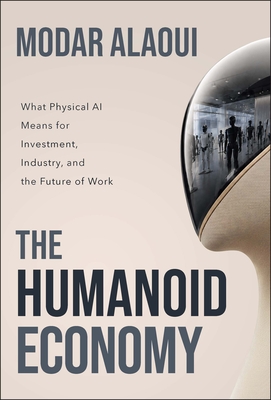
The Humanoid Economy: What Physical AI Means for Investment, Industry, and the Future of Work
暫譯: 人形機器人經濟:實體 AI 對投資、產業與未來工作的意義
Alaoui, Modar
- 出版商: Wiley
- 出版日期: 2026-10-12
- 售價: $1,400
- 貴賓價: 9.5 折 $1,330
- 語言: 英文
- 頁數: 240
- 裝訂: Hardcover - also called cloth, retail trade, or trade
- ISBN: 1394453647
- ISBN-13: 9781394453641
-
相關分類:
機器人製作 Robots、Computer Vision、投資理財 Investment
尚未上市,無法訂購
相關主題

商品描述
The insider account of how humanoid robotics is evolving into a global commercial movement
The humanoid robotics market will reach multi-trillion-dollar scale over the coming decades, with projections of up to $5T by 2050. The Humanoid Economy: What Physical AI Means for Investment, Industry, and the Future of Work maps the full architecture of this shift--its technical foundations, financial realities, cultural dynamics, and geopolitical stakes--written by a venture capitalist and ecosystem builder at the center of the field.
Across seven chapters, The Humanoid Economy traces why the humanoid form factor fits human-built environments, how convergences in AI maturity and global labor shortages created the inflection point, what it takes to engineer and deploy a humanoid system, and how venture capital, policy frameworks, safety standards, and global summits combined to build an entire ecosystem around the field.
Readers will also discover:
- How investment platforms, emerging standards efforts, and policy proposals such as the U.S. Humanoids Act shape commercialization
- The technical convergences in sensor fusion, computer vision, and embodied intelligence driving physical AI systems from research labs toward real-world deployment
- Frameworks for evaluating humanoid ventures, including funding models, go-to-market strategies, and portfolio construction in physical AI
- How global labor shortages, cultural readiness, and geopolitical competition accelerated the humanoid robotics inflection point
- Strategies for responsible scaling, including workforce adaptation, human-robot collaboration models, and safety standards development
Written for venture capitalists, C-suite executives, robotics founders, and policymakers, The Humanoid Economy delivers the technical depth, financial analysis, and strategic perspective required to evaluate and participate in the transition from fragmented robotics research to coordinated global commercialization.
商品描述(中文翻譯)
人形機器人如何演變為全球商業運動的業界內幕
未來數十年,人形機器人市場的規模將達到數兆美元,預估到 2050 年最高可達 5 兆美元。《人形經濟:Physical AI 對投資、產業與未來工作型態的意義》全面剖析這項轉型的完整架構——包括其技術基礎、金融現實、文化動態與地緣政治利益。本書由身處產業核心的創業投資家與生態系建構者撰寫。
《人形經濟》全書分為七章,追溯人形設計為何適合人類打造的環境、AI 成熟度與全球勞動力短缺的交會如何創造轉捩點、工程化與部署人形系統需要哪些條件,以及創業投資、政策架構、安全標準與全球高峰會如何共同建立圍繞此領域的完整生態系。
讀者還將了解:
• 投資平台、新興標準制定工作,以及美國《Humanoids Act》等政策提案如何形塑商業化進程
• 感測器融合、電腦視覺與具身智慧(embodied intelligence)在技術上的匯聚,如何推動 Physical AI 系統從研究實驗室走向實際部署
• 評估人形機器人新創企業的架構,包括 Physical AI 領域的募資模式、上市策略與投資組合建構
• 全球勞動力短缺、文化準備程度與地緣政治競爭,如何加速人形機器人產業的轉捩點
• 負責任地擴大規模的策略,包括勞動力轉型、人機協作模式與安全標準的制定
《人形經濟》專為創業投資家、C-suite 高階主管、機器人新創公司創辦人與政策制定者撰寫,提供評估並參與這場轉型所需的技術深度、金融分析與策略視角,協助讀者理解產業如何從零散的機器人研究,走向協調一致的全球商業化。
作者簡介
MODAR ALAOUI is the founder and general partner of ALM Ventures, a Silicon Valley venture capital firm focused on humanoids, physical AI, and spatial intelligence. He is also the founder and chair of the Humanoids Summit, a global forum that brings together leading builders, investors, and operators shaping humanoid robotics, with editions in Silicon Valley, Tokyo, and London. He operates at the intersection of capital, strategy, and infrastructure, and has played a central role in advancing the humanoid robotics ecosystem toward commercial deployment and mass production.
Modar is the founder and chair of the Bay Area Robotics Association (BARA), a member-led industry organization established to connect capital, startups, enterprises, and public sector stakeholders across Silicon Valley and global robotics hubs. He created International Humanoids Day, a global initiative advancing "humanoids for humanity," aligning industry leaders around ethical development, global standards, and international collaboration in humanoid robotics. He contributes to policy efforts shaping US humanoid strategy and long-term deployment frameworks, helping strengthen US competitiveness in physical AI.
Earlier in his career, Modar founded Eyeris, where he developed computer vision and sensor fusion AI systems for in-cabin sensing. His work combined software and hardware across perception and edge compute, providing hands-on experience with real-world systems operating around people.
He studied behavioral science and communication at Concordia University in Montreal, forming the foundation for his work in human behavior understanding and machine perception. This combination of behavioral insight and physical AI systems continues to inform his work in humanoids and real-world autonomy.
His work and perspectives have been featured in major media outlets including Bloomberg, CNBC, The Wall Street Journal, Reuters, Wired, and Forbes. In The Humanoid Economy, he draws on his role in building the humanoid robotics ecosystem to frame the next phase of industrial transformation.
作者簡介(中文翻譯)
MODAR ALAOUI 是 ALM Ventures 的創辦人兼普通合夥人。ALM Ventures 是一家位於矽谷、專注於人形機器人、實體 AI(physical AI)與空間智慧(spatial intelligence)的創投公司。他也是 Humanoids Summit 的創辦人兼主席。Humanoids Summit 是一個全球論壇,匯聚致力於推動人形機器人發展的領導者、投資人與營運者,並於矽谷、東京和倫敦舉辦。他的工作橫跨資本、策略與基礎建設,並在推動人形機器人生態系邁向商業部署與大規模量產方面扮演核心角色。
Modar 是 Bay Area Robotics Association(BARA)的創辦人兼主席。BARA 是一個由會員組成的產業組織,旨在連結矽谷及全球機器人產業聚落中的資本、創新企業、企業與公共部門利害關係人。他創立了 International Humanoids Day,這項全球倡議以「人形機器人為人類福祉」(humanoids for humanity)為宗旨,促成產業領導者在機器人倫理發展、全球標準與人形機器人國際合作方面凝聚共識。他也參與制定美國人形機器人策略與長期部署架構的政策工作,協助強化美國在實體 AI 領域的競爭力。
在職涯早期,Modar 創立了 Eyeris,並開發用於車艙內感測的 computer vision 與 sensor fusion AI 系統。他的工作結合了感知技術與邊緣運算領域的軟體和硬體,累積了在以人為運作環境中部署真實世界系統的實務經驗。
他曾在蒙特婁的 Concordia University 修習行為科學與傳播,這些學習奠定了他在人類行為理解與機器感知方面的工作基礎。這種對行為的洞察與實體 AI 系統的結合,至今仍持續影響他在人形機器人與真實世界自主系統領域的工作。
他的工作與觀點曾受到多家主要媒體報導,包括 Bloomberg、CNBC、《The Wall Street Journal》、Reuters、《Wired》與《Forbes》。在《The Humanoid Economy》一書中,他以自身建立人形機器人生態系的經驗為基礎,闡述工業轉型的下一個階段。