Reinforcement Learning from Human Feedback: LLM Alignment and Post-Training
暫譯: 從人類反饋中學習的強化學習:大型語言模型的對齊與後期訓練
Lambert, Nathan
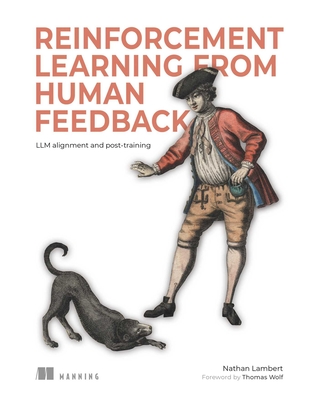
- 出版商: Manning
- 出版日期: 2026-08-04
- 售價: $2,380
- 貴賓價: 9.5 折 $2,261
- 語言: 英文
- 頁數: 312
- 裝訂: Quality Paper - also called trade paper
- ISBN: 1633434303
- ISBN-13: 9781633434301
-
相關分類:
Reinforcement
海外代購書籍(需單獨結帳)
相關主題

商品描述
Get the eBook free when you register your print book at Manning. "A masterful synthesis of the field's intellectual roots and its practical tools."
--Saurabh Sawant, Microsoft Reinforcement Learning from Human Feedback: LLM alignment and post-training helps you understand how modern AI models can be adapted to better match the needs and expectations of their users. Rather than surveying the vast field of reinforcement learning, elite AI researcher Nathan Lambert concentrates exclusively on RLHF and its immediate importance to post-training generative AI models. This compact book gets right to the point. Early chapters establish the training overview, explain instruction fine-tuning, and build reliable reward models. The middle chapters transition into the heart of alignment, exploring core policy gradient algorithms, Direct Preference Optimization (DPO), and inference-time scaling. Later chapters tackle the messy reality of data, guiding you through preference data collection, synthetic data generation, and the nuances of function calling. As you go, you will see how these post-training methods actually work, including their unique compute costs and latency trade-offs. You will explore common failure modes, such as qualitative over-optimization, reward hacking, and the unreliability of external evaluation comparisons. Difficult concepts like KL regularization, proximal policy optimization, and generative reward modeling are clarified with hands-on experiments. Reinforcement Learning from Human Feedback avoids irrelevant academic details in favor of immediate, practical value. Everything author Nathan Lambert includes appears because a modern RLHF project requires it. He skillfully explains complex post-training pipelines by making every detail concrete, connecting isolated abstractions directly to the goal of making models safer, smarter, and perfectly tuned to a desired style. The book's seventeen short chapters lay out the core material, while supplements like vocabulary definitions, compute cost management, evaluation variance, and training performance tracking appear in handy appendixes. The result is a logically flowing book that remains highly navigable and technically deep without getting bogged down in unnecessary theory. The book covers - Core RLHF implementations and Direct Alignment Algorithms
- Building robust preference and synthetic data pipelines
- Evaluating models and crafting specific AI personas About the reader For established engineers, AI scientists, and students trying to get a practical foothold in AI model alignment. About the author Dr. Nathan Lambert is a leading AI researcher known for leading post-training at the Allen Institute for AI. With previous experience at HuggingFace, DeepMind, and Meta, he is a passionate advocate for open models. His work focuses on increasing access to, and the understanding of, AI technology--empowering readers to contribute to the advancement of AI outside closed corporate labs. Table of Contents Part 1
1 Introduction
2 A tiny history of RLHF
3 Training overview
Part 2
4 Instruction fine-tuning
5 Reward modeling
6 Reinforcement learning
7 Reasoning and inference-time scaling
8 Direct-alignment algorithms
9 Rejection sampling
Part 3
10 The nature of preferences
11 Preference data
12 Synthetic data
Part 4
13 Tool use and function calling
14 Over-optimization
15 Regularization
16 Evaluation
17 Crafting model character and products
A Definitions
B Beyond "just style"
C Practical Issues
--Saurabh Sawant, Microsoft Reinforcement Learning from Human Feedback: LLM alignment and post-training helps you understand how modern AI models can be adapted to better match the needs and expectations of their users. Rather than surveying the vast field of reinforcement learning, elite AI researcher Nathan Lambert concentrates exclusively on RLHF and its immediate importance to post-training generative AI models. This compact book gets right to the point. Early chapters establish the training overview, explain instruction fine-tuning, and build reliable reward models. The middle chapters transition into the heart of alignment, exploring core policy gradient algorithms, Direct Preference Optimization (DPO), and inference-time scaling. Later chapters tackle the messy reality of data, guiding you through preference data collection, synthetic data generation, and the nuances of function calling. As you go, you will see how these post-training methods actually work, including their unique compute costs and latency trade-offs. You will explore common failure modes, such as qualitative over-optimization, reward hacking, and the unreliability of external evaluation comparisons. Difficult concepts like KL regularization, proximal policy optimization, and generative reward modeling are clarified with hands-on experiments. Reinforcement Learning from Human Feedback avoids irrelevant academic details in favor of immediate, practical value. Everything author Nathan Lambert includes appears because a modern RLHF project requires it. He skillfully explains complex post-training pipelines by making every detail concrete, connecting isolated abstractions directly to the goal of making models safer, smarter, and perfectly tuned to a desired style. The book's seventeen short chapters lay out the core material, while supplements like vocabulary definitions, compute cost management, evaluation variance, and training performance tracking appear in handy appendixes. The result is a logically flowing book that remains highly navigable and technically deep without getting bogged down in unnecessary theory. The book covers - Core RLHF implementations and Direct Alignment Algorithms
- Building robust preference and synthetic data pipelines
- Evaluating models and crafting specific AI personas About the reader For established engineers, AI scientists, and students trying to get a practical foothold in AI model alignment. About the author Dr. Nathan Lambert is a leading AI researcher known for leading post-training at the Allen Institute for AI. With previous experience at HuggingFace, DeepMind, and Meta, he is a passionate advocate for open models. His work focuses on increasing access to, and the understanding of, AI technology--empowering readers to contribute to the advancement of AI outside closed corporate labs. Table of Contents Part 1
1 Introduction
2 A tiny history of RLHF
3 Training overview
Part 2
4 Instruction fine-tuning
5 Reward modeling
6 Reinforcement learning
7 Reasoning and inference-time scaling
8 Direct-alignment algorithms
9 Rejection sampling
Part 3
10 The nature of preferences
11 Preference data
12 Synthetic data
Part 4
13 Tool use and function calling
14 Over-optimization
15 Regularization
16 Evaluation
17 Crafting model character and products
A Definitions
B Beyond "just style"
C Practical Issues
商品描述(中文翻譯)
在Manning註冊您的印刷書籍時可免費獲得電子書。
「對於該領域的智識根源和實用工具的精妙綜合。」--Saurabh Sawant, Microsoft 來自人類反饋的強化學習:LLM對齊與後訓練幫助您理解現代AI模型如何調整以更好地符合用戶的需求和期望。這本書的作者,精英AI研究員Nathan Lambert,專注於RLHF及其對後訓練生成AI模型的直接重要性,而不是對強化學習這個廣泛領域進行調查。 這本簡潔的書直入主題。早期章節建立了訓練概述,解釋了指令微調,並構建了可靠的獎勵模型。中間章節過渡到對齊的核心,探索核心策略梯度算法、直接偏好優化(Direct Preference Optimization, DPO)和推理時的擴展。後面的章節處理數據的複雜現實,指導您進行偏好數據收集、合成數據生成以及函數調用的細微差別。 在過程中,您將看到這些後訓練方法實際上是如何運作的,包括它們獨特的計算成本和延遲權衡。您將探索常見的失敗模式,例如質量過度優化、獎勵駭客和外部評估比較的不可靠性。像KL正則化、近端策略優化和生成獎勵建模等困難概念將通過實驗得到澄清。 來自人類反饋的強化學習避免了不相關的學術細節,而是專注於立即的實用價值。作者Nathan Lambert所包含的一切都是因為現代RLHF項目需要它。他巧妙地通過使每個細節具體化來解釋複雜的後訓練管道,將孤立的抽象直接連接到使模型更安全、更智能以及完美調整到所需風格的目標。 這本書的十七個短章節列出了核心材料,而詞彙定義、計算成本管理、評估變異和訓練性能跟蹤等補充內容則出現在方便的附錄中。結果是一本邏輯流暢的書,保持高度可導航且技術深度,卻不會陷入不必要的理論中。 本書涵蓋 - 核心RLHF實現和直接對齊算法
- 構建穩健的偏好和合成數據管道
- 評估模型和創建特定的AI角色 讀者對象 適合已建立的工程師、AI科學家和試圖在AI模型對齊中獲得實用基礎的學生。 關於作者 Dr. Nathan Lambert是知名的AI研究員,以在Allen Institute for AI領導後訓練而聞名。曾在HuggingFace、DeepMind和Meta工作,他是開放模型的熱情倡導者。他的工作專注於增加對AI技術的訪問和理解,賦予讀者在封閉的企業實驗室之外推動AI進步的能力。 目錄 第一部分
1 引言
2 RLHF的簡史
3 訓練概述
第二部分
4 指令微調
5 獎勵建模
6 強化學習
7 推理和推理時擴展
8 直接對齊算法
9 拒絕取樣
第三部分
10 偏好的本質
11 偏好數據
12 合成數據
第四部分
13 工具使用和函數調用
14 過度優化
15 正則化
16 評估
17 創建模型角色和產品
A 定義
B 超越「僅僅是風格」
C 實用問題
作者簡介
Nathan Lambert is the post-training lead at the Allen Institute for AI, having previously worked for HuggingFace, Deepmind, and Facebook AI. Nathan has guest lectured at Stanford, Harvard, MIT and other premier institutions, and is a frequent and popular presenter at NeurIPS and other AI conferences. He has won numerous awards in the AI space, including the "Best Theme Paper Award" at ACL and "Geekwire Innovation of the Year". He has 8,000 citations on Google Scholar for his work in AI and writes articles on AI research that are viewed millions of times annually at the popular Substack interconnects.ai. Nathan earned a PhD in Electrical Engineering and Computer Science from University of California, Berkeley.
作者簡介(中文翻譯)
Nathan Lambert 是艾倫人工智慧研究所的後訓練負責人,之前曾在 HuggingFace、DeepMind 和 Facebook AI 工作。Nathan 曾在史丹佛大學、哈佛大學、麻省理工學院及其他頂尖機構擔任客座講師,並且是 NeurIPS 及其他人工智慧會議的常客和受歡迎的演講者。他在人工智慧領域獲得了多項獎項,包括 ACL 的「最佳主題論文獎」和「Geekwire 年度創新獎」。他在 Google Scholar 上的人工智慧相關研究有 8,000 次引用,並在受歡迎的 Substack 平台 interconnects.ai 上撰寫的人工智慧研究文章每年被瀏覽數百萬次。Nathan 在加州大學伯克利分校獲得電機工程與計算機科學的博士學位。