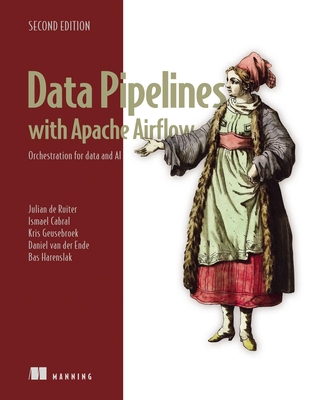
Data Pipelines with Apache Airflow : Orchestration for Data and AI, 2/e (Paperback)
暫譯: 使用 Apache Airflow 建構資料管線:資料與 AI 的流程編排,第 2 版(平裝)
Ruiter, Julian de, Cabral, Ismael, Geusebroek, Kris
- 出版商: Manning
- 出版日期: 2026-01-27
- 定價: $2,260
- 售價: 9.0 折 $2,034
- 語言: 英文
- 頁數: 512
- 裝訂: Quality Paper - also called trade paper
- ISBN: 1633436373
- ISBN-13: 9781633436374
-
相關分類:
分散式架構、Kubernetes
立即出貨 (庫存=1)
買這商品的人也買了...
-
 Machine Learning (IE-Paperback)
$1,100$1,078 -
 $990Analyzing Baseball Data with R (Paperback)
 -
 $474React Native 精解與實戰
 -
 $300Node.js 10實戰
 -
 $474了不起的 JavaScript 工程師:從前端到全端高級進階
 -
 0 陷阱!0 誤解!8 天重新認識 JavaScript!(iT邦幫忙鐵人賽系列書)
$550$467 -
 $534深度學習之 PyTorch 物體檢測實戰
 -
 強者用 PyTorch:實作史上最經典 AI 範例
$690$545 -
 $516程序員的AI書:從代碼開始
 -
 $207React Native 移動開發實戰, 2/e
 -
 跟著 Docker 隊長,修練 22天就精通 - 搭配 20小時作者線上教學,無縫接軌 Microservices、Cloud-native、Serverless、DevOps 開發架構
$880$695 -
 數位孿生:虛實融合打造元宇宙的關鍵技術
$450$351 -
 解密數位孿生:從製造、建築、能源到航空的智慧化應用
$450$351 -
 Docker 實戰 6堂課:56個實驗動手做,掌握 Linux 容器核心技術(iThome鐵人賽系列書)【平裝】
$650$507 -
 Hugging Face 模型及資料大公開 - 利用 BERT 建立全中文 NLP 應用
$720$568
相關主題


商品描述
Simplify, streamline, and scale your data operations with data pipelines built on Apache Airflow.
Apache Airflow provides a batteries-included platform for designing, implementing, and monitoring data pipelines. Building pipelines on Airflow eliminates the need for patchwork stacks and homegrown processes, adding security and consistency to the process. Now in its second edition, Data Pipelines with Apache Airflow teaches you to harness this powerful platform to simplify and automate your data pipelines, reduce operational overhead, and seamlessly integrate all the technologies in your stack.
In Data Pipelines with Apache Airflow, Second Edition you'll learn how to:
- Master the core concepts of Airflow architecture and workflow design
- Schedule data pipelines using the Dataset API and time tables, including complex irregular schedules
- Develop custom Airflow components for your specific needs
- Implement comprehensive testing strategies for your pipelines
- Apply industry best practices for building and maintaining Airflow workflows
- Deploy and operate Airflow in production environments
- Orchestrate workflows in container-native environments
- Build and deploy Machine Learning and Generative AI models using Airflow
Data Pipelines with Apache Airflow has empowered thousands of data engineers to build more successful data platforms. This new second edition has been fully revised to cover the latest features of Apache Airflow, including the Taskflow API, deferrable operators, and Large Language Model integration. Filled with real-world scenarios and examples, you'll be carefully guided from Airflow novice to expert.
About the book
Data Pipelines with Apache Airflow, Second Edition teaches you how to build and maintain effective data pipelines. You'll master every aspect of directed acyclic graphs (DAGs)--the power behind Airflow--and learn to customize them for your pipeline's specific needs. Part reference and part tutorial, each technique is illustrated with engaging hands-on examples, from training machine learning models for generative AI to optimizing delivery routes. You'll explore common Airflow usage patterns, including aggregating multiple data sources and connecting to data lakes, while discovering exciting new features such as dynamic scheduling, the Taskflow API, and Kubernetes deployments.
About the reader
For DevOps, data engineers, machine learning engineers, and sysadmins with intermediate Python skills.
About the author
Julian de Ruiter is a Data + AI engineering lead at Xebia Data, with a background in computer and life sciences and a PhD in computational cancer biology. As consultant at Xebia Data, he enjoys helping clients design and build AI solutions and platforms, as well as the teams that drive them. From this work, he has extensive experience in deploying and applying Apache Airflow in production in diverse environments.
Ismael Cabral is a Machine Learning Engineer and Airflow trainer with experience spanning across Europe, US, Mexico, and South America, where he has worked with market-leading companies. He has vast experience implementing data pipelines and deploying machine learning models in production.
Kris Geusebroek is a data-engineering consultant with extensive hands-on experience with Apache Airflow at several clients and is the maintainer of Whirl (the open source local testing with Airflow repository), where he is actively adding new examples based on new functionality and new technologies that integrate with Airflow.
Daniel van der Ende is a Data Engineer who first started using Apache Airflow back in 2016. Since then, he has worked in many different Airflow environments, both on-premises and in the cloud. He has actively contributed to the Airflow project itself, as well as related projects such as Astronomer-Cosmos.
Bas Harenslak is a Staff Architect at Astronomer, where he helps customers develop mission-critical data pipelines at large scale using Apache Airflow and the Astro platform. With a background in software engineering and computer science, he enjoys working on software and data as if they are challenging puzzles. He favours working on open source software, is a committer on the Apache Airflow project, and co-author of the first edition of Data Pipelines with Apache Airflow.
Get a free eBook (PDF or ePub) from Manning as well as access to the online liveBook format (and its AI assistant that will answer your questions in any language) when you purchase the print book.
商品描述(中文翻譯)
簡化、精簡並擴展您的資料作業,使用以 Apache Airflow 建置的資料管線。
Apache Airflow 提供一個功能完整的平台,用於設計、實作與監控資料管線。在 Airflow 上建置管線,可以免除拼湊式技術堆疊與自行開發流程的需求,為整個流程增添安全性與一致性。現在推出第二版,《Data Pipelines with Apache Airflow》將教您如何善用這個強大的平台,簡化並自動化資料管線、降低營運負擔,並順暢整合技術堆疊中的所有技術。
在《Data Pipelines with Apache Airflow, Second Edition》中,您將學會如何:
- 精通 Airflow 架構與工作流程設計的核心概念
- 使用 Dataset API 與時間表(timetable)排程資料管線,包括複雜的不規則排程
- 針對特定需求開發自訂 Airflow 元件
- 為資料管線實作完整的測試策略
- 採用建置與維護 Airflow 工作流程的業界最佳實務
- 在正式環境中部署與操作 Airflow
- 在容器原生環境中協調工作流程
- 使用 Airflow 建置與部署 Machine Learning 和 Generative AI 模型
《Data Pipelines with Apache Airflow》已協助數千名資料工程師打造更成功的資料平台。本次全新第二版經過完整修訂,涵蓋 Apache Airflow 的最新功能,包括 Taskflow API、可延後執行的運算子(deferrable operators),以及 Large Language Model 整合。本書充滿真實世界的情境與範例,將循序引導您從 Airflow 新手成為專家。
關於本書
《Data Pipelines with Apache Airflow, Second Edition》將教您如何建置與維護有效的資料管線。您將精通有向無環圖(directed acyclic graphs,DAGs)——也就是 Airflow 背後的核心——的各個面向,並學習如何依照資料管線的特定需求進行自訂。本書兼具參考手冊與教學指南的特色,每項技術都搭配引人入勝的實作範例說明,內容涵蓋從訓練 Generative AI 的 Machine Learning 模型到最佳化配送路線。您將探索常見的 Airflow 使用模式,包括彙整多個資料來源與連接資料湖,同時了解動態排程、Taskflow API 以及 Kubernetes 部署等令人期待的新功能。
適合讀者
適合具備中階 Python 技能的 DevOps 工程師、資料工程師、Machine Learning 工程師與系統管理員。
關於作者
Julian de Ruiter 是 Xebia Data 的 Data + AI 工程主管,具備電腦科學與生命科學背景,並擁有計算癌症生物學博士學位。身為 Xebia Data 的顧問,他樂於協助客戶設計與建置 AI 解決方案和平台,以及推動這些方案的團隊。透過這些工作,他累積了在各種環境中於正式環境部署與應用 Apache Airflow 的豐富經驗。
Ismael Cabral 是 Machine Learning 工程師與 Airflow 講師,工作經驗遍及歐洲、美國、墨西哥與南美洲,曾與業界領先企業合作。他在實作資料管線以及將 Machine Learning 模型部署至正式環境方面擁有豐富經驗。
Kris Geusebroek 是資料工程顧問,曾為多家客戶累積廣泛的 Apache Airflow 實作經驗,同時也是 Whirl(使用 Airflow 進行本機測試的開放原始碼儲存庫)的維護者。他目前持續根據新功能與可整合至 Airflow 的新技術,積極新增範例。
Daniel van der Ende 是資料工程師,於 2016 年開始使用 Apache Airflow。自此之後,他曾在許多不同的 Airflow 環境中工作,包括地端環境與雲端環境。他不僅積極參與 Airflow 專案本身,也貢獻於 Astronomer-Cosmos 等相關專案。
Bas Harenslak 是 Astronomer 的 Staff Architect,協助客戶使用 Apache Airflow 與 Astro 平台,在大規模環境中開發關鍵任務資料管線。他具備軟體工程與電腦科學背景,喜歡將軟體與資料視為具有挑戰性的謎題來解決。他偏好開放原始碼軟體,是 Apache Airflow 專案的提交者(committer),也是《Data Pipelines with Apache Airflow》第一版的共同作者。
購買紙本書後,您可以從 Manning 免費取得電子書(PDF 或 ePub),並存取線上 liveBook 格式;其中還包含能以任何語言回答您問題的 AI 助理。
作者簡介
Julian de Ruiter is a Data + AI engineering lead at Xebia Data, with a background in computer and life sciences and a PhD in computational cancer biology. As consultant at Xebia Data, he enjoys helping clients design and build AI solutions and platforms, as well as the teams that drive them. From this work, he has extensive experience in deploying and applying Apache Airflow in production in diverse environments.
Ismael Cabral is a Machine Learning Engineer and Airflow trainer with experience spanning across Europe, US, Mexico, and South America, where he has worked with market-leading companies. He has vast experience implementing data pipelines and deploying machine learning models in production.
Kris Geusebroek is a data-engineering consultant with extensive hands-on experience with Apache Airflow at several clients and is the maintainer of Whirl (the open source local testing with Airflow repository), where he is actively adding new examples based on new functionality and new technologies that integrate with Airflow.
Daniel van der Ende is a Data Engineer who first started using Apache Airflow back in 2016. Since then, he has worked in many different Airflow environments, both on-premises and in the cloud. He has actively contributed to the Airflow project itself, as well as related projects such as Astronomer-Cosmos.
Bas Harenslak is a Staff Architect at Astronomer, where he helps customers develop mission-critical data pipelines at large scale using Apache Airflow and the Astro platform. With a background in software engineering and computer science, he enjoys working on software and data as if they are challenging puzzles. He favours working on open source software, is a committer on the Apache Airflow project, and co-author of the first edition of Data Pipelines with Apache Airflow.
作者簡介(中文翻譯)
Julian de Ruiter 是 Xebia Data 的資料與 AI 工程主管,具備電腦科學與生命科學背景,並取得計算癌症生物學博士學位。身為 Xebia Data 的顧問,他樂於協助客戶設計與建置 AI 解決方案和平台,以及推動這些方案與平台的團隊。透過這些工作,他累積了在各種環境中於正式環境部署及應用 Apache Airflow 的豐富經驗。
Ismael Cabral 是一名 Machine Learning Engineer 及 Airflow 講師,工作經歷遍及歐洲、美國、墨西哥與南美洲,曾與業界領先企業合作。他在實作資料管線,以及將機器學習模型部署至正式環境方面,擁有豐富經驗。
Kris Geusebroek 是一名資料工程顧問,曾在多家客戶企業中累積豐富的 Apache Airflow 實務經驗,也是 Whirl(使用 Airflow 進行本機測試的開源 repository)的維護者。他持續根據 Airflow 的新功能,以及可與 Airflow 整合的新技術,積極加入新的範例。
Daniel van der Ende 是一名 Data Engineer,早在 2016 年便開始使用 Apache Airflow。自那時起,他便在許多不同的 Airflow 環境中工作,包括地端部署與雲端環境。他也積極參與 Airflow 專案本身,以及 Astronomer-Cosmos 等相關專案的貢獻。
Bas Harenslak 是 Astronomer 的 Staff Architect,負責協助客戶使用 Apache Airflow 與 Astro 平台,大規模開發攸關任務成敗的資料管線。他具備軟體工程與電腦科學背景,喜歡將軟體與資料視為需要解決的挑戰性謎題。他偏好投入開源軟體的開發,是 Apache Airflow 專案的 committer,也是《Data Pipelines with Apache Airflow》第一版的共同作者。