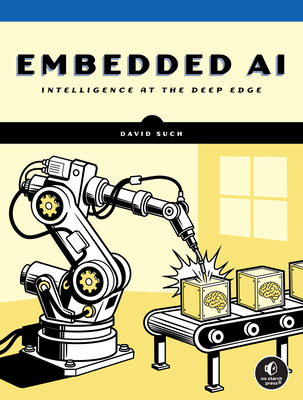
Embedded AI: Intelligence at the Deep Edge
暫譯: 嵌入式 AI:深度邊緣的智慧生態系
Such, David
- 出版商: No Starch Press
- 出版日期: 2026-10-27
- 售價: $2,800
- 貴賓價: 9.5 折 $2,660
- 語言: 英文
- 頁數: 600
- 裝訂: Quality Paper - also called trade paper
- ISBN: 171850490X
- ISBN-13: 9781718504905
-
相關分類:
Machine Learning、Arduino、單晶片
海外代購書籍(需單獨結帳)
相關主題

商品描述
- A wake-word detector that responds to your voice
- A real-time AI noise suppressor
- An AI-powered MIDI synthesizer that composes music
- A battery monitor that collects its own training data
- A person detector that runs a neural network on a camera board
Whether you're an embedded developer adding AI to your products, a machine learning practitioner moving onto embedded hardware, or a maker ready to move beyond beginner projects, Embedded AI teaches you the engineering decisions behind every design. When the breadboard is flaky, the sensor data is noisy, or the tensor arena is too small, you'll know how to fix it--and why. Prerequisites
Most projects require an Arduino UNO or Raspberry Pi Pico; a few use specialized boards. You'll also need to download some free software, including Python with TensorFlow, Arduino IDE, and Raspberry Pi Pico SDK.
商品描述(中文翻譯)
一本以專案為導向的指南,帶你直接在嵌入式硬體上設計、訓練與部署人工智慧,學習如何在真實世界的限制下,打造智慧且能自主運作的系統。
你已經知道如何建置嵌入式系統。現在,是時候讓它們變得更智慧了。
將 AI 加入嵌入式裝置,不只是訓練一個模型。你必須選擇合適的硬體、收集並準備資料、將模型部署到資源受限的裝置上,並把所有元件整合成一個能可靠運作的系統。
David Such 憑藉超過 30 年的嵌入式工程經驗,將帶你走過完整的工程流程。你將實際完成超過 25 個動手操作的專案,並取得可下載的原始碼、電路圖、PCB 設計與資料集;不需要具備 machine learning 經驗。
你將建置:
• 能回應你聲音的喚醒詞偵測器
• 即時 AI 雜訊抑制器
• 能創作音樂的 AI MIDI 合成器
• 能自行收集訓練資料的電池監測器
• 在 camera board 上執行 neural network 的人員偵測器
無論你是想為產品加入 AI 的嵌入式開發人員、準備將 machine learning 應用到嵌入式硬體的實作者,還是已準備好超越入門專案的 maker,《Embedded AI》都會教你每一項設計背後的工程決策。當 breadboard 運作不穩定、感測器資料充滿雜訊,或 tensor arena 空間不足時,你將知道該如何修正問題,以及為什麼要這樣修正。
先備條件
大多數專案都需要 Arduino UNO 或 Raspberry Pi Pico;其中少數專案會使用專用開發板。你也需要下載一些免費軟體,包括搭載 TensorFlow 的 Python、Arduino IDE,以及 Raspberry Pi Pico SDK。
作者簡介
作者簡介(中文翻譯)
David Such 是一名嵌入式系統工程師,也是 Reefwing Software 的創辦人,專注於打造 IoT 裝置、機器人平台與無人機飛行控制系統。他擁有超過 30 年的經驗,曾在 Serco Australia、Honeywell 與 Tyco 擔任資深職務。他的技術著作受到數千名從事邊緣運算與邊緣裝置開發的工程師及創客追蹤。