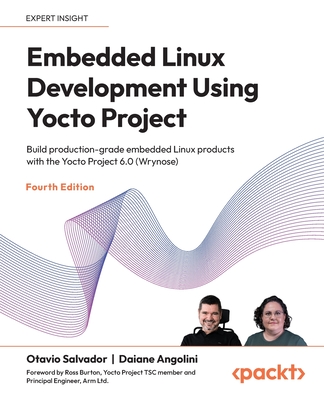
Embedded Linux Development Using Yocto Project - Fourth Edition: Build production-grade embedded Linux products with the Yocto Project 6.0, 4/e (Paperback)
暫譯: 使用 Yocto Project 開發 Embedded Linux——第四版:運用 Yocto Project 6.0 建構生產等級的 Embedded Linux 產品,第四版(平裝本)
Salvador, Otavio, Angolini, Daiane, Burton, Ross
- 出版商: Packt Publishing
- 出版日期: 2026-09-30
- 售價: $1,750
- 貴賓價: 9.5 折 $1,662
- 語言: 英文
- 頁數: 344
- 裝訂: Quality Paper - also called trade paper
- ISBN: 1806695073
- ISBN-13: 9781806695072
-
相關分類:
Linux、嵌入式系統
海外代購書籍(需單獨結帳)
買這商品的人也買了...
-
 $1,501Test Driven Development for Embedded C (Paperback)
-
 無瑕的程式碼 - 敏捷軟體開發技巧守則 (Clean Code: A Handbook of Agile Software Craftsmanship)
$580$435 -
 無瑕的程式碼 番外篇-專業程式設計師的生存之道 (The Clean Coder: A Code of Conduct for Professional Programmers)
$360$280 -
 Python 錦囊妙計, 3/e (Python Cookbook, 3/e)
$880$695 -
 $780Embedded Linux Development using Yocto Projects - Second Edition: Learn to leverage the power of Yocto Project to build efficient Linux-based products
-
 無瑕的程式碼-整潔的軟體設計與架構篇 (Clean Architecture: A Craftsman's Guide to Software Structure and Design)
$580$452 -
 $267奔跑吧 Linux內核 入門篇
-
 精通 Python|運用簡單的套件進行現代運算, 2/e (Introducing Python: Modern Computing in Simple Packages, 2/e)
$880$695 -
 $504Visual Studio Code 權威指南
-
 Python 自動化的樂趣|搞定重複瑣碎&單調無聊的工作, 2/e (Automate the Boring Stuff with Python : Practical Programming for Total Beginners, 2/e)
$680$537 -
 $601嵌入式 C語言自我修養 — 從芯片、編譯器到操作系統
-
 核心開發者親授!PyTorch 深度學習攻略 (Deep Learning with Pytorch)
$1,000$790 -
 $714Linux 嵌入式系統開發從小白到大牛
-
 STM32Cube 高效開發教程 (基礎篇)
$719$683 -
 $198嵌入式技術應用項目式教程(STM32版)
-
 野火 STM32 挑戰者開發板套件 V2 (底板+挑戰者F429核心板 + DAP下載器)
$4,400$4,312 -
 $504從零開始 Linux 運維實踐
-
 Linux Kernel Debugging: Leverage proven tools and advanced techniques to effectively debug Linux kernels and kernel modules (Paperback)
$1,800$1,710 -
 Firmware Development: A Guide to Specialized Systemic Knowledge (Paperback)
$2,250$2,137 -
 System Firmware: An Essential Guide to Open Source and Embedded Solutions (Paperback)
$2,290$2,175 -
 Windows Native API Programming (Paperback)
$1,520$1,489 -
 Windows 內核調試技術
$474$450 -
 Programming:Principles and Practice Using C++, 3/e (繁體中文版)
$990$782 -
 Embedded Linux Essentials Handbook: Build embedded Linux systems and real-world apps with Yocto, Buildroot, and RPi (Paperback)
$1,750$1,662 -
 Binary Hacks Rebooted|探索底層世界的 89個實戰技法 (Binary Hacks Rebooted —低レイヤの世界を探検するテクニック89選)
$980$774
商品描述
Master the Yocto Project 6.0 (Wrynose) LTS and ship dependable embedded Linux products, from your first QEMU boot to GPL-compliant production builds backed by SBOMs, custom BSPs, and reproducible BitBake workflows
Free with your book: DRM-free PDF version + access to Packt's next-gen Reader*
Key Features:
- Bootstrap reproducible builds in minutes with bitbake-setup and BitBake Configuration Fragments
- Author custom layers, recipes, and distributions for production-grade embedded Linux
- Generate SPDX 3.0 SBOMs, scan CVEs, and ship GPL-compliant releases with confidence
Book Description:
The Yocto Project powers some of the world's most demanding embedded Linux products, from medical devices and industrial gateways to networking gear and consumer electronics. With this book, you join the engineers who rely on it every day to ship reliable, reproducible Linux systems.
Embedded Linux Development Using Yocto Project, 4th Edition, is your hands-on guide to the Yocto Project 6.0 (Wrynose) LTS release. You'll move from your first QEMU boot to a custom production distribution running on real hardware, mastering Poky and BitBake along the way. The book covers custom layers and recipes, the Standard and Extensible SDKs, Toaster, package feeds, Build History, devshell debugging, and GPL compliance backed by SPDX 3.0 SBOMs and CVE scanning.
A brand-new chapter on Managing BitBake Configuration walks through the bitbake-setup and bitbake-config-build workflows reshaping how teams bootstrap, share, and reproduce builds. You'll package BitBake Configuration Templates and Fragments, manage registries, and synchronize configurations across teams.
By the end, you'll be ready to bake images for BeagleBone Black, Raspberry Pi 4 and 5, and VisionFive RISC-V boards, generate SBOMs ready for EU CRA and U.S. EO 14028 reporting, speed up iteration with QEMU, and lead embedded Linux projects with confidence.
*Email sign-up and proof of purchase required
What You Will Learn:
- Bootstrap projects with bitbake-setup and BitBake Configuration Fragments
- Drive builds from Toaster's web dashboard for full visibility
- Assemble packages and host package feeds for production rollouts
- Author custom layers, recipes, machines, and distributions
- Build applications and the Linux kernel with standard and extensible SDKs
- Pinpoint regressions with Build History, devshell, and Package Information
- Boot custom images on BeagleBone Black, Raspberry Pi 4/5, and VisionFive
- Generate SPDX 3.0 SBOMs, scan CVEs, and meet EU CRA reporting needs
Who this book is for:
This book is for embedded Linux developers, integrators, and engineering leads who want to ship dependable products with the Yocto Project. If you build embedded Linux for a living, or you're tired of fragile build scripts and one-off Linux distributions, this book is your production playbook. You'll get the most value if you're comfortable with Git, the Linux command line, cross-compilation, and shell scripting. No prior Yocto Project experience is required. Hardware hackers graduating from prototypes to maintainable, reproducible products will feel right at home.
Table of Contents
- Meeting the Yocto Project
- Baking Our First Yocto Project Image
- Using VS Code with the BitBake Extension
- Meeting the BitBake Tool
- Grasping the BitBake Tool
- Detailing the Temporary Build Directory
- Assimilating Packaging Support
- Understanding BitBake Metadata
- Developing with the Yocto Project
- Debugging with the Yocto Project
- Exploring External Layers
(N.B. Please use the Read Sample option to see further chapters)
商品描述(中文翻譯)
掌握 Yocto Project 6.0(Wrynose)LTS,打造可靠的嵌入式 Linux 產品:從首次啟動 QEMU,到以 SBOM、自訂 BSP 與可重現的 BitBake 工作流程支援符合 GPL 規範的正式環境建置
購書免費提供:無 DRM 的 PDF 版本,以及 Packt 新一代 Reader 的使用權限*
主要特色:
- 使用 bitbake-setup 與 BitBake Configuration Fragments,在幾分鐘內建立可重現的建置環境
- 為正式環境等級的嵌入式 Linux 撰寫自訂 layers、recipes 與 distributions
- 產生 SPDX 3.0 SBOM、掃描 CVE,並安心發布符合 GPL 規範的版本
書籍介紹:
Yocto Project 支援全球許多要求嚴苛的嵌入式 Linux 產品,涵蓋醫療裝置、工業閘道器、網路設備與消費性電子產品。透過本書,您將加入每天仰賴 Yocto Project 發布可靠且可重現 Linux 系統的工程師行列。
《Embedded Linux Development Using Yocto Project, 4th Edition》是一本針對 Yocto Project 6.0(Wrynose)LTS 版本所撰寫的實作指南。您將從首次啟動 QEMU 開始,逐步建立能在實體硬體上運作的自訂正式環境發行版,並在過程中掌握 Poky 與 BitBake。本書涵蓋自訂 layers 與 recipes、Standard SDK 與 Extensible SDK、Toaster、套件 feed、Build History、使用 devshell 進行除錯,以及透過 SPDX 3.0 SBOM 與 CVE 掃描來確保符合 GPL 規範。
全新章節「管理 BitBake Configuration」將逐步介紹 bitbake-setup 與 bitbake-config-build 工作流程,說明團隊如何透過這些流程重新建立、共用並重現建置環境。您將學會封裝 BitBake Configuration Templates 與 Fragments、管理 registry,以及在團隊之間同步組態。
讀完本書後,您將能夠為 BeagleBone Black、Raspberry Pi 4 與 5,以及 VisionFive RISC-V 開發板建置映像檔;產生可用於 EU CRA 與美國 EO 14028 報告的 SBOM;利用 QEMU 加快反覆開發;並有信心主導嵌入式 Linux 專案。
*需要註冊電子郵件並提供購買證明
您將學到:
- 使用 bitbake-setup 與 BitBake Configuration Fragments 建立專案
- 透過 Toaster 的 Web 儀表板執行建置,取得完整可見性
- 組裝套件並架設套件 feed,以支援正式環境部署
- 撰寫自訂 layers、recipes、machines 與 distributions
- 使用 Standard SDK 與 Extensible SDK 建置應用程式和 Linux kernel
- 利用 Build History、devshell 與 Package Information 精確找出回歸問題
- 在 BeagleBone Black、Raspberry Pi 4/5 與 VisionFive 上啟動自訂映像檔
- 產生 SPDX 3.0 SBOM、掃描 CVE,並符合 EU CRA 報告需求
適合對象:
本書適合希望使用 Yocto Project 發布可靠產品的嵌入式 Linux 開發人員、整合工程師與工程主管。如果您以開發嵌入式 Linux 為業,或已厭倦脆弱的建置指令碼與一次性 Linux 發行版,本書就是您的正式環境實作指南。若您熟悉 Git、Linux 命令列、交叉編譯與 shell scripting,將能從本書獲得最大的效益。不需要具備 Yocto Project 的先備經驗。對於正從原型開發邁向可維護、可重現產品的硬體開發者而言,本書也非常適合。
目錄:
- 認識 Yocto Project
- 建置我們的第一個 Yocto Project 映像檔
- 搭配 BitBake Extension 使用 VS Code
- 認識 BitBake 工具
- 理解 BitBake 工具
- 詳細剖析暫存建置目錄
- 掌握套件支援
- 了解 BitBake Metadata
- 使用 Yocto Project 進行開發
- 使用 Yocto Project 進行除錯
- 探索外部 layers
(請使用「Read Sample」選項查看後續章節)