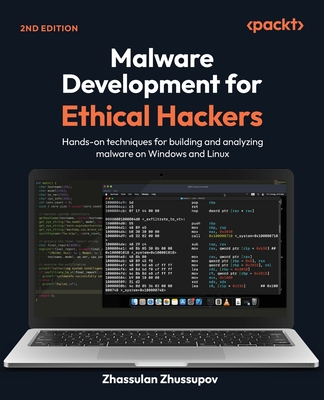
Malware Development for Ethical Hackers - Second Edition: Hands-on techniques for building and analyzing malware on Windows and Linux
暫譯: 給道德駭客的惡意軟體開發(第二版):在 Windows 與 Linux 上建構與分析惡意軟體的實作技巧
Zhussupov, Zhassulan
- 出版商: Packt Publishing
- 出版日期: 2026-08-31
- 售價: $1,250
- 貴賓價: 9.5 折 $1,187
- 語言: 英文
- 頁數: 258
- 裝訂: Quality Paper - also called trade paper
- ISBN: 1807427595
- ISBN-13: 9781807427597
-
相關分類:
Penetration-test
海外代購書籍(需單獨結帳)
相關主題

商品描述
Expanded to cover malware development across Windows and Linux, persistence, injection, evasion, and malware analysis, this practical, lab-based guide uses real-world examples to equip ethical hackers with hands-on skills.
Key Features:
- Build practical malware PoCs using C/C++ and Assembly in controlled labs
- Apply red and blue team perspectives to understand malware behavior, detection opportunities, and forensic artifacts
- Explore execution, injection, persistence, evasion, and anti-analysis techniques
- Purchase of the print or Kindle book includes a free PDF eBook
Book Description:
Malware Development for Ethical Hackers, Second Edition is a practical guide to understanding how modern malware works across Windows and Linux in an ethical, research-driven context. It focuses on controlled proof-of-concept development, showing how adversaries build capabilities such as droppers, keyloggers, infostealers, loaders, persistence modules, and process injection techniques.
The second edition covers malware development for Windows and Linux, with hands-on examples in C/C++ and Assembly. You'll explore execution techniques, evasion, persistence, anti-analysis, abuse of legitimate APIs, low-level system techniques, and real-world tradecraft inspired by modern APTs and malware families. The book also connects offensive development with malware analysis, detection opportunities, and forensic artifacts for security researchers and Blue Team readers.
By the end of this book, you'll understand how malware is designed, executed, hidden, persisted, and analyzed across Windows and Linux. You'll be able to build safe lab PoCs, understand adversary behavior, recognize forensic artifacts, and apply this knowledge to ethical hacking, red team simulations, malware research, and practical defense.
What You Will Learn:
- Implement execution and injection techniques across Windows and Linux
- Explore persistence mechanisms and the artifacts they leave behind
- Develop practical PoCs for droppers, keyloggers, infostealers, and loaders
- Study evasion, anti-analysis, and living-off-the-land techniques to understand how malware avoids detection
- Reconstruct real-world adversary tradecraft for red team simulations, security research, and defensive improvement
Who this book is for:
This book is for penetration testers, red team engineers, malware researchers, exploit developers, threat hunters, and blue team analysts who want to understand how real-world malware techniques work in practice. It is also useful for ethical hackers and cybersecurity students seeking hands-on experience with malware concepts across Windows, Linux, macOS, Android, and iOS in controlled lab environments. Familiarity with C/C++, basic Assembly, operating system internals, and core cybersecurity concepts will help readers get the most from the examples.
Table of Contents
- Malware Families and Capabilities for Windows
- Exploring Malware Running Techniques for Windows
- Windows Malware Persistence Mechanisms
- Bypass Windows OS Security and Cat and Mouse Game for Windows
- Linux Malware Capabilities
- Exploring Malware Running Techniques for Linux
- Linux Malware Persistence Mechanisms
商品描述(中文翻譯)
擴充涵蓋 Windows 與 Linux 上的惡意軟體開發、持久化、注入、規避與惡意軟體分析。本書是一部以實驗室為基礎的實作指南,透過真實世界的範例,培養道德駭客的實務技能。
主要特色:
- 在受控實驗室中,使用 C/C++ 與 Assembly 建立實用的惡意軟體 PoC
- 從紅隊與藍隊的角度,了解惡意軟體行為、偵測機會與鑑識痕跡
- 探索執行、注入、持久化、規避與反分析技術
- 購買紙本書或 Kindle 電子書,即可免費取得 PDF 電子書
書籍介紹:
《Malware Development for Ethical Hackers, Second Edition》是一部實作指南,旨在以符合道德規範且以研究為導向的方式,協助讀者了解現代惡意軟體如何在 Windows 與 Linux 上運作。本書著重於受控環境中的概念驗證(proof of concept,PoC)開發,展示攻擊者如何建立 dropper、keylogger、infostealer、loader、持久化模組,以及程序注入等技術能力。
第二版涵蓋 Windows 與 Linux 的惡意軟體開發,並提供以 C/C++ 與 Assembly 撰寫的實作範例。你將探索執行技術、規避、持久化、反分析、濫用合法 API、低階系統技術,以及受到現代 APT 與惡意軟體家族啟發的真實世界攻擊技術。本書也將攻擊性開發與惡意軟體分析、偵測機會及鑑識痕跡連結起來,適合安全性研究人員與藍隊讀者閱讀。
讀完本書後,你將了解惡意軟體如何在 Windows 與 Linux 上被設計、執行、隱藏、建立持久化,以及進行分析。你將能夠建立安全的實驗室 PoC、了解攻擊者行為、辨識鑑識痕跡,並將這些知識應用於道德駭客活動、紅隊模擬、惡意軟體研究與實務防禦。
你將學到:
- 在 Windows 與 Linux 上實作執行與注入技術
- 探索持久化機制及其留下的痕跡
- 為 dropper、keylogger、infostealer 與 loader 開發實用的 PoC
- 研究規避、反分析與就地取材(living-off-the-land)技術,了解惡意軟體如何避免被偵測
- 重現真實世界的攻擊者技術,以應用於紅隊模擬、安全性研究與防禦能力提升
適合讀者:
本書適合想要了解真實世界惡意軟體技術實務運作方式的滲透測試人員、紅隊工程師、惡意軟體研究人員、漏洞利用程式開發者、威脅獵捕人員與藍隊分析師。此外,本書也適合希望在受控實驗室環境中,實際學習 Windows、Linux、macOS、Android 與 iOS 惡意軟體概念的道德駭客與網路安全學生。若具備 C/C++、基礎 Assembly、作業系統內部機制及核心網路安全概念的相關知識,將能更充分掌握本書中的範例。
目錄
- Windows 惡意軟體家族與功能
- 探索 Windows 惡意軟體的執行技術
- Windows 惡意軟體持久化機制
- 繞過 Windows 作業系統安全機制與 Windows 的貓捉老鼠攻防
- Linux 惡意軟體功能
- 探索 Linux 惡意軟體的執行技術
- Linux 惡意軟體持久化機制