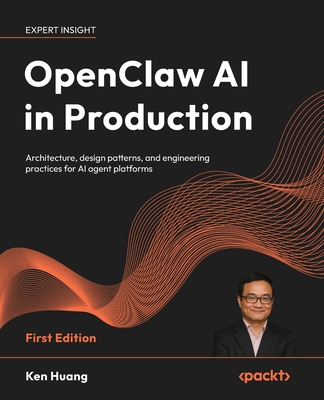
OpenClaw AI in Production: Architecture, design patterns, and engineering practices for AI agent platforms
暫譯: OpenClaw AI 在生產中的應用:AI 代理平台的架構、設計模式與工程實踐
Huang, Ken
- 出版商: Packt Publishing
- 出版日期: 2026-06-29
- 售價: $1,670
- 貴賓價: 9.5 折 $1,586
- 語言: 英文
- 頁數: 422
- 裝訂: Quality Paper - also called trade paper
- ISBN: 1807785017
- ISBN-13: 9781807785017
-
相關分類:
AI Coding
海外代購書籍(需單獨結帳)
商品描述
Build production grade AI agent platforms on OpenClaw with security, state management, and resilience patterns that are held under real load
DRM-free PDF version + access to Packt's next-gen Reader*
Key Features:
- Apply a reusable pattern language, from Hub and Spoke to Heartbeat Loop across any agent stack
- Embed zero trust identity, PBAC, and fault injection into your architecture from the first chapter
- Deploy OpenClaw with observable, self correcting infrastructure ready for federated and edge runtimes
Book Description:
Shipping a working agent prototype is easier than keeping it reliable under concurrent sessions, real-world tool failures, and adversarial inputs. Most AI tutorials leave this engineering discipline unaddressed.
This book works through that discipline using OpenClaw, an open-source AI agent operating system, as a practical reference platform. Each chapter opens with a realistic production challenge, such as a cascade failure or a prompt injection attempt, then dissects the relevant OpenClaw internals, identifies the pattern that addresses it, and closes with an implementation checklist and a hands-on exercise.
You will move through the six-phase request pipeline, distributed session state and compaction, zero-trust identity and policy-based access control, hook-based observability and self-correcting stacks, chaos engineering for agent runtimes, and high-throughput concurrency patterns. Security is not treated as a final chapter. Token exchange, mTLS, and sandboxing appear throughout the book and within every architectural section, just as they should in the systems you build.
By the end, you will be able to design, operate, and scale production AI agent platforms with the engineering rigor of distributed databases and service meshes, and extend them to federated, edge-deployed, and decentralized architectures.
*Email sign-up and proof of purchase required
What You Will Learn:
- Design a Gateway control plane that scales horizontally without coupling
- Route requests through a six-phase pipeline without creating latency bottlenecks
- Implement zero-trust identity and Token Exchange as structural, not add-on, concerns
- Manage distributed session state with safe compaction and CRDT-friendly design
- Instrument agent reasoning with semantic observability beyond uptime monitoring
- Inject faults deliberately to verify that resilience patterns hold under load
- Extend OpenClaw toward federated gateways and decentralized identity meshes
Who this book is for:
AI engineers, platform architects, and senior software engineers building autonomous agent systems in production. Readers should be comfortable with Python, distributed systems concepts, and REST or WebSocket APIs. Familiarity with OpenClaw's core architecture and components is recommended, as the book focuses on production implementation patterns rather than introductory concepts.
Table of Contents
- The OpenClaw Architecture: Decoupling and Scaling
- Request Traversal Without Bottlenecks
- Containing Cascading Failures Across the Stack
- Identity and Encryption as Architectural Fabric
- Policy-Based Access Control in OpenClaw
- State Management in Distributed OpenClaw Environments
- Offloading Cross-Cutting Concerns
- Observability Beyond Simple Monitoring
- Designing a Self-Correcting Stack
- API Gateway Patterns for OpenClaw
- Resilience Testing Through Fault Injection
- High-Throughput and Low-Latency Design Patterns
- Ecosystem Roadmap and Decentralized Deployments
商品描述(中文翻譯)
在 OpenClaw 上構建生產級 AI 代理平台,具備安全性、狀態管理和在實際負載下的韌性模式
無 DRM 的 PDF 版本 + 訪問 Packt 的下一代 Reader*
主要特點:
- 應用可重用的模式語言,從 Hub and Spoke 到 Heartbeat Loop,適用於任何代理堆疊
- 從第一章開始將零信任身份、基於政策的訪問控制 (PBAC) 和故障注入嵌入到您的架構中
- 部署 OpenClaw,具備可觀察性、自我修正的基礎設施,準備好用於聯邦和邊緣運行時
書籍描述:
交付一個可運行的代理原型比在並發會話、現實世界工具故障和對抗性輸入下保持其可靠性要容易得多。大多數 AI 教程未能解決這一工程學科。
本書通過使用 OpenClaw(一個開源 AI 代理操作系統)作為實用參考平台,來探討這一學科。每一章都以一個現實的生產挑戰開頭,例如級聯故障或提示注入嘗試,然後剖析相關的 OpenClaw 內部結構,識別解決該問題的模式,並以實施檢查清單和實作練習結束。
您將經歷六階段請求管道、分佈式會話狀態和壓縮、零信任身份和基於政策的訪問控制、基於鉤子的可觀察性和自我修正堆疊、針對代理運行時的混沌工程以及高吞吐量的並發模式。安全性不僅僅被視為最後一章。令牌交換、mTLS 和沙盒技術貫穿整本書,並在每個架構部分中出現,正如您所構建的系統中應有的那樣。
到最後,您將能夠設計、運營和擴展生產 AI 代理平台,具備分佈式數據庫和服務網格的工程嚴謹性,並將其擴展到聯邦、邊緣部署和去中心化架構。
*需要電子郵件註冊和購買證明
您將學到的內容:
- 設計一個無耦合的橫向擴展的 Gateway 控制平面
- 通過六階段管道路由請求,而不產生延遲瓶頸
- 將零信任身份和令牌交換作為結構性問題,而非附加問題來實施
- 使用安全壓縮和 CRDT 友好的設計來管理分佈式會話狀態
- 以超越正常運行時間監控的語義可觀察性來儀表化代理推理
- 故意注入故障以驗證韌性模式在負載下的有效性
- 將 OpenClaw 擴展到聯邦網關和去中心化身份網格
本書適合誰:
AI 工程師、平台架構師和在生產中構建自主代理系統的高級軟體工程師。讀者應對 Python、分佈式系統概念以及 REST 或 WebSocket API 感到舒適。建議熟悉 OpenClaw 的核心架構和組件,因為本書專注於生產實施模式,而非入門概念。
目錄
- OpenClaw 架構:解耦與擴展
- 無瓶頸的請求遍歷
- 控制堆疊中的級聯故障
- 身份與加密作為架構基礎
- OpenClaw 中的基於政策的訪問控制
- 在分佈式 OpenClaw 環境中的狀態管理
- 剝離跨切關注點
- 超越簡單監控的可觀察性
- 設計自我修正堆疊
- OpenClaw 的 API Gateway 模式
- 通過故障注入進行韌性測試
- 高吞吐量和低延遲設計模式
- 生態系統路線圖和去中心化部署






![素養檢定:國中自然素養題本 探究理化 [本書適用國中會考自然科]-cover](https://cf-assets2.tenlong.com.tw/products/images/000/231/862/medium/9786263278448.jpg?1733303400)


