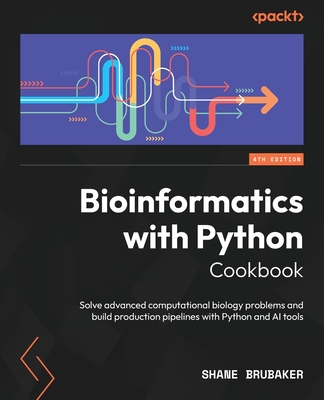
Bioinformatics with Python Cookbook : Solve advanced computational biology problems and build production pipelines with Python and AI, 4/e (Paperback)
暫譯: Python 生物資訊學食譜:解決高級計算生物學問題並使用 Python 和 AI 建立生產管道,第 4 版(平裝本)
Brubaker, Shane
- 出版商: Packt Publishing
- 出版日期: 2025-12-19
- 售價: $1,850
- 貴賓價: 9.5 折 $1,757
- 語言: 英文
- 頁數: 618
- 裝訂: Quality Paper - also called trade paper
- ISBN: 183664275X
- ISBN-13: 9781836642756
-
相關分類:
Python、生物資訊 Bioinformatics、Large language model
立即出貨 (庫存=1)
買這商品的人也買了...
-
 Introduction to Applied Linear Algebra: Vectors, Matrices, and Least Squares (Hardcover)
$1,580$1,548 -
 $2,146Introduction to Algorithms, 4/e (Hardcover)
 -
 $2,520AI and ML for Coders in Pytorch: A Coder's Guide to Generative AI and Machine Learning (Paperback)
 -
 $1,629The Linux Command Line, 3rd Edition: A Complete Introduction
 -
 $1,953Generative AI on Kubernetes: Operationalizing Large Language Models (Paperback)
相關主題


商品描述
Enhance your bioinformatics toolbox with practical Python recipes, tips, and tricks for key tasks like aligning sequence data, calling variants, and building Infrastructure as Code
Key Features:
- Perform sequence analysis at primary, secondary, and tertiary levels using Python libraries
- Solve real-world problems in the fields of phylogenetics, protein design, and annotation
- Use language models and other AI techniques to work with multimodal bioinformatics data
- Purchase of the print or Kindle book includes a free PDF eBook
Book Description:
If you've ever felt overwhelmed by the vast number of Python tools available for bioinformatics, you're not alone. The Bioinformatics with Python Cookbook is a recipe-based guide that explores practical approaches for solving classic bioinformatics challenges, showing you which Python packages work best for each task.
You'll start with the essential Python libraries for data science and bioinformatics, then move through key workflows in sequencing analysis, quality control, alignment, and variant calling. Along the way, you'll pick up modern coding practices, explore recent advances in bioinformatics research, and gain hands-on experience with libraries such as NumPy, pandas, and sci-kit learn. This book walks you through core bioinformatics tasks such as phylogenetic analysis and population genomics while familiarizing you with the wealth of modern public bioinformatics databases. You'll learn cloud computing approaches used by researchers, set up workflow orchestration systems for controlling bioinformatics pipelines, and see how AI and the use of large language models (LLMs) are reshaping the field-right down to designing proteins and DNA.
By the end of this book, you'll be ready to apply Python for real bioinformatics work and launch bioinformatics pipelines for your research.
What You Will Learn:
- Process, analyze, and align sequencing data
- Call variants and interpret their biological meaning
- Use modern cloud infrastructure to launch bioinformatics workflows
- Ingest, clean, and transform data efficiently
- Explore how AI is shaping the future of bioinformatics
- Leverage imaging data for biological insights
- Apply single-cell sequencing to cluster and compare gene expression
Who this book is for:
This book is for early- to mid-level practitioners in bioinformatics, data science, and software engineering who want to improve their skills and apply practical solutions to real-world problems. You should have a basic understanding of biology, including DNA, proteins, and cell structure, as well as Python programming and software engineering techniques. While prior exposure to machine learning with Python is not essential, experience with a cloud computing platform (AWS, GCP, or Azure) will be helpful.
Table of Contents
- Computer Specifications and Python Setup
- Basics of Data Manipulation
- Modern Coding Practices and AI-Generated Coding
- Data Science and Graphing
- Alignment and Variant Calling
- Annotation and Biological Interpretation
- Genomes and Genome Assembly
- Accessing Public Databases
- Protein Structure and Proteomics
- Phylogenetics
- Population Genetics
- Metabolic Modeling and Other Applications
- Genome Editing
- Cloud Basics
- Workflow Systems
- More Workflow Systems
- Deep Learning and LLMs for Nucleic Acid and Protein Design
- Single-Cell Technology and Imaging
商品描述(中文翻譯)
強化您的生物資訊學工具箱,透過實用的 Python 食譜、技巧和竅門,完成關鍵任務,如對齊序列數據、變異呼叫和構建基礎設施即代碼(Infrastructure as Code)。
主要特點:
- 使用 Python 函式庫在初級、次級和三級層面執行序列分析
- 解決系統發生學、蛋白質設計和註解等領域的實際問題
- 使用語言模型和其他 AI 技術處理多模態生物資訊學數據
- 購買印刷版或 Kindle 書籍可獲得免費 PDF 電子書
書籍描述:
如果您曾經被可用於生物資訊學的眾多 Python 工具所淹沒,您並不孤單。《Python 生物資訊學食譜》是一本基於食譜的指南,探索解決經典生物資訊學挑戰的實用方法,告訴您每個任務最適合使用哪些 Python 套件。
您將從數據科學和生物資訊學的基本 Python 函式庫開始,然後進入序列分析、質量控制、對齊和變異呼叫的關鍵工作流程。在此過程中,您將學習現代編碼實踐,探索生物資訊學研究的最新進展,並獲得使用 NumPy、pandas 和 sci-kit learn 等函式庫的實踐經驗。本書將引導您完成核心生物資訊學任務,如系統發生學分析和群體基因組學,同時讓您熟悉現代公共生物資訊學數據庫的豐富資源。您將學習研究人員使用的雲計算方法,設置控制生物資訊學管道的工作流程編排系統,並了解 AI 及大型語言模型(LLMs)如何重塑該領域,甚至包括蛋白質和 DNA 的設計。
在本書結束時,您將準備好將 Python 應用於實際的生物資訊學工作,並啟動您的研究生物資訊學管道。
您將學到的內容:
- 處理、分析和對齊序列數據
- 呼叫變異並解釋其生物意義
- 使用現代雲基礎設施啟動生物資訊學工作流程
- 高效地攝取、清理和轉換數據
- 探索 AI 如何塑造生物資訊學的未來
- 利用影像數據獲取生物學見解
- 應用單細胞測序進行基因表達的聚類和比較
本書適合對象:
本書適合生物資訊學、數據科學和軟體工程的初級至中級從業者,想要提升技能並將實用解決方案應用於現實問題。您應該對生物學有基本了解,包括 DNA、蛋白質和細胞結構,以及 Python 編程和軟體工程技術。雖然之前接觸 Python 機器學習並非必需,但擁有雲計算平台(AWS、GCP 或 Azure)的經驗將會有所幫助。
目錄:
- 電腦規格與 Python 設定
- 數據操作基礎
- 現代編碼實踐與 AI 生成編碼
- 數據科學與圖形化
- 對齊與變異呼叫
- 註解與生物學解釋
- 基因組與基因組組裝
- 訪問公共數據庫
- 蛋白質結構與蛋白質組學
- 系統發生學
- 群體遺傳學
- 代謝建模與其他應用
- 基因組編輯
- 雲基礎知識
- 工作流程系統
- 更多工作流程系統
- 用於核酸和蛋白質設計的深度學習與 LLMs
- 單細胞技術與影像學