Programming the Raspberry Pi Pico/W in MicroPython, Third Edition
暫譯: 使用 MicroPython 編程 Raspberry Pi Pico/W,第三版
James, Mike, Fairhead, Harry
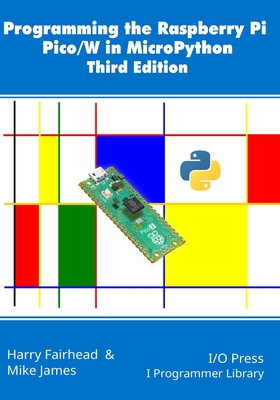
- 出版商: I/O Press
- 出版日期: 2025-07-24
- 售價: $2,130
- 貴賓價: 9.5 折 $2,023
- 語言: 英文
- 頁數: 396
- 裝訂: Quality Paper - also called trade paper
- ISBN: 1871962978
- ISBN-13: 9781871962970
-
相關分類:
Raspberry Pi
海外代購書籍(需單獨結帳)
商品描述
Reviews of previous editions
"This book is great, written by an engineer, showing you how to get around limitations of MicroPython. Has a good section on PIO, I2C, SPI and what to do when they don't work. have read most of the other books on Pi Pico, and this is by far the best."
This updated and expanded edition was prompted by the launch of the Pico 2 and Pico 2W which use a new chip, the RP2350, with significant improvements but also changes. This book therefore covers four devices, the new Pico 2 and its WiFi counterpart, the Pico 2W, as well as the original Pico and Pico W.
MicroPython is a good choice of language to program the Pico. It isn't the fastest way, but in most cases it is fast enough to interface with the Pico's hardware and its big advantage is that it is easy to use. As a high-level language, MicroPython is based on Python 3 and is fully object-oriented. This means that you can create classes to encapsulate hardware and makes it easier to use and understand. The purpose of the book is to reveal what you can do with the Pico's GPIO lines together with widely used sensors, servos, motors and ADCs. After covering the GPIO, outputs and inputs, events and interrupts, it gives you hands-on experience of PWM, the SPI bus, the I2C bus and the 1-Wire bus. One of the key advantages of the Pico is its PIO (Programmable I/O) and while this is an advanced feature, it is introduced in this book. After finding out how the PIO works, we apply it to writing a PIO program for the DHT22 and the 1-Wire bus. Three chapters are dedicated to how to make use of the additional features of the Pico W, including how to create a web client and a web server, use HTTPS and asyncio. Finally we look at more advanced hardware, Watchdog timer, file system, SDcard reader, using the second core and more. Jointly authored by Harry Fairhead and Mike James, this book combines Harry's expertise in electronics and the IoT with Mike's knowledge of Python. They have also collaborated on similar titles for the Raspberry Pi, the Raspberry Pi Compute Module 5 and the ESP 32. Harry Fairhead is also the author of Programming the Raspberry Pi Pico/W in C, Fundamental C: Getting Closer To The Machine and Applying C For The IoT With Linux. Mike James is the author of the Programmer's Python: Something Completely Different series of books which set out to show how Python diverges from other programming languages and how its special features deserve our attention and Extending and Embedding Python Using C in which he solves many of Python's speed-related problems.商品描述(中文翻譯)
前幾版的評價
「這本書很棒,由一位工程師撰寫,展示了如何克服 MicroPython 的限制。對於 PIO、I2C、SPI 以及當它們無法正常工作時該怎麼辦有很好的說明。我已經讀過大部分關於 Pi Pico 的其他書籍,而這本書無疑是最好的。」
這一更新和擴展的版本是因為 Pico 2 和 Pico 2W 的推出而促成的,這些新設備使用了新的晶片 RP2350,具有顯著的改進但也有變化。因此,本書涵蓋了四種設備,包括新的 Pico 2 及其 WiFi 版本 Pico 2W,以及原始的 Pico 和 Pico W。
MicroPython 是編程 Pico 的良好選擇。它不是最快的方式,但在大多數情況下,它足夠快速以與 Pico 的硬體介面連接,其最大的優勢是易於使用。作為一種高級語言,MicroPython 基於 Python 3,並且完全物件導向。這意味著你可以創建類來封裝硬體,使其更易於使用和理解。本書的目的是揭示你可以如何利用 Pico 的 GPIO 線與廣泛使用的感測器、伺服器、馬達和 ADC 進行互動。在介紹 GPIO、輸出和輸入、事件和中斷後,提供了 PWM、SPI 總線、I2C 總線和 1-Wire 總線的實作經驗。Pico 的一個關鍵優勢是其 PIO(可程式化 I/O),雖然這是一個進階功能,但在本書中有介紹。在了解 PIO 的運作後,我們將其應用於為 DHT22 和 1-Wire 總線編寫 PIO 程式。三個章節專門介紹如何利用 Pico W 的附加功能,包括如何創建網路客戶端和網路伺服器、使用 HTTPS 和 asyncio。最後,我們將探討更進階的硬體,如看門狗計時器、檔案系統、SD 卡讀取器、使用第二核心等。本書由 Harry Fairhead 和 Mike James 共同撰寫,結合了 Harry 在電子學和物聯網方面的專業知識以及 Mike 對 Python 的了解。他們還合作撰寫了 Raspberry Pi、Raspberry Pi Compute Module 5 和 ESP 32 的類似書籍。Harry Fairhead 也是 用 C 語言編程 Raspberry Pi Pico/W、基礎 C:更接近機器 和 在 Linux 上應用 C 於物聯網 的作者。Mike James 是 程序員的 Python:完全不同的東西 系列書籍的作者,該系列旨在展示 Python 如何與其他編程語言不同,以及其特殊功能值得我們關注,還有 使用 C 擴展和嵌入 Python,在其中他解決了許多與 Python 速度相關的問題。