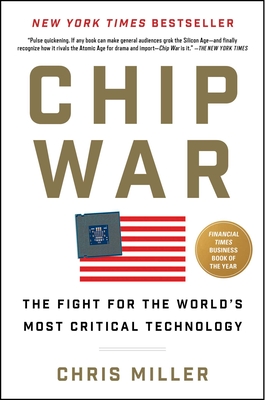
The Financial Times Business Book of the Year, this epic account of the decades-long battle to control one of the world's most critical resources--microchip technology--with the United States and China increasingly in fierce competition is "pulse quickening...a nonfiction thriller" (The New York Times). You may be surprised to learn that microchips are the new oil--the scarce resource on which the modern world depends. Today, military, economic, and geopolitical power are built on a foundation of computer chips. Virtually
everything--from missiles to microwaves--runs on chips, including cars, smartphones, the stock market, even the electric grid. Until recently, America designed and built the fastest chips and maintained its lead as the #1 superpower, but America's edge is in danger of slipping, undermined by players in Taiwan, Korea, and Europe taking over manufacturing. Now, as
Chip War reveals, China, which spends more on chips than any other product, is pouring billions into a chip-building initiative to catch up to the US. At stake is America's military superiority and economic prosperity.
Economic historian Chris Miller explains how the semiconductor came to play a critical role in modern life and how the US became dominant in chip design and manufacturing and applied this technology to military systems. America's victory in the Cold War and its global military dominance stems from its ability to harness computing power more effectively than any other power. Until recently, China had been catching up, aligning its chip-building ambitions with military modernization. Here, in this paperback edition of the book, the author has added intriguing new material focused on "America's Chip Comeback," which overviews the global consequences of the just passed CHIPS Act, the new export controls on China, and the effort to rally allies to better guard chip technology.
Illuminating, timely, and fascinating,
Chip War is "an essential and engrossing landmark study" (
The Times, London).
《金融時報》年度商業書籍,本書詳述了為控制全球最關鍵資源之一——微晶片技術而展開的數十年戰鬥,隨著美國和中國之間的激烈競爭,這是一部「令人心跳加速的...非虛構驚悚小說」(《紐約時報》)。
您可能會驚訝地發現,微晶片是新的石油——現代世界所依賴的稀缺資源。如今,軍事、經濟和地緣政治力量都是建立在電腦晶片的基礎上。幾乎「所有」事物——從導彈到微波爐——都依賴晶片運行,包括汽車、智慧型手機、股市,甚至電網。直到最近,美國設計和製造了最快的晶片,並保持其作為第一超級大國的領先地位,但美國的優勢正面臨滑落的危險,台灣、韓國和歐洲的製造商正在取代其地位。現在,正如《晶片戰爭》所揭示的,中國在晶片上的支出超過任何其他產品,正投入數十億美元於晶片建設計劃,以追趕美國。美國的軍事優越性和經濟繁榮正岌岌可危。
經濟歷史學家克里斯·米勒解釋了半導體如何在現代生活中扮演關鍵角色,以及美國如何在晶片設計和製造上取得主導地位,並將這項技術應用於軍事系統。美國在冷戰中的勝利及其全球軍事主導地位源於其比其他任何國家更有效地利用計算能力。直到最近,中國一直在追趕,將其晶片建設的雄心與軍事現代化相結合。在本書的平裝版中,作者新增了引人入勝的新材料,聚焦於「美國的晶片回歸」,概述了剛通過的《晶片法案》的全球影響、新的對中國的出口管制,以及努力團結盟友以更好地保護晶片技術。
《晶片戰爭》是一本啟發性、及時且引人入勝的作品,被譽為「一部必讀且引人入勝的里程碑研究」(《泰晤士報》,倫敦)。
Chris Miller is Professor of International History at the Fletcher School at Tufts University. He also serves as non-resident Senior Fellow at the American Enterprise Institute, and as a Director at Greenmantle, a New York and London-based macroeconomic and geopolitical consultancy. He is the author of three previous books--Putinomics, The Struggle to Save the Soviet Economy, and We Shall Be Masters--and he frequently writes for The New York Times, The Wall Street Journal, Foreign Affairs, Foreign Policy, The American Interest, and other outlets. He received a PhD in history from Yale University and a BA in history from Harvard University. Visit his website at ChristopherMiller.net and follow him on X @CRMiller1.