Handbook of Magnetism and Magnetic Materials
暫譯: 磁性與磁性材料手冊
Coey, Michael, Parkin, Stuart S. P.
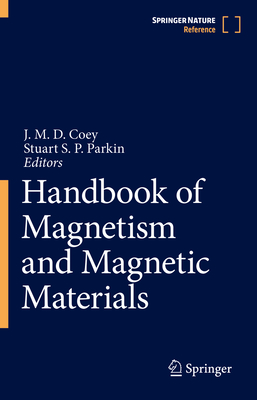
- 出版商: Springer
- 出版日期: 2021-10-07
- 售價: $41,000
- 貴賓價: 9.5 折 $38,950
- 語言: 英文
- 頁數: 1648
- 裝訂: Hardcover - also called cloth, retail trade, or trade
- ISBN: 3030632083
- ISBN-13: 9783030632083
-
相關分類:
電磁學 Electromagnetics
海外代購書籍(需單獨結帳)
相關主題

商品描述
This handbook presents a comprehensive survey of magnetism and magnetic materials. The dramatic advances in information technology and electromagnetic engineering make it necessary to systematically review the approved key knowledge and summarize the state of the art in this vast field within one seminal reference work. The book thus delivers up-to-date and well-structured information on a wealth of topics encompassing all fundamental aspects of the underlying physics and materials science, as well as advanced experimental methodology and applications. It features coverage of the host of fascinating and complex phenomena that arise from the use of magnetic fields in e.g. chemistry and biology.
Edited by two internationally renowned scholars and featuring authored chapters from leading experts in the field, Springer's Handbook of Magnetism and Magnetic Materials is an invaluable source of essential reference information for a broad audience of students, researchers, and magnetism professionals.商品描述(中文翻譯)
本手冊提供了磁性及磁性材料的全面調查。隨著資訊科技和電磁工程的劇烈進步,有必要系統性地回顧已獲批准的關鍵知識,並在這個廣泛領域內總結最新的技術狀態,形成一部重要的參考著作。因此,本書提供了最新且結構良好的資訊,涵蓋了所有基礎物理和材料科學的基本方面,以及先進的實驗方法和應用。它還涵蓋了在化學和生物學等領域中使用磁場所產生的一系列迷人且複雜的現象。
由兩位國際知名學者編輯,並包含來自該領域領先專家的章節,Springer的《磁性及磁性材料手冊》是學生、研究人員和磁性專業人士的重要參考資料來源。
作者簡介
Michael Coey was born in Belfast in 1945. He studied physics at Cambridge, and then taught English and Physics at the Sainik School, Balachadi (Gujarat) where he read Allan Morrish's Physical Principles of Magnetism from cover to cover (while suffering from jaundice) before moving to Canada in 1968 to join Morrish's group at the University of Manitoba for a PhD on Mossbauer spectroscopy of iron oxides. He has worked on magnetism ever since -- a life of paid play. On graduating in 1971, he took up a post-doc with Benoy Chakraverty's group at the CNRS in Grenoble with a letter of appointment signed by Louis Néel. There, he was appointed attaché and then chargé de recherche, studying the metal-insulator as well as the magnetism of amorphous solids and natural minerals. In France, he built a network of collaborators which sustained much of his career. A first sabbatical was with Stefan von Molnar at the IBM Thomas J Watson Research Center at Yorktown Heights where he learned about magneto-transport and specific heat and the crystal field. Then in 1979, he left France for Ireland taking a position of lecturer at Trinity College Dublin and set about establishing a magnetism research group in a venerable but woefully underfunded Physics Department. Luckily, he secured support from the EU substitution program and began work on melt-spun metallic glasses. After the discovery of Nd2Fe14B permanent magnets in 1982, together with colleagues from Grenoble, Birmingham and Berlin they launched the Concerted European Action on Magnets, which blossomed into an informal association of 90 academic and industrial research institutes interested in all aspects of the properties, processing and applications of rare-earth iron permanent magnets. Together with Sun Hong, he discovered the interstitial nitride magnet Sm2Fe17N3 in 1993, and his group investigated rare-earth intermetallic compounds, as well as magnetic oxide films produced by pulsed-laser deposition. During this period, he started up Magnetic Solutions with David Hurley in 1996 to develop innovative applications of permanent magnets. Then in 2000, the scientific landscape in Ireland was transformed by the creation of Science Foundation Ireland, with the ambition to develop scientific research and a budget to match. His group were able to develop a competitive research program in thin film magnetism and spin electronics. They produced Europe's first magnetic tunnel junctions to exhibit 200 % tunnel magnetoresistance, and later discovered the first zero-moment ferrimagnetic half-metal. He also developed an interest in magnetoelectrochemistry. He was a promotor of CRANN, Ireland's nanoscience research centre, and the Science Gallery, now an international franchise, was his brainchild. Together with Dominique Givord, he started the Joint European Magnetic Symposia (JEMS), and when chair of C9, the IUPAP Magnetism Commission, he inaugurated the Néel medal that is awarded at the triennial International Conference on Magnetism. The 2015 JEMS meeting in Dublin saw a reunion of many of his 60 PhD students, from all over the world. Together they have published many papers, and he has written several books, including Magnetic Glasses 1984 (with Kishin Moorjani), Permanent Magnetism 1999 (with Ralph Skomski) and Magnetism and Magnetic Materials 2010. Honours include Fellowship of the Royal Society, International membership of the US National Academy of Sciences, a Fulbright fellowship, a Humboldt Prize, the Gold Medal of the Royal Irish Academy and the 2019 Born Medal. Visiting professorships included the University of Strasbourg, the National University of Singapore and Beihang University in Beijing. Michael Coey married Wong May, a poet, in 1973; they have two sons.
Stuart Parkin is the Managing Director of the Max Planck Institute for Microstructure Physics, Halle, Germany, and an Alexander von Humboldt Professor, Martin Luther University, Halle-Wittenberg. His research interests include spintronic materials and devices for advanced sensor, memory, and logic applications, oxide thin-film heterostructures, topological metals, exotic superconductors, and cognitive devices. Parkin's discoveries in spintronics enabled a more than 10000-fold increase in the storage capacity of magnetic disk drives. For his work that thereby enabled the "big data" world of today, Parkin was awarded the Millennium Technology Award from the Technology Academy Finland in 2014 (worth 1,000,000 Euro). Parkin is a Fellow/ Member of: Royal Society (London), Royal Academy of Engineering, National Academy of Sciences, National Academy of Engineering, German National Academy of Science - Leopoldina, Royal Society of Edinburgh, Indian Academy of Sciences, and TWAS - academy of sciences for the developing world and has received numerous awards from around the world.
作者簡介(中文翻譯)
邁克爾·科伊於1945年出生於貝爾法斯特。他在劍橋大學學習物理,然後在巴拉查迪(古吉拉特)的Sainik School教授英語和物理,期間他在患有黃疸的情況下通讀了艾倫·莫里什的磁性物理原理,並於1968年移居加拿大,加入莫里什在曼尼托巴大學的團隊,攻讀有關鐵氧化物的莫斯堡光譜學博士學位。自那時起,他便一直從事磁性研究,過著有薪的遊戲生活。1971年畢業後,他在格勒諾布爾的法國國家科學研究中心(CNRS)與貝諾伊·查克拉瓦提的團隊進行博士後研究,任命信由路易·內爾簽署。在那裡,他被任命為隨員,然後成為研究負責人,研究金屬-絕緣體以及非晶固體和天然礦物的磁性。在法國,他建立了一個合作網絡,支持了他職業生涯的大部分。第一次休假是在IBM托馬斯·J·沃森研究中心與斯特凡·馮·莫爾納合作,在那裡他學習了磁輸運、比熱和晶場。然後在1979年,他離開法國前往愛爾蘭,擔任都柏林三一學院的講師,並著手在一個歷史悠久但資金不足的物理系建立一個磁性研究小組。幸運的是,他獲得了歐盟替代計劃的支持,開始研究熔融旋轉金屬玻璃。1982年發現Nd2Fe14B永磁體後,他與來自格勒諾布爾、伯明翰和柏林的同事們啟動了歐洲磁性協作行動,這發展成為一個非正式的協會,涵蓋90個學術和工業研究機構,專注於稀土鐵永磁體的性質、加工和應用的各個方面。1993年,他與孫宏共同發現了間隙氮化物磁體Sm2Fe17N3,他的團隊研究了稀土金屬間化合物,以及通過脈衝激光沉積產生的磁性氧化物薄膜。在此期間,他於1996年與大衛·赫利創立了磁性解決方案公司,開發永磁體的創新應用。2000年,愛爾蘭的科學景觀因愛爾蘭科學基金會的成立而發生變化,該基金會旨在發展科學研究並提供相應的預算。他的團隊能夠在薄膜磁性和自旋電子學方面開展具有競爭力的研究計劃。他們生產了歐洲首個展現200%隧道磁阻的磁性隧道接合器,並後來發現了首個零矩鐵磁半金屬。他還對磁電化學產生了興趣。他是愛爾蘭納米科學研究中心CRANN的推動者,科學畫廊(現已成為國際特許經營)是他的創意。與多米尼克·吉沃德合作,他啟動了歐洲聯合磁性研討會(JEMS),並在擔任IUPAP磁性委員會C9主席時,創立了在三年一次的國際磁性會議上頒發的內爾獎。2015年在都柏林舉行的JEMS會議上,許多來自世界各地的60位博士生重聚。他們共同發表了許多論文,他也撰寫了幾本書,包括磁性玻璃1984(與基辛·穆爾賈尼合著)、永磁性1999(與拉爾夫·斯科姆斯基合著)和磁性與磁性材料2010。榮譽包括英國皇家學會院士、美國國家科學院國際會員、富布賴特獎學金、洪堡獎、愛爾蘭皇家學院金獎和2019年博恩獎。訪問教授職位包括斯特拉斯堡大學、新加坡國立大學和北京的北航。邁克爾·科伊於1973年與詩人黃梅結婚;他們有兩個兒子。
斯圖爾特·帕金是德國哈雷馬克斯·普朗克微結構物理研究所的董事總經理,也是哈雷-維滕堡馬丁·路德大學的亞歷山大·馮·洪堡教授。他的研究興趣包括用於先進傳感器、記憶體和邏輯應用的自旋電子材料和器件、氧化物薄膜異質結構、拓撲金屬、奇異超導體和認知設備。帕金在自旋電子學方面的發現使磁碟驅動器的存儲容量增加了超過10000倍。因為他的工作使今天的「大數據」世界成為可能,帕金於2014年獲得芬蘭科技學院的千年科技獎(價值100萬歐元)。帕金是以下機構的院士/成員:英國皇家學會(倫敦)、皇家工程學院、美國國家科學院、美國國家工程學院、德國國家科學院-萊奧波爾丁娜、愛丁堡皇家學會、印度科學院和TWAS(發展中國家的科學院),並獲得了來自世界各地的多項獎項。


