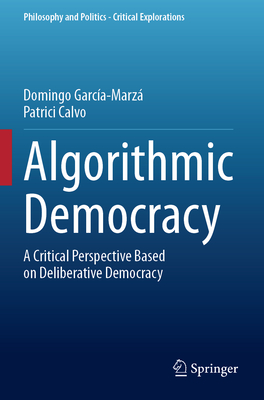
Algorithmic Democracy: A Critical Perspective Based on Deliberative Democracy
暫譯: 算法民主:基於審議民主的批判性視角
García-Marzá, Domingo, Calvo, Patrici
相關主題

商品描述
Based on a deliberative democracy, this book uses a hermeneutic-critical methodology to study bibliographical sources and practical issues in order to analyse the possibilities, limits and consequences of the digital transformation of democracy. Drawing on a two-way democracy, the aim of this book is intended as an aid for thinking through viable alternatives to the current state of democracy with regard to its ethical foundations and the moral knowledge implicit in or assumed by the way we perceive and understand democracy. It is intended to stimulate reflection and discussion on the basis that, by addressing what we understand as democracy, we can inevitably influence the reality known as democracy. Democracy's evident regression in today's world makes this all too apparent: it has become a hostage to all kinds of autocracies and technopopulisms, which are supported to a greater or lesser extent by the current algorithmic revolution.
商品描述(中文翻譯)
基於審議民主,本書採用詮釋批判的方法論來研究書目來源和實際問題,以分析民主數位轉型的可能性、限制和後果。本書的目標是基於雙向民主,旨在幫助思考可行的替代方案,以應對當前民主狀態,特別是其倫理基礎以及我們對民主的理解和認知中隱含或假設的道德知識。它旨在激發反思和討論,因為通過探討我們所理解的民主,我們不可避免地會影響被稱為民主的現實。當今世界民主的明顯倒退使這一點變得尤為明顯:它已成為各種專制主義和技術民粹主義的人質,而這些現象在不同程度上受到當前算法革命的支持。
作者簡介
Domingo García-Marzá is Professor of Ethics at the Universitat Jaume I of Castellón (Spain). He has extended his studies on Politics in Frankfurt (Germany) and on Economic Ethics at St. Gallen (Switzerland), at the Notre Dame University (USA), at Magee College of the University of Ulster (Northern Ireland), at Bologna University (Italy) and at Porto University (Portugal). His research lines include:
His areas of research cover topics of great relevance in the field of ethics and political philosophy, such as dialogic digital ethics, deliberative democracy, institutional design, business ethics, civil society and critical hermeneutics.
Among his most outstanding works are "Ethics of Justice: J. Habermas and discursive ethics" (1992), "Theory of democracy" (1993), "Business ethics: from dialogue to trust" (2004), "Integrating the ethical perspective: methods, cases, levels in business and management" (2005, in collaboration with Martin Büscher and Hans de Geer), "Business ethics: Claves para una nueva cultura empresarial" (1994, in collaboration with Adela Cortina, Jesús Conill and Agustín Domingo), "La empresa socialmente responsable: Ética y empresa" (2003) and "Razón pública y éticas aplicadas" (2003, edited together with A. Cortina).
His recent work has focused on the digital transformation of the different functional spheres of society. Especially in the design of a dialogical digital ethics to guide and critique the design, application and use of intelligent technology, in the development of an ethical infrastructure for the governance of artificial intelligence in institutions, organisations and companies, and in the critique of algorithmic democracy.
Patrici Calvo is Full Professor of Ethics at the Universitat Jaume I of Castellón (Spain), where he teaches Roboethics, Bioethics, Economic and Business Ethics and Philosophy of Science and New Technology. In addition, he has carried out research stays insome of the leading international centres, such as the University of Oxford, the University of Bologna, and the Institute of Philosophy of CSIC.
His work has focused on five main lines of research in the field of the Ethics of Artificial Intelligence and Digital Transformation and Economic and Business Ethics. Firstly, in the theoretical and practical development of a proposal for an economy that, through the design or redesign of institutions, organisations and companies, iscapable of widely deploying reciprocity to promote fairer, more responsible and happier economic growth and development. Secondly, in the design and application of cybernetic ecosystems that enable a morally valid and socially responsible digital transformation of the different functional spheres of society (health, politics, economy, etc.). Thirdly, in an applied roboethics proposal capable of guiding professional practice with a sense of justice and addressing the current ethical challenges of the design, application and use of artificially intelligent machines. Fourthly, in the theoretical and practical development of an algorithmic democracy that meets the expectations of today's society. Finally, fifthly, in the design of an ethical governance infrastructure for artificial intelligence in the field of scientific research.The work developed in these five main lines of research has resulted in the publication of two books as author: The Cordial Economy. Ethics, Recognition and Reciprocity (Springer, 2018) and Algorithmic democracy: A critical perspective based on deliberative democracy (Springer, 2024), one book as editor: Moral neuroeducation for a Democratic and pluralistic society (Springer, 2020), as well as multiple articles on the Ethics of Artificial Intelligence and digital transformation in scientific journals indexed in Clarivate and Scopus.
作者簡介(中文翻譯)
Domingo García-Marzá 是西班牙卡斯特利翁的哈梅大學(Universitat Jaume I)倫理學教授。他曾在德國法蘭克福進行政治學研究,並在瑞士聖加倫、 美國聖母大學、北愛爾蘭阿爾斯特大學的梅基學院、意大利博洛尼亞大學和葡萄牙波爾圖大學進行經濟倫理學的研究。他的研究方向包括:
他的研究領域涵蓋倫理學和政治哲學中極具相關性的主題,如對話數位倫理、審議民主、制度設計、商業倫理、公民社會和批判詮釋學。
他最突出的著作包括《正義倫理:J. 哈貝馬斯與話語倫理》(1992)、《民主理論》(1993)、《商業倫理:從對話到信任》(2004)、《整合倫理視角:商業與管理中的方法、案例、層次》(2005,與馬丁·比許(Martin Büscher)和漢斯·德·基爾(Hans de Geer)合作)、《商業倫理:企業文化的新關鍵》(1994,與阿黛拉·科爾蒂納(Adela Cortina)、耶穌·科尼爾(Jesús Conill)和阿古斯丁·多明戈(Agustín Domingo)合作)、《社會責任企業:倫理與企業》(2003)以及《公共理性與應用倫理》(2003,與A. 科爾蒂納共同編輯)。
他最近的工作集中在社會不同功能領域的數位轉型上。特別是在設計對話式數位倫理,以指導和批判智能技術的設計、應用和使用,發展人工智慧在機構、組織和企業治理中的倫理基礎設施,以及對算法民主的批判。
Patrici Calvo 是西班牙卡斯特利翁的哈梅大學(Universitat Jaume I)倫理學全職教授,教授機器人倫理學、生物倫理學、經濟與商業倫理學以及科學與新技術哲學。此外,他還在一些國際頂尖中心進行過研究,如牛津大學、博洛尼亞大學和西班牙國家科學研究委員會的哲學研究所。
他的工作集中在人工智慧倫理、數位轉型以及經濟與商業倫理領域的五個主要研究方向。首先,在理論和實踐上發展一個經濟提案,通過設計或重新設計機構、組織和企業,能夠廣泛推動互惠,以促進更公平、更負責任和更幸福的經濟增長與發展。其次,在設計和應用控制論生態系統,使不同功能領域的社會(健康、政治、經濟等)能夠實現道德有效和社會負責的數位轉型。第三,在應用機器人倫理的提案中,能夠以正義感指導專業實踐,並應對當前設計、應用和使用人工智能機器的倫理挑戰。第四,在理論和實踐上發展一個符合當今社會期望的算法民主。最後,第五,在科學研究領域設計人工智慧的倫理治理基礎設施。
在這五個主要研究方向上所開展的工作,已經導致兩本書的出版,作為作者的有《和諧經濟:倫理、認可與互惠》(Springer, 2018)和《算法民主:基於審議民主的批判視角》(Springer, 2024),作為編輯的有《為民主和多元社會的道德神經教育》(Springer, 2020),以及在Clarivate和Scopus索引的科學期刊上發表的多篇有關人工智慧倫理和數位轉型的文章。