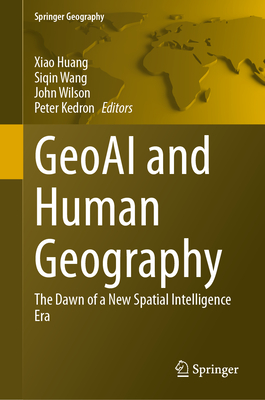
Geoai and Human Geography: The Dawn of a New Spatial Intelligence Era (Hardcover)
暫譯: GeoAI 與人文地理學:嶄新空間智慧時代的黎明(精裝)
Huang, Xiao, Wang, Siqin, Wilson, John
- 出版商: Springer
- 出版日期: 2025-07-31
- 售價: $7,500
- 語言: 英文
- 頁數: 413
- 裝訂: Hardcover - also called cloth, retail trade, or trade
- ISBN: 303187420X
- ISBN-13: 9783031874208
-
相關分類:
地理資訊系統 Gis、Machine Learning、Computer Vision
下單後立即進貨 (約3週~4週)
相關主題


商品描述
This volume outlines a comprehensive journey into how geospatial artificial intelligence (GeoAI) is reshaping our understanding of people and places. Merging traditional geographic inquiry with AI technologies, it offers a holistic view of digital tools and advanced algorithms that redefine human geography. Across twenty‐eight chapters, the book chronicles the evolution of geographic thought into the GeoAI era. Innovative methodologies--from explainable spatial analysis and natural language processing to human-centered computer vision and high-performance computing--reveal new patterns and relationships beyond conventional approaches. Each contribution highlights both technical strides in data processing and enriched perspectives on cultural, economic, political, health, and urban studies. Showcasing diverse applications in disaster management, climate change adaptation, and urban planning, the volume demonstrates GeoAI's transformative potential. It also engages with ethical, sustainable, and social challenges, emphasizing that technological innovation must serve real-world impacts and inclusivity. Ideal for researchers, students, and practitioners alike, this volume invites you to explore new frontiers at the intersection of technology and human experience.
商品描述(中文翻譯)
本書全面概述地理空間人工智慧(geospatial artificial intelligence, GeoAI)如何重塑我們對人與地方的理解。透過結合傳統地理探究與 AI 技術,本書完整呈現重新定義人文地理學的數位工具與進階演算法。全書共二十八章,記錄地理思想邁入 GeoAI 時代的演進歷程。從可解釋空間分析(explainable spatial analysis)與自然語言處理,到以人為本的電腦視覺與高效能運算,這些創新方法揭示了超越傳統途徑的新模式與新關聯。每篇內容不僅展現資料處理方面的技術進展,也拓展了文化、經濟、政治、健康與都市研究的觀點。
本書展示 GeoAI 在災害管理、氣候變遷調適與都市規劃等領域的多元應用,彰顯其帶來轉型的潛力。同時,本書也探討倫理、永續與社會層面的挑戰,強調技術創新必須服務於真實世界的影響與包容性。無論是研究人員、學生或實務工作者,都能從本書探索科技與人類經驗交會處的新疆域。
作者簡介
Dr. Xiao Huang is an Assistant Professor in the Department of Environmental Sciences at Emory University. His research expertise encompasses human-environment interaction, computational social sciences, urban informatics, disaster mapping and mitigation, GeoAI, and disaster remote sensing. He has contributed extensively to his field, authoring over 200 peer-reviewed journal articles, and over 20 book chapters, and playing a pivotal role in editing five books. He is among the World's Top 2% Scientists by Stanford/Elsevier's rankings. In his professional capacity, he serves as an Associate Editor for Computational Urban Science and is a member of the Editorial Board for several prestigious journals. His research has garnered significant attention and received coverage in renowned media outlets such as Nature News, NASA, NBC, and Fox. His work has attracted substantial funding from NSF, NASA, the Bill & Melinda Gates Foundation, the National Academies, and the Centers for Medicare and Medicaid Services.
Dr. Siqin Wang is an Associate Professor at the Spatial Sciences Institute, University of Southern California. She holds affiliated research roles as a Research Associate at Harvard Center for Geographic Analysis, an Adjunct Senior Lecturer at the Royal Melbourne Institute of Technology and the University of Queensland, Australia, and a JSPS Research Fellow at the University of Tokyo, Japan. She is a human geographer and spatial scientist, specializing in human-environment interactions and computational social science, where she has 80+ publications. Her work has earned international recognition via funds from Australia, the U.S., China, Japan, and Morocco; and awards including the 2024 Geospatial World 50 Rising Stars, 2024 IGU- MGSC Excellent Young Scholar Award, and the 2021 Top 20 Global Frontier Technology Young Scientist Award. Her professional roles include serving as Associate Chair of the Spatial Data Lab at Harvard CGA, Vice Chair of the Young Scientist Innovation Network for the International Society for Digital Earth, and an editorial board member, guest editor, and peer reviewer for over 30 international journals.
Dr. Peter Kedron is an Associate Professor of Geography at the University of California Santa Barbara and the Associate Director of the Center for Spatial Studies and Data Science. His research develops and uses spatial analytical methods to explain geographic variation in social and ecological processes. His recent work focuses on the use of replication as a means of evaluating geographic research, and on developing statistical approaches to improve the accumulation of evidence collected from different locations. To date, he has authored over 55 peer-reviewed articles, given over 100 conference presentations and public talks, and supervised over 20 graduate students and post-doctoral scholars. He has been consistently funded by the National Science Foundation and appears in publications in top field journals in Geography, GIScience, and Regional Science.
Dr. John P. Wilson is a Professor of Sociology and Spatial Sciences in the Dana and David Dornsife College of Letters, Arts and Sciences at the University of Southern California where he directs the Spatial Sciences Institute and the Wilson Map Lab. He also holds appointments as Professor in the School of Architecture, in the Keck School of Medicine of USC's Department of Population and Public Health Sciences, and in the Viterbi School of Engineering's Departments of Computer Science and Civil and Environmental Engineering. He currently serves as Editor-in-Chief for Transactions in GIS and the UCGIS GIST Body of Knowledge project. His research focuses on the modeling of coupled human and environmental systems and makes extensive use of GIS, spatial analysis, and computer models. He has published numerous books and articles on these topics, including Spatial Data Science, Environmental Applications of Digital Terrain Modeling, and two edited volumes, i.e. Terrain Analysis: Principles and Applications and the Handbook of Geographic Information Science.
作者簡介(中文翻譯)
Dr. Xiao Huang 是 Emory University 環境科學系助理教授。他的研究專長涵蓋人類—環境互動、計算社會科學、都市資訊學、災害製圖與減災、GeoAI,以及災害遙測。他在該領域貢獻卓著,已發表超過 200 篇經同儕審查的期刊論文、20 多篇書籍章節,並在五本書的編輯工作中發揮關鍵作用。根據 Stanford/Elsevier 的排名,他名列全球前 2% 科學家。在專業職務方面,他擔任 Computational Urban Science 副主編,並為多本知名期刊的編輯委員會成員。他的研究受到廣泛關注,Nature News、NASA、NBC 和 Fox 等知名媒體皆曾報導相關成果。他的研究也獲得 NSF、NASA、Bill & Melinda Gates Foundation、National Academies,以及 Centers for Medicare and Medicaid Services 的大量資助。
Dr. Siqin Wang 是 University of Southern California Spatial Sciences Institute 副教授。她同時擔任多項研究職務,包括 Harvard Center for Geographic Analysis 研究助理、澳洲 Royal Melbourne Institute of Technology 與 University of Queensland 兼任高級講師,以及日本 University of Tokyo 的 JSPS 研究員。她是一名人文地理學家與空間科學家,專長為人類—環境互動與計算社會科學,已發表 80 多篇出版品。她的研究獲得國際肯定,並曾取得來自澳洲、美國、中國、日本與摩洛哥的研究資助;所獲獎項包括 2024 Geospatial World 50 Rising Stars、2024 IGU-MGSC Excellent Young Scholar Award,以及 2021 Top 20 Global Frontier Technology Young Scientist Award。她的專業職務包括擔任 Harvard CGA Spatial Data Lab 副主席、International Society for Digital Earth Young Scientist Innovation Network 副主席,以及超過 30 本國際期刊的編輯委員、客座編輯與同儕審查者。
Dr. Peter Kedron 是 University of California Santa Barbara 地理學副教授,也是 Center for Spatial Studies and Data Science 副主任。他的研究透過發展與運用空間分析方法,解釋社會與生態過程在地理上的差異。他近期的研究聚焦於運用重現研究(replication)評估地理學研究,以及發展統計方法,以改善不同地點所蒐集證據的累積與整合。截至目前,他已發表超過 55 篇經同儕審查的論文,進行超過 100 場研討會發表與公開演講,並指導超過 20 名研究生與博士後研究學者。他持續獲得 National Science Foundation 的研究資助,研究成果也發表於 Geography、GIScience 與 Regional Science 領域的頂尖期刊。
Dr. John P. Wilson 是 University of Southern California Dana and David Dornsife College of Letters, Arts and Sciences 社會學與空間科學教授,並主持 Spatial Sciences Institute 與 Wilson Map Lab。他同時擔任 School of Architecture 教授、USC Keck School of Medicine Department of Population and Public Health Sciences 教授,以及 Viterbi School of Engineering Department of Computer Science 與 Department of Civil and Environmental Engineering 教授。目前,他擔任 Transactions in GIS 主編,以及 UCGIS GIST Body of Knowledge 計畫的主編。他的研究聚焦於人類與環境耦合系統的建模,並廣泛運用 GIS、空間分析與電腦模型。他已針對這些主題出版多本書籍並發表多篇文章,包括 Spatial Data Science、Environmental Applications of Digital Terrain Modeling,以及兩本編著作品 Terrain Analysis: Principles and Applications 與 Handbook of Geographic Information Science。