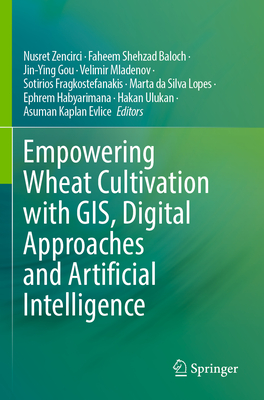
Empowering Wheat Cultivation with Gis, Digital Approaches and Artificial Intelligence
暫譯: 運用 GIS、數位方法與人工智慧提升小麥栽培效能
Zencirci, Nusret, Baloch, Faheem Shehzad, Gou, Jin-Ying
- 出版商: Springer
- 出版日期: 2026-10-02
- 售價: $8,260
- 貴賓價: 9.5 折 $7,847
- 語言: 英文
- 頁數: 297
- 裝訂: Quality Paper - also called trade paper
- ISBN: 3031999568
- ISBN-13: 9783031999567
-
相關分類:
地理資訊系統 Gis、Machine Learning
海外代購書籍(需單獨結帳)
相關主題

商品描述
The global population is projected to exceed 9 billion by 2050, leading to imminent food shortages not only for the current but also future generations. Anticipated increases in appetite coming 50 years will pose significant challenges to food production. This demand will exert additional pressure on agriculture for the escalating need for food. On one hand, research indicates a 60% increase in food production is necessary to accommodate the projected 9 billion people, on the other hand, a substantial portion of the population is grappling with various micronutrient deficiencies, such as iron, zinc, iodine, vitamin A, and folic acid, a condition referred to as "hidden hunger." Hence, it is imperative to exert substantial efforts towards developing improved cultivars under enhanced technological conditions.
Concerns about climate change are anticipated to profoundly affect soil water availability, carbon storage, and crop yields. Droughts in the Mediterranean and Africa are expected to worsen during certain seasons. Each year, climate change leads to substantial losses in agricultural production, with a worsening scenario in the future.
Wheat breeding has witnessed significant advancements with the wheat genomics, whole-genome sequencing, high-throughput phenotyping, genome-editing technologies, and marker-assisted breeding. These enable genome-based breeding to produce higher enough yielding by 2050. Speed breeding has a crucial role in the incorporation of new genes into breeding pipelines, facilitating the creation of innovative homozygous advanced lines, and accelerating the identification and functional characterization of new genes.
Climate change and recent technological advancements necessitate efficient utilization of remote sensing, digital tools, and artificial intelligence approaches, have gained prominence in wheat agriculture. This book aims to encompass both past and upcoming research activities in this domain. It serves as a valuable resource for wheat breeders interested in leveraging modern data technologies in their research endeavours.
商品描述(中文翻譯)
預計到 2050 年,全球人口將超過 90 億,這將導致迫在眉睫的糧食短缺問題,不僅影響當代,也將影響未來世代。未來 50 年預期增加的糧食需求,將對糧食生產帶來重大挑戰。這項需求將因日益增加的糧食需求,對農業施加更大的壓力。一方面,研究顯示,為因應預計達到 90 億的人口,糧食產量必須增加 60%;另一方面,全球相當大比例的人口正面臨各種微量營養素缺乏問題,例如鐵、鋅、碘、維生素 A 與葉酸缺乏,這種情況稱為「隱性飢餓」(hidden hunger)。因此,在更先進的技術條件下,投入大量努力培育改良品種至關重要。
預計氣候變遷將對土壤水分可利用性、碳儲存量及作物產量造成深遠影響。地中海地區與非洲的乾旱情況,預期將在某些季節進一步惡化。氣候變遷每年都會造成農業生產的重大損失,而且未來情勢可能更加嚴峻。
隨著小麥基因體學(wheat genomics)、全基因體定序(whole-genome sequencing)、高通量表型分析(high-throughput phenotyping)、基因體編輯技術(genome-editing technologies)及標誌輔助育種(marker-assisted breeding)的發展,小麥育種已取得重大進展。這些技術使以基因體為基礎的育種成為可能,並有望在 2050 年前培育出產量足夠高的品種。快速育種(speed breeding)在將新基因導入育種流程中扮演關鍵角色,有助於創造創新的純合進階品系、加速新基因的鑑定與功能特性分析。
氣候變遷與近期的技術進展,使遙測(remote sensing)、數位工具及人工智慧(artificial intelligence)方法在小麥農業中的有效運用日益受到重視。本書旨在涵蓋此領域過去與未來的研究活動,並為有意在研究工作中運用現代資料技術的小麥育種家提供寶貴的參考資源。
作者簡介
Nusret Zencirci, a Çukurova University graduate, worked as a wheat breeder in Central Research Institute for Field Crops, Ankara and served as National and International Coordinator to wheat programs. He was a molecular biology professor at Bolu Abant İzzet Baysal University, Türkiye. He is a member of various editorial boards, breeder of twenty-two wheat cultivars. His research interests are cereals, biotic and abiotic stresses, and plant genetic resources.
FaheemShehzad Baloch is plant genetics and genomics Professor at Mersin University, Türkiye, with a dissertation on 'QTL mapping in wheat'. He has more than ten years of teaching and research experience. He contributed to projects and co-supervised MSC, PhD and postdoc candidates. He has over 120 WOS publications, co-edited 6 books and written over fourteen book chapters. He has over 3800 google scholar citations (h-Index of thirty-two. He serves as editorial board member of many impacted journals in WOS.
Jin-Ying Gou, a China Agricultural University professor, has more than ten years of teaching and research experience in wheat genetics, metabolomics, and biotechnology. He led many projects. He supervised over 30 MSC, PhD, and postdoc candidates. He is serving as an Editorial Board member for BMC Plant Biology, Molecular Breeding, and Wheat Omics. He has more than 40 SCI publications in WOS and over three thousand in Google Scholar.
Velimir Mladenov, an University of Novi Sad, Serbia professor, currently coordinates Horizon Europe project called ClimaPannonia and develops global expertise collaborations -such as COST actions, where he serves in ReCrop: Reproductive Enhancement of CROP resilience to extreme climate CA22157 as a Science Communication Coordinator. He supervises seven Serbian and Kazakhstan PhD and some MSc and BSc students. He has published widely in the areas of crop genetics, plant breeding in wheat and corn mostly.
Sotirios Fragkostefanakis, a heat stress biologist, leads the Plant Molecular and Cell Biology group at Goethe University Frankfurt. Over the past decade, he has coordinated and contributed to international research initiatives, being the Chair of the COST Action RECROP. His group utilizes advanced approaches in transcriptomics, proteomics, and genome engineering, with a strong emphasis on tomato as a model system. He has authored over forty peer-reviewed publications.
Marta da Silva Sabino Lopes, head of the Sustainable Field Crops Program at the Institute of Agrifood Research and Technology (IRTA) in Lleida, Spain. She has led efforts to automate and digitize breeding pipelines and phenotyping protocols across multiple experimental stations, significantly improving the efficiency and cost-effectiveness of large-scale research programs. She has authored over 50 SCI-indexed publications, contributed to book chapters, and participates in national and EU-funded projects. She currently supervises seven Ph.D. students and a postdoctoral.
Ephrem Habyarimana leading ICRISAT sorghum breeding with more than 25 years of experience in sorghum science, genetics, and plant breeding, he integrates diverse technologies and skills i.e., agroecological and genomic modelling, big data analytics e.g., phenomics, genomics for the sustainable, resilient, cost-effective, environment and biodiversity friendly crop improvement. He was the finalist for the 2019 European DataSci & Artificial Intelligence Awards.
Hakan Ulukan is a graduate of Ankara University, Türkiye. He serves in Field Crops Department in Ankara, Spain, Bosna-Herzegovina at the Erasmus+ Universities at various levels. He also contributes various high-impact scientific national and international journals' at different levels. Meantime, stress types on field crops, plant genetic resources, and wheat land races are among his interests.
Asuman Kaplan Evlice, an Associate Professor at Sivas University of Science and Technology, Türkiye, is specialized in quality. She has published articles and authored book chapters on cereal technology and sustainable agriculture. Additionally, she supervises graduates in agricultural sciences. Her experience contains programs and scholarships in Germany and Italy. She researched in food science, plant breeding, and agricultural technology.
作者簡介(中文翻譯)
Nusret Zencirci 畢業於 Çukurova University,曾任職於安卡拉的 Central Research Institute for Field Crops,擔任小麥育種家,並出任小麥計畫的國家及國際協調員。他曾任土耳其 Bolu Abant İzzet Baysal University 分子生物學教授。目前是多個編輯委員會的成員,並培育出 22 個小麥品種。他的研究興趣包括穀類作物、生物性與非生物性逆境,以及植物遺傳資源。
FaheemShehzad Baloch 是土耳其 Mersin University 的植物遺傳學與基因體學教授,博士論文主題為「小麥中的 QTL 定位」。他擁有超過 10 年的教學與研究經驗,參與多項研究計畫,並共同指導 MSC、PhD 與博士後研究人員。他在 WOS 收錄期刊發表超過 120 篇論文,共同編輯 6 本書,並撰寫超過 14 篇書籍章節。他在 Google Scholar 上獲得超過 3,800 次引用,h-index 為 32。他也擔任許多 WOS 收錄高影響力期刊的編輯委員。
Jin-Ying Gou 是 China Agricultural University 的教授,在小麥遺傳學、代謝體學與生物技術領域擁有超過 10 年的教學與研究經驗。他主持過多項研究計畫,並指導超過 30 名 MSC、PhD 與博士後研究人員。目前擔任 BMC Plant Biology、Molecular Breeding 與 Wheat Omics 的編輯委員。他在 WOS 收錄的 SCI 期刊發表超過 40 篇論文,並在 Google Scholar 上獲得超過 3,000 次引用。
Velimir Mladenov 是塞爾維亞 University of Novi Sad 的教授,目前負責協調 Horizon Europe 計畫 ClimaPannonia,並推動全球專業合作,例如 COST actions。他在 ReCrop:Reproductive Enhancement of CROP resilience to extreme climate(CA22157)中擔任科學傳播協調員。他指導 7 名來自塞爾維亞與哈薩克的 PhD 學生,以及部分 MSc 與 BSc 學生。他主要在作物遺傳學,以及小麥與玉米的植物育種領域發表了大量研究成果。
Sotirios Fragkostefanakis 是熱逆境生物學家,領導 Goethe University Frankfurt 的植物分子與細胞生物學研究團隊。在過去 10 年間,他協調並參與多項國際研究計畫,並擔任 COST Action RECROP 的主席。他的研究團隊採用轉錄體學、蛋白質體學與基因體工程等先進方法,並特別以番茄作為模式系統。他已發表超過 40 篇同儕審查論文。
Marta da Silva Sabino Lopes 是西班牙 Lleida 的 Institute of Agrifood Research and Technology(IRTA)永續旱作物計畫主管。她曾主導多個實驗站的育種流程與表型鑑定程序自動化及數位化工作,大幅提升大型研究計畫的效率與成本效益。她已發表超過 50 篇 SCI 收錄論文,參與撰寫書籍章節,並參與國家及 EU 資助的研究計畫。目前她指導 7 名 Ph.D. 學生及 1 名博士後研究人員。
Ephrem Habyarimana 領導 ICRISAT 的高粱育種工作,在高粱科學、遺傳學與植物育種領域擁有超過 25 年經驗。他整合多種技術與專業,包括農業生態與基因體建模,以及大數據分析,例如表型體學與基因體學,以推動永續、具韌性、具成本效益,並兼顧環境與生物多樣性友善的作物改良工作。他曾入選 2019 European DataSci & Artificial Intelligence Awards 決選名單。
Hakan Ulukan 畢業於土耳其 Ankara University。他曾在安卡拉、西班牙及波士尼亞與赫塞哥維納的 Erasmus+ 大學中,於不同層級從事 Field Crops Department 相關工作。他也以不同身分參與多份國內與國際高影響力科學期刊的工作。此外,旱作物逆境類型、植物遺傳資源與小麥地方品種也是他的研究興趣。
Asuman Kaplan Evlice 是土耳其 Sivas University of Science and Technology 的副教授,專長為品質研究。她曾發表穀物技術與永續農業相關論文,並撰寫書籍章節。此外,她也指導農業科學領域的研究生。她曾參與德國與義大利的研究計畫及獎學金計畫,研究領域涵蓋食品科學、植物育種與農業技術。







.jpg)


