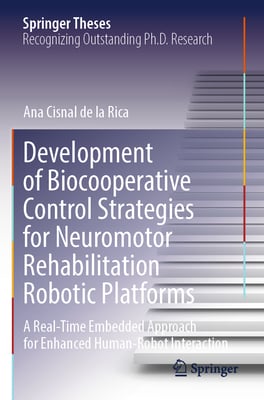
Development of Biocooperative Control Strategies for Neuromotor Rehabilitation Robotic Platforms: A Real-Time Embedded Approach for Enhanced Human-Rob
暫譯: 神經動作復健機器人平台的生物協同控制策略開發:提升人機互動的即時嵌入式方法
Cisnal de la Rica, Ana
- 出版商: Springer
- 出版日期: 2026-08-27
- 售價: $6,820
- 貴賓價: 9.5 折 $6,479
- 語言: 英文
- 頁數: 78
- 裝訂: Quality Paper - also called trade paper
- ISBN: 3032024870
- ISBN-13: 9783032024879
-
相關分類:
控制系統 Control-systems、感測器 Sensor、嵌入式系統
海外代購書籍(需單獨結帳)
相關主題

商品描述
This book presents the development of a multimodal physiological signal acquisition system and cooperative control strategies for applications in upper-limb robotic rehabilitation. First, it introduces a non-pattern recognition EMG-based platform for hand rehabilitation, demonstrating its strong performance in both gesture recognition accuracy and responsiveness. It also discusses the role of EMG-based visual feedback, showing how real-time visualization of muscle activation enhances user performance during training. In turn, it reports on the validation of a low-cost multimodal acquisition solution using two different real-time biocooperative control strategies. The results demonstrate that the developed low-cost wearable platform, which integrates multiple sensors, wireless communication, and a high-efficiency real-time microcontroller, is highly versatile and configurable, and shows a good signal quality. By addressing two main aspects that limit the adoption of biocooperative systems in clinical rehabilitation settings - hardware affordability and system reliability - this outstanding PhD thesis paves the way to the implementation of real-time biocooperative controls for future applications in robotic rehabilitation.
商品描述(中文翻譯)
本書介紹用於上肢機器人復健應用的多模態生理訊號擷取系統開發,以及協同控制策略。首先,本書介紹一套以肌電圖(EMG)為基礎、無需模式辨識的手部復健平台,展示其在手勢辨識準確度與反應速度方面的優異表現。此外,本書也探討以 EMG 為基礎的視覺回饋所扮演的角色,說明即時視覺化肌肉活化狀態如何提升使用者在訓練過程中的表現。
接著,本書說明如何運用兩種不同的即時生物協同控制策略,驗證一套低成本多模態訊號擷取方案。結果顯示,所開發的低成本穿戴式平台整合多個感測器、無線通訊與高效率即時微控制器,具備高度的多功能性與可配置性,並能提供良好的訊號品質。
本優秀的博士論文針對限制生物協同系統導入臨床復健環境的兩大主要因素——硬體可負擔性與系統可靠性——提出解決方案,為未來在機器人復健領域實作即時生物協同控制奠定了基礎。