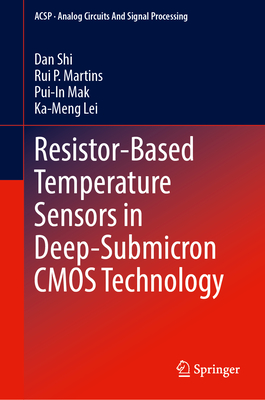
Resistor-Based Temperature Sensors in Deep-Submicron CMOS Technology
暫譯: 深亞微米CMOS技術中的電阻式溫度感測器
Shi, Dan, Martins, Rui P., Mak, Pui-In
- 出版商: Springer
- 出版日期: 2026-02-14
- 售價: $5,420
- 貴賓價: 9.5 折 $5,149
- 語言: 英文
- 頁數: 96
- 裝訂: Hardcover - also called cloth, retail trade, or trade
- ISBN: 3032135001
- ISBN-13: 9783032135001
-
相關分類:
微電子學 Microelectronics
海外代購書籍(需單獨結帳)
相關主題


商品描述
This book discusses in detail the fundamental principles and design specifications governing fully-integrated temperature sensors in deep-submicron CMOS technology. It provides an in-depth analysis of diverse sensing and readout circuit architectures, cutting-edge ultra-low-voltage and frequency-locked loop (FLL) design methodologies, and detailed implementation strategies. Readers will gain valuable insights from the latest advancements in deep-submicron CMOS technology, mastering a range of precision-driven, area- and energy-efficient techniques. This knowledge empowers readers to identify and develop optimal architectures tailored to specific applications and technology nodes. Moreover, the book serves as an invaluable resource for professionals in circuit and system design, particularly those focused on temperature sensing systems or high-performance integrated circuits, offering practical guidance for researchers and engineers in both academia and industry.
商品描述(中文翻譯)
本書詳細討論了在深亞微米CMOS技術中,完全整合的溫度傳感器所遵循的基本原則和設計規範。它對各種感測和讀取電路架構進行了深入分析,介紹了尖端的超低電壓和頻率鎖定迴路(FLL)設計方法,以及詳細的實施策略。讀者將從深亞微米CMOS技術的最新進展中獲得寶貴的見解,掌握一系列以精度為驅動、區域和能量效率為考量的技術。這些知識使讀者能夠識別並開發針對特定應用和技術節點的最佳架構。此外,本書對於電路和系統設計的專業人士,特別是專注於溫度感測系統或高性能集成電路的研究人員和工程師,提供了寶貴的資源和實用指導,無論是在學術界還是業界。
作者簡介
Dan Shi received the B.Sc. and M.Sc. degree in microelectronics from Sichuan University, Chengdu, China, in 2016 and 2019, respectively. And, she received the Ph.D. degree in electrical and computer engineering (ECE) at University of Macau, Macau, China in 2025. She served as an Associate Professor at Guangdong University of Technology since 2025. She worked as an analog circuits design engineer at IC company for two years from 2019 to 2021, where she was involved in high-speed clock, I/O interface, analog driven-circuit designs. Her current research focuses on the design of low-voltage and energy-efficient smart temperature sensors.
Dr. Shi has published prestigious IEEE journals and conferences, including International Solid-State Circuits Conference (ISSCC), Journal of Solid-State Circuits (JSSC), Transactions on Circuits and Systems I (TCAS-I), Transactions on Circuits and Systems II (TCAS-II), and International Conference on Integrated Circuits, Technologies and Applications (ICTA). She was a recipient of the student travel grant award (STGA) in 2025 ISSCC.
Rui P. Martins received the Ph.D. in Electrical Engineering and Computers from the Department of Electrical and Computer Engineering, Instituto Superior Técnico, University of Lisbon, Portugal, in 1992, and has been with that Department since October 1980. From 1992, he has been on leave from University of Lisbon and with the Department of Electrical and Computer Engineering, Faculty of Science and Technology, University of Macau, Macao, China, where he is a Chair-Professor since Aug. 2013. His research interests are on analog and mixed-signal VLSI design and has authored or co-authored 900+ publications, including 10 books, 12 book chapters, 50 Patents, 300+ papers in scientific journals and 400+ in conference proceedings. He was the Founding Director of the State Key Laboratory of Analog and Mixed-Signal VLSI, between 2011 and 2022, and is currently the Director of the Institute of Microelectronics, both at the University of Macau, Macao, China.
Prof. Rui Martins is an IEEE Fellow, received an Author Recognition Award at the 70 years of ISSCC, in 2023, as a Top Contributor with more than 50 papers, and 3 Medals from Macao Government in 1999, 2001 and 2021. Since July 2010 he is an Academician with the Lisbon Academy of Sciences, Portugal.
Pui-In Mak received the Ph.D. degree from University of Macau (UM), Macao, China, in 2006. He is currently Professor at UM Faculty of Science and Technology - ECE Department, Director at the State Key Laboratory of Analog and Mixed-Signal VLSI and Deputy Director (Research) at the Institute of Microelectronics. His research interests are on analog and radio-frequency (RF) circuits and systems for wireless and multidisciplinary innovations.
His involvements with IEEE are: Editorial Board Member of IEEE Press ('14-'16); Member of Board-of-Governors of IEEE Circuits and Systems Society ('09-'11); Senior Editor of IEEE Journal on Emerging and Selected Topics in Circuits and Systems ('14-'15); Associate Editor of IEEE Journal of Solid-State Circuits ('18-), IEEE Solid-State Circuits Letters ('17-), IEEE Transactions on Circuits and Systems I ('10-'11, '14-'15) and II ('10-'13). He is/was the TPC Vice Co-Chair of ASP-DAC ('16), TPC Member of A-SSCC ('13-'16, '19), ESSCIRC ('16-'17) and ISSCC ('17-'19). He is/was Distinguished Lecturer of IEEE Circuits and Systems Society ('14-'15) and IEEE Solid-State Circuits Society ('17-'18). He was the chairman of the Distinguished Lecturer Program of IEEE Circuits and Systems Society ('18-'19).
Ka-Meng Lei received the B.Sc. degree in electrical and electronic engineering (EEE) and the Ph.D. degree in electrical and computer engineering (ECE) from the University of Macau, Macau, in 2012 and 2016, respectively. He has served as an Assistant professor at the University of Macau since 2019. He was a Postdoctoral Fellow at Harvard University from 2017 to 2019, where he was involved in developing the high-resolution portable nuclear magnetic resonance (NMR) spectrometer.
Ka-Meng Lei has published 60+ refereed papers. He co-authored one book Handheld Total Chemical and Biological Analysis Systems: Bridging NMR, Digital Microfluidics, and Semiconductors (Springer'18), and two book chapter Micro-NMR on CMOS for Biomolecular Sensing (Springer'18) and Ultra-Low-Voltage Clock References (Springer'23). His current research interests include ultralow voltage analog circuit techniques, sensors and analog front-end interfaces, and high-resolution portable NMR platforms.
作者簡介(中文翻譯)
丹·史(Dan Shi)於2016年和2019年分別在中國成都的四川大學獲得微電子學的學士和碩士學位。她於2025年在澳門大學獲得電機與計算機工程(ECE)博士學位。自2025年以來,她在廣東工業大學擔任副教授。她於2019年至2021年在一家IC公司擔任類比電路設計工程師,參與高頻時鐘、I/O介面和類比驅動電路的設計。她目前的研究重點是低電壓和節能智能溫度傳感器的設計。
史博士已在多個知名的IEEE期刊和會議上發表論文,包括國際固態電路會議(ISSCC)、固態電路期刊(JSSC)、電路與系統I期刊(TCAS-I)、電路與系統II期刊(TCAS-II)以及集成電路、技術與應用國際會議(ICTA)。她是2025年ISSCC學生旅行補助獎(STGA)的獲得者。
魯伊·P·馬丁斯(Rui P. Martins)於1992年在葡萄牙里斯本大學高等技術學院的電機與計算機工程系獲得電氣工程與計算機的博士學位,自1980年10月以來一直在該系任職。自1992年起,他從里斯本大學請假,任職於澳門大學科學技術學院電機與計算機工程系,自2013年8月起擔任講座教授。他的研究興趣集中在類比和混合信號VLSI設計,已發表或共同發表超過900篇論文,包括10本書、12章書籍、50項專利、300多篇科學期刊論文和400多篇會議論文。他曾於2011年至2022年擔任國家重點實驗室的創始主任,並目前是澳門大學微電子學研究所的所長。
魯伊·馬丁斯教授是IEEE Fellow,於2023年在ISSCC 70周年慶典上獲得作者認可獎,因為他是超過50篇論文的主要貢獻者,並於1999年、2001年和2021年獲得澳門政府的3枚獎牌。自2010年7月以來,他是葡萄牙里斯本科學院的院士。
麥培賢(Pui-In Mak)於2006年在澳門大學(UM)獲得博士學位。目前他是澳門大學科學技術學院電機與計算機工程系的教授,並擔任國家重點實驗室的主任及微電子學研究所的副所長(研究)。他的研究興趣包括無線和多學科創新的類比和射頻(RF)電路及系統。
他在IEEE的參與包括:IEEE Press編輯委員會成員('14-'16);IEEE電路與系統學會理事會成員('09-'11);IEEE新興與選定電路與系統主題期刊的高級編輯('14-'15);IEEE固態電路期刊的副編輯('18-)、IEEE固態電路快報('17-)、IEEE電路與系統I期刊('10-'11, '14-'15)和II期刊('10-'13)。他是/曾是ASP-DAC的TPC副主席('16)、A-SSCC的TPC成員('13-'16, '19)、ESSCIRC('16-'17)和ISSCC('17-'19)的TPC成員。他是/曾是IEEE電路與系統學會('14-'15)和IEEE固態電路學會('17-'18)的傑出講者。他曾擔任IEEE電路與系統學會傑出講者計劃的主席('18-'19)。
雷家銘(Ka-Meng Lei)於2012年和2016年分別在澳門大學獲得電氣與電子工程(EEE)學士學位和電機與計算機工程(ECE)博士學位。自2019年以來,他在澳門大學擔任助理教授。他於2017年至2019年在哈佛大學擔任博士後研究員,參與開發高解析度便攜式核磁共振(NMR)光譜儀。
雷家銘已發表超過60篇經審核的論文。他共同編著了一本書《手持式化學和生物分析系統:橋接NMR、數位微流體和半導體》(Springer'18),以及兩章書籍《CMOS上的微型NMR用於生物分子感測》(Springer'18)和《超低電壓時鐘參考》(Springer'23)。他目前的研究興趣包括超低電壓類比電路技術、傳感器和類比前端介面,以及高解析度便攜式NMR平台。