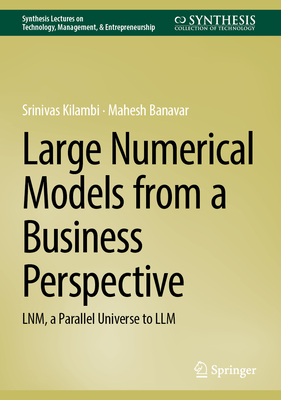
Large Numerical Models from a Business Perspective: Lnm, a Parallel Universe to LLM
暫譯: 從商業角度看大型數值模型:Lnm,LLM的平行宇宙
Kilambi, Srinivas, Banavar, Mahesh
- 出版商: Springer
- 出版日期: 2026-01-13
- 售價: $2,060
- 貴賓價: 9.5 折 $1,957
- 語言: 英文
- 頁數: 112
- 裝訂: Hardcover - also called cloth, retail trade, or trade
- ISBN: 3032148685
- ISBN-13: 9783032148681
-
相關分類:
Large language model
海外代購書籍(需單獨結帳)
商品描述
Large Language Models (LLMs) have disruptively changed the world of AI for good and their adoption is near universal. However, how many know that they have a big limitation while processing large numerical quantitative business datasets usually found in ERPs as 1000s of tables. LLMs cannot process 100s of spreadsheets or tables at one time and when they try, they either fail to run or generate inaccurate predictions at best.
The authors of this book propose LNMs or Large Numerical Models as a parallel universe to LLMs. LNMs are designed and built for numerical datasets and they offer some significant advantages over LLMs such as very accurate predictions, no hallucinations, improvement in business outcomes and ability to deliver in a "cold start" environment. LNMs are vertically curated and can run on a CPU as opposed to energy guzzling GPUs or water consuming cooling systems that LLMs need.
This book introduces LNMs, it's underlying structure and SXI. SXI is to LNM as GPT is to LLMs, the underlying core science and technology. The authors also present specific applications of LNMs in healthcare, fintech, wireless, supplychain, marketing campaigns. Finally, the authors introduce their current research area of LLNMs. LLNM combines both LLM and LNM and has significant potential advantages over either LLM or LNMs.
商品描述(中文翻譯)
大型語言模型(LLMs)顛覆性地改變了人工智慧的世界,並且它們的採用幾乎是普遍的。然而,有多少人知道它們在處理通常存在於企業資源規劃(ERP)系統中的大型數值量化商業數據集時存在一個重大限制,這些數據集通常包含數千個表格。LLMs無法同時處理數百個電子表格或表格,當它們嘗試這樣做時,通常要麼無法運行,要麼生成的預測最多也只是準確性不高。
本書的作者提出了大型數值模型(LNMs)作為LLMs的平行宇宙。LNMs專為數值數據集設計和構建,並且相較於LLMs,它們提供了一些顯著的優勢,例如非常準確的預測、沒有幻覺、改善商業結果以及在「冷啟動」環境中交付的能力。LNMs是垂直策劃的,並且可以在中央處理器(CPU)上運行,而不是像LLMs那樣需要耗能的圖形處理單元(GPU)或消耗水的冷卻系統。
本書介紹了LNMs及其底層結構和SXI。SXI對於LNM的意義就如同GPT對於LLMs,代表著底層的核心科學和技術。作者還展示了LNMs在醫療保健、金融科技、無線通訊、供應鏈和行銷活動中的具體應用。最後,作者介紹了他們目前的研究領域——LLNMs。LLNM結合了LLM和LNM,並且相較於LLM或LNMs具有顯著的潛在優勢。
作者簡介
Dr. Srinivas Kilambi is a passionate technologist at heart with a career spanning over three decades in academics, research, industry/corporates, start-ups across diverse verticals such as chemicals, biomass & renewable energy, clean water, machine-learning & artificial intelligence and education. He is the founder of the Sriya Group.
His specialties include: Large Numerical Models (LNM), Large Language and Numerical Models (LLNM), Machine Learning, Green Building Materials, Green Chemicals, Bio-Refineries, Biomass, solar, nanotechnology, biotechnology, and clean water.
Dr. Kilambi earned his BS in Chemical Engineering from the Indian Institute of Technology, Chennai, India, and then MS in Environmental Engineering from Clarkson and Johns Hopkins Universities, followed by a PhD in Chemical Engineering from the University of Tennessee-Knoxville. Dr. Kilambi also holds a CFA certification.
Dr. Mahesh Banavar is a Professor of Electrical and Computer Engineering at Clarkson University, where he also serves as the Associate Director for Faculty Support at the Institute for STEM Education. He received his BE in Telecommunications Engineering from Visvesvaraya Technological University in India, followed by MS and PhD degrees in Electrical Engineering from Arizona State University.
Dr. Banavar's research spans signal processing, machine learning and artificial intelligence, and STEM education. He leads the Communications, Signal Processing, and Networking (CoSiNe) Lab at Clarkson University, where his work bridges algorithms and applications, with a focus on interdisciplinary and community-engaged research. He is a member of the Tau Beta Pi and Eta Kappa Nu engineering honor societies.
Outside academia, Dr. Banavar serves his community as a certified New York State EMT and active volunteer with the Potsdam Volunteer Rescue Squad.
作者簡介(中文翻譯)
Dr. Srinivas Kilambi 是一位充滿熱情的技術專家,擁有超過三十年的學術、研究、產業/企業及新創公司經驗,涵蓋化學、生物質與可再生能源、清潔水、機器學習與人工智慧以及教育等多個領域。他是 Sriya Group 的創辦人。
他的專長包括:大型數值模型 (Large Numerical Models, LNM)、大型語言與數值模型 (Large Language and Numerical Models, LLNM)、機器學習、綠色建材、綠色化學品、生物精煉廠、生物質、太陽能、奈米技術、生物技術以及清潔水。
Dr. Kilambi 在印度的印度理工學院(Indian Institute of Technology, Chennai)獲得化學工程學士學位,隨後在克拉克森大學(Clarkson University)和約翰霍普金斯大學(Johns Hopkins University)獲得環境工程碩士學位,並在田納西大學-諾克斯維爾(University of Tennessee-Knoxville)獲得化學工程博士學位。Dr. Kilambi 也持有 CFA 認證。
Dr. Mahesh Banavar 是克拉克森大學(Clarkson University)電機與計算機工程系的教授,同時擔任 STEM 教育研究所的教職員支持副主任。他在印度的維斯維薩拉亞科技大學(Visvesvaraya Technological University)獲得電信工程學士學位,隨後在亞利桑那州立大學(Arizona State University)獲得電機工程碩士及博士學位。
Dr. Banavar 的研究範圍包括信號處理、機器學習與人工智慧以及 STEM 教育。他領導克拉克森大學的通訊、信號處理與網路實驗室(Communications, Signal Processing, and Networking, CoSiNe Lab),其工作橋接演算法與應用,專注於跨學科及社區參與的研究。他是 Tau Beta Pi 和 Eta Kappa Nu 工程榮譽學會的成員。
在學術界之外,Dr. Banavar 以紐約州認證的緊急醫療技術員(EMT)身份服務社區,並積極參與波茨坦志願救援隊(Potsdam Volunteer Rescue Squad)的志願工作。