Introduction to Tensor Network Methods: From Many-Body Quantum Systems to Machine Learning
暫譯: 張量網路方法導論:從多體量子系統到機器學習
Felser, Timo, Montangero, Simone
商品描述
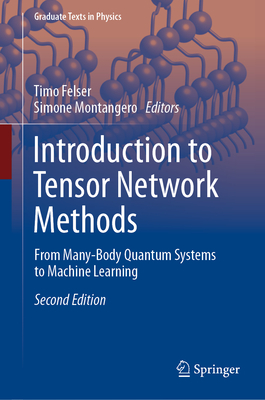
This second edition of the textbook Introduction to Tensor Network Methods contains more advanced and technical parts as new topics related to tensor network algorithms that have been developed in the last few years. The reader finds new chapters dedicated to tree tensor networks for high-dimensional systems as applications to lattice gauge theory. The implementation of tensor networks for machine learning is also presented in detail.
This textbook gives an in-depth overview on the numerical simulation technique of tensor networks (TNs) with hands-on technical descriptions, work exercises and computation results. TNs have originally been developed for solving the quantum many-body problem and simulating quantum systems on a classical computer. However, as a mathematical tool, TNs have emerged as powerful theoretical and numerical versatile tools to attack more generally hard mathematical problems. In particular, their range application has expanded to combinatorial optimization and even as an alternative tool for machine learning in the field of artificial intelligence. This textbook introduces the reader to the field, describing the main principles and core mathematical concepts in the light of its application in quantum physics and, along the way, touches on the application of TNs to problems from various fields, ranging from low-energy to high-energy physics up to medical physics and machine learning.
It is designed for graduate courses in computational physics, where a student learns how to write a tensor network program and can begin to explore the physics of many-body quantum systems.
商品描述(中文翻譯)
這本教科書《張量網路方法導論》的第二版包含了更高級和技術性的內容,涵蓋了近幾年來發展出的與張量網路演算法相關的新主題。讀者將會發現新章節專門介紹針對高維系統的樹狀張量網路,並應用於格點規範理論。張量網路在機器學習中的實作也有詳細的介紹。
這本教科書深入概述了張量網路(TNs)的數值模擬技術,並提供了實用的技術描述、工作練習和計算結果。TNs最初是為了解決量子多體問題和在經典計算機上模擬量子系統而開發的。然而,作為一種數學工具,TNs已經成為強大的理論和數值多功能工具,用於解決更一般的困難數學問題。特別是,它們的應用範圍已擴展到組合優化,甚至作為人工智慧領域中機器學習的替代工具。本教科書向讀者介紹了這一領域,描述了主要原則和核心數學概念,並在其應用於量子物理的背景下,涉及了TNs在各個領域問題上的應用,從低能物理到高能物理,再到醫學物理和機器學習。
本書旨在用於計算物理的研究生課程,讓學生學會如何編寫張量網路程式,並開始探索多體量子系統的物理。
作者簡介
Timo Felser received his doctoral degree in Physics with distinction from the University of Padua and the University of Saarland, working on the development of tensor networks for high-dimensional quantum many-body systems. His research interests focus on tensor network development and applications in various fields, ranging from low-energy to high-energy physics up to medical physics and machine learning. He published his work in journals with high impact factor, such as Physical Review X, Physical Review Letters, Nature Comm., npj Quantum Information. Further, he developed tensor network computations to perform machine learning tasks in the field of AI and is now leading the research transfer project Tensor Solutions at Ulm University to spin-off the tensor network machine learning technology into a start-up which aims to address data problems in industry.
Simone Montangero is Full Professor at the Department of Physics and Astronomy of University of Padova . He has been a Heisenberg Fellow of the German Science Foundation, and a Humboldt Fellow. He is Honorary Professor at Ulm University and an IQOQI visiting fellow of the Institute for Quantum Optics and Quantum Information of the Austrian Academy of Science. He is a member of the Quantum Coordination Board of the EU-Quantum Flagship and of the Scientific Council of the National Metrology Institute of Italy - INRiM. He co-coordinates the quantum activities of the Italian National Center for HPC, Big Data and Quantum Computing - Foundation ICSC. Prof. Montangero has pioneered the development of tensor network methods for quantum technologies and lattice gauge theories, and the application of optimal control theory to many-body quantum systems. He has published more than 170 research articles at the interface of quantum science, many-body physics, and condensed matter in international journals and books, including Science, PNAS, Physical Review Letters, Physical Review X, Nature Communication. He has been involved in many national and international projects on quantum science: as coordinator of the EU-QuantERA QTFLAG and T-NISQ and as principal investigator of the EU projects RYSQ, SIQS, DIADEMS, PASQUANS, PASQUANS2, EURYQA, QEC4QEA.
作者簡介(中文翻譯)
Timo Felser 以優異的成績獲得帕多瓦大學和薩爾蘭大學的物理學博士學位,研究高維量子多體系統的張量網絡發展。他的研究興趣集中在張量網絡的開發及其在各個領域的應用,涵蓋從低能物理到高能物理,甚至醫學物理和機器學習。他在高影響力的期刊上發表了他的研究成果,如 Physical Review X、Physical Review Letters、Nature Comm.、npj Quantum Information。此外,他開發了張量網絡計算以執行人工智慧領域的機器學習任務,並且目前在烏爾姆大學領導研究轉移專案 Tensor Solutions,旨在將張量網絡機器學習技術轉化為初創公司,以解決工業中的數據問題。
Simone Montangero 是帕多瓦大學物理與天文系的全職教授。他曾是德國科學基金會的海森堡研究員和洪堡研究員。他是烏爾姆大學的名譽教授,也是奧地利科學院量子光學與量子資訊研究所的IQOQI訪問研究員。他是歐盟量子旗艦計畫的量子協調委員會成員,以及意大利國家計量研究所(INRiM)的科學委員會成員。他共同協調意大利國家高效能計算、大數據和量子計算中心 - ICSC基金會的量子活動。Montangero教授在量子技術和格點規範理論的張量網絡方法開發方面開創了先河,並將最佳控制理論應用於多體量子系統。他在國際期刊和書籍上發表了超過170篇關於量子科學、多體物理和凝聚態物理的研究文章,包括 Science、PNAS、Physical Review Letters、Physical Review X、Nature Communication。他參與了許多國內外的量子科學專案,擔任 EU-QuantERA QTFLAG 和 T-NISQ 的協調員,以及歐盟專案 RYSQ、SIQS、DIADEMS、PASQUANS、PASQUANS2、EURYQA、QEC4QEA 的主要研究員。