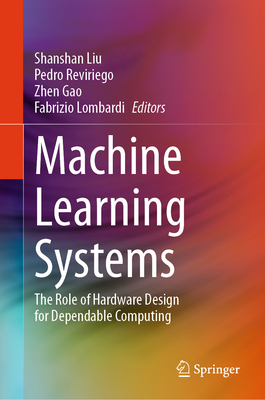
Machine Learning Systems: The Role of Hardware Design for Dependable Computing
暫譯: 機器學習系統:可靠計算的硬體設計角色
Liu, Shanshan, Reviriego, Pedro, Gao, Zhen
- 出版商: Springer
- 出版日期: 2026-05-23
- 售價: $5,910
- 貴賓價: 9.5 折 $5,614
- 語言: 英文
- 頁數: 413
- 裝訂: Hardcover - also called cloth, retail trade, or trade
- ISBN: 3032179475
- ISBN-13: 9783032179470
-
相關分類:
Machine Learning
海外代購書籍(需單獨結帳)
商品描述
This book addresses the technological contributions and developments of advanced hardware for Machine Learning (ML) computing systems. The authors discuss state-of-the-art progress in this area (and related topics) as well as reporting on their application to diverse fields. This is achieved by chapters covering the entire spectrum of research activities to include design and applications, with a focus on high performance and dependable operation. The entire hardware stack (from circuit, to architecture, up to the system level) is discussed in detail. The book will cover innovative material as well as tutorials, reviews and surveys of current theoretical/experimental results, design methodologies and applications over a wide spectrum of scope for an enlarged readership, so to include engineers as well as scientists.
- Discusses a wide range of topics for Machine Learning-based computer systems;
- Covers design and application for the entire hardware stack, with a focus on high performance and dependability;
- Includes innovative material, as well as tutorials, reviews and surveys of current theoretical/experimental results.
商品描述(中文翻譯)
本書探討了用於機器學習(Machine Learning, ML)計算系統的先進硬體的技術貢獻和發展。作者討論了該領域(及相關主題)的最新進展,並報告其在多個領域的應用。這是通過涵蓋整個研究活動範疇的章節來實現的,包括設計和應用,重點在於高性能和可靠運行。整個硬體堆疊(從電路到架構,再到系統層級)都進行了詳細討論。本書將涵蓋創新材料,以及當前理論/實驗結果的教程、評論和調查,設計方法論和應用,旨在擴大讀者群,包括工程師和科學家。
- 討論基於機器學習的計算機系統的廣泛主題;
- 涵蓋整個硬體堆疊的設計和應用,重點在於高性能和可靠性;
- 包含創新材料,以及當前理論/實驗結果的教程、評論和調查。
作者簡介
Shanshan Liu received the Ph.D. degree in Microelectronics and Solid-State Electronics from Harbin Institute of Technology, Harbin, China, in 2018. She was a post-doctoral researcher with the Department of Electrical and Computer Engineering, Northeastern University, Boston, USA, from 2018 to 2021, and an assistant professor with the Klipsch School of Electrical and Computer Engineering, New Mexico State University, Las Cruces, USA from 2021 to 2023. She is currently a professor with the School of Information and Communication Engineering, University of Electronic Science and Technology of China, Chengdu, China.Dr. Liu is an Associate Editor for the IEEE Transactions on Emerging Topics in Computing and the IEEE Transactions on Nanotechnology and serves as a technical program committee member for several IEEE/ACM conferences such as NANO, DFT, GLSVLSI. She is also the 2024-elected Member-at-Large of the IEEE Nanotechnology Council. Her research interests include fault tolerance design in high performance computing systems, emerging computing, VLSI design, dependable machine learning, and error correction codes.
Pedro Reviriego completed the PhD in 1997 and joined the R&D department of Teldat a Spanish company that designs and manufactures routers. Then in 2000, he moved on to an Irish a start-up that was developing Ethernet transceiver ASICs and that later was acquired by an US company (now part of Broadcom). The transceivers developed were licensed to Intel and had a large commercial success. Since 2007 he has been in Academia with positions at Nebrija University, Universidad Carlos III de Madrid and currently Universidad Politécnica de Madrid.Pedro Reviriego has made significant contributions in different areas like Energy Efficiency in Ethernet on which he was a pioneer contributing to the IEEE 802.3 standards and writing seminal papers on the field with more than 470 citations in Google Scholar. This work was recognized with two Google Research Awards. The second topic on which he has worked is the design and implementation of Error Correction Codes (ECCs) to protect memories. In this area, he has pioneered the use of one step majority logic decodable codes for memory protection with a large number of publications. More recently, he focuses on fault-tolerant machine learning, in this area he has proposed fault tolerant implementations for many machine learning algorithms including complex neural networks.Pedro Reviriego is associate editor of IEEE Transactions on Emerging Topics in Computing and has published more than 300 papers on journals indexed on the JCR, most of them in Transactions of the IEEE and more than 5900 citations on Google Scholar. He also holds more than 12 US patents most of them in collaboration with NVIDIA/Mellanox.
Zhen Gao received the BS, MS and PhD degree in Electrical Engineering from Tianjin University, China, in 2005, 2007 and 2011, respectively. He was a visiting scholar in GeorgiaTech during 2008 2010, and a Postdoc researcher in Tsinghua University during 2011 2014. He is currently an Associate Professor in Tianjin University. His research interests include circuit reliability, fault tolerance design, wireless communications and blockchain technologies.
Fabrizio Lombardi graduated in 1977 from the University of Essex (UK) with a B.Sc. (Hons.) in Electronic Engineering. In 1977 he joined the Microwave Research Unit at University College London, where he received the Master in Microwaves and Modern Optics (1978), the Diploma in Microwave Engineering (1978) and the Ph. D. from the University of London (1982). He is currently the holder of the International Test Conference (ITC) Endowed Chair at Northeastern University, Boston. Currently, Dr. Lombardi is the 2022-2023 President; of the IEEE Nanotechnology Council (NTC); in 2021 he was 2nd VP of the IEEE Computer Society (CS). He was the VP of Publications of the IEEE CS (2019-2020) and the NTC (2020) as well as also a member of the IEEE Publication Services and Products Board (PSPB) (2019-2023). He has been appointed on Executive Boards of many non-profit organizations (such as Computing-in-the-Core, now code.org the non-partisan advocacy coalition for K-12 Computer Science education) as well as the Computer Society (as an elected two-term member of its Board of Governors (2012-2017)) and the IEEE (as an appointed member of the Future Directions Committee (2014-2017)).In the past Dr. Lombardi has been a two 2-year term Editor-in-Chief (2007-2010), Associate Editor-in-Chief (2000-2006) and Associate Editor (1996-2000) of the IEEE Transactions on Computers, the inaugural two-term Editor-in-Chief of the IEEE Transactions on Emerging Topics in Computing (2013-2017); Editor-in-Chief of the IEEE Transactions on Nanotechnology (2014-2019) as well as member of the Editorial Boards of the ACM Journal of Emerging Technologies in Computing Systems, the IEEE Design & Test Magazine and IEEE Transactions on CAD of ICAS. Dr. Lombardi has been twice a Distinguished Visitor of the IEEE Computer Society (1990-1993 and 2001-2004). He serves as Chair of the Committee on "Nanotechnology Devices and Systems" of the Test Technology Technical Council of the IEEE.Dr. Lombardi is a Fellow of the IEEE for "contributions to testing and fault tolerance of digital systems". He was the recipient of the 2011 Meritorious Service Award and elevated to Golden Core membership in the same year by the IEEE CS; he was the Chair of the 2016 and 2017 IEEE CS Fellow Evaluation Committee. He has been awarded the 2019 NTC Distinguished Service Award, the 2019 "Spirit of the CS" Award and the 2021 T Michael Elliott Distinguished Service Certificate from the CS. He has received many professional awards: the Visiting Fellowship at the British Columbia Advanced System Institute, University of Victoria, Canada (1988), twice the Texas Experimental Engineering Station Research Fellowship (1991-1992, 1997-1998) the Halliburton Professorship (1995), the Outstanding Engineering Research Award at Northeastern University (2004) and an International Research Award from the Ministry of Science and Education of Japan (1993-1999). Dr. Lombardi was the recipient of the 1985/86 Research Initiation Award from the IEEE/Engineering Foundation and a Silver Quill Award from Motorola-Austin (1996). Together with his students, his manuscripts have been selected for the best paper awards at technical events/meetings such as IEEE DFT and IEEE/ACM Nanoarch. Since inception, he has been always included in the list of World's Top 2% Scientists, as compiled by Stanford University.Dr. Lombardi has been involved in organizing many international symposia, conferences and workshops sponsored by professional organizations as well as guest editor of Special Issues in archival journals and magazines. His research interests are emerging technologies (mostly nanoscale circuits and magnetic devices), memory systems, VLSI design and fault/defect tolerance of digital systems. He has extensively published in these areas and coauthored/edited eleven books.
作者簡介(中文翻譯)
Shanshan Liu於2018年獲得中國哈爾濱工業大學微電子與固態電子學博士學位。她於2018年至2021年在美國波士頓的東北大學電氣與計算機工程系擔任博士後研究員,並於2021年至2023年在美國新墨西哥州立大學Klipsch電氣與計算機工程學院擔任助理教授。她目前是中國電子科技大學信息與通信工程學院的教授。劉博士是《IEEE Transactions on Emerging Topics in Computing》和《IEEE Transactions on Nanotechnology》的副編輯,並擔任多個IEEE/ACM會議的技術程序委員會成員,如NANO、DFT、GLSVLSI。她還是2024年當選的IEEE納米技術委員會成員。她的研究興趣包括高性能計算系統中的容錯設計、新興計算、VLSI設計、可靠的機器學習和錯誤更正碼。
Pedro Reviriego於1997年獲得博士學位,並加入西班牙公司Teldat的研發部門,該公司設計和製造路由器。然後在2000年,他轉到一家愛爾蘭初創公司,該公司開發以太網收發器ASIC,後來被一家美國公司收購(現在是Broadcom的一部分)。所開發的收發器授權給Intel,並取得了巨大的商業成功。自2007年以來,他一直在學術界工作,曾在內布里哈大學、卡洛斯三世大學和目前的馬德里理工大學任職。Pedro Reviriego在以太網的能源效率等不同領域做出了重要貢獻,他是IEEE 802.3標準的先驅,並在該領域撰寫了多篇開創性論文,Google Scholar引用超過470次。這項工作獲得了兩個Google研究獎。第二個他研究的主題是設計和實現錯誤更正碼(ECC)以保護記憶體。在這個領域,他開創性地使用一步多數邏輯可解碼碼進行記憶體保護,並發表了大量的論文。最近,他專注於容錯機器學習,在這個領域,他為許多機器學習算法,包括複雜的神經網絡,提出了容錯實現。Pedro Reviriego是《IEEE Transactions on Emerging Topics in Computing》的副編輯,並在JCR索引的期刊上發表了300多篇論文,其中大多數發表在IEEE Transactions上,Google Scholar引用超過5900次。他還擁有12項以上的美國專利,大多數是與NVIDIA/Mellanox合作的。
Zhen Gao於2005年、2007年和2011年分別在中國天津大學獲得電氣工程學士、碩士和博士學位。他於2008年至2010年在喬治亞理工學院擔任訪問學者,並於2011年至2014年在清華大學擔任博士後研究員。他目前是天津大學的副教授。他的研究興趣包括電路可靠性、容錯設計、無線通信和區塊鏈技術。
Fabrizio Lombardi於1977年在英國埃塞克斯大學獲得電子工程學士學位(榮譽)。1977年,他加入倫敦大學學院的微波研究單位,並於1978年獲得微波和現代光學碩士學位、微波工程文憑,於1982年獲得倫敦大學博士學位。他目前是美國波士頓東北大學國際測試會議(ITC)贊助教授。Lombardi博士目前是2022-2023年IEEE納米技術委員會(NTC)主席;在2021年,他是IEEE計算機學會(CS)的第二副主席。他曾擔任IEEE CS的出版副主席(2019-2020)和NTC(2020),以及IEEE出版服務和產品委員會(PSPB)的成員(2019-2023)。他曾被任命為多個非營利組織的執行委員會成員(如Computing-in-the-Core,現在的code.org,這是一個無黨派的K-12計算機科學教育倡導聯盟),以及計算機學會(作為其理事會的兩屆當選成員(2012-2017))和IEEE(作為未來方向委員會的任命成員(2014-2017))。過去,Lombardi博士曾擔任《IEEE Transactions on Computers》的兩屆主編(2007-2010)、副主編(2000-2006)和副編輯(1996-2000),是《IEEE Transactions on Emerging Topics in Computing》的首位兩屆主編(2013-2017);《IEEE Transactions on Nanotechnology》的主編(2014-2019),以及ACM Journal of Emerging Technologies in Computing Systems、IEEE Design & Test Magazine和IEEE Transactions on CAD of ICAS的編輯委員會成員。Lombardi博士曾兩次被IEEE計算機學會評選為傑出訪客(1990-1993和2001-2004)。他擔任IEEE測試技術技術委員會的“納米技術設備和系統”委員會主席。Lombardi博士因“對數位系統的測試和容錯的貢獻”而成為IEEE會士。他於2011年獲得優秀服務獎,並在同年被提升為黃金核心會員;他曾擔任2016年和2017年IEEE CS會士評估委員會的主席。他獲得了2019年NTC傑出服務獎、2019年“CS精神”獎和2021年T Michael Elliott傑出服務證書。他獲得了許多專業獎項:1988年在加拿大維多利亞大學不列顛哥倫比亞高級系統研究所的訪問獎學金、兩次德克薩斯實驗工程站研究獎學金(1991-1992、1997-1998)、哈利伯頓教授職位(1995)、東北大學的傑出工程研究獎(2004)以及日本文部科學省的國際研究獎(1993-1999)。Lombardi博士曾獲得1985/86年IEEE/工程基金會的研究啟動獎和1996年摩托羅拉奧斯丁的銀筆獎。與他的學生一起,他的手稿曾在技術活動/會議上獲得最佳論文獎,如IEEE DFT和IEEE/ACM Nanoarch。自創立以來,他一直被列入斯坦福大學編制的全球前2%科學家名單。Lombardi博士參與組織了許多由專業組織贊助的國際研討會、會議和工作坊,並擔任過多個期刊和雜誌的特刊客編。他的研究興趣包括新興技術(主要是納米級電路和磁性設備)、記憶體系統、VLSI設計以及數位系統的容錯/缺陷容忍。他在這些領域發表了大量論文,並共同編著了十一部書籍。