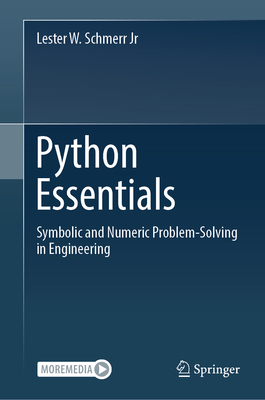
Python Essentials: Symbolic and Numeric Problem-Solving in Engineering
暫譯: Python 基礎:工程中的符號與數值問題解決
Schmerr Jr, Lester W.
相關主題

商品描述
This text describes the essentials of the Python programming language for symbolic and numeric engineering problems, emphasizing an interactive approach. It incorporates the Spyder IDE in conjunction with the four Python packages (NumPy, SciPy, SymPy, and MatplotLib) most frequently used in engineering and the sciences. The book is divided into four parts. The first part, chapter 1, outlines the environment for using Python in an interactive mode and provides descriptions of the many functions and operations available in that environment for numerical and symbolic problem-solving and for basic 2-D plotting of results. For users with no or little experience with Python the chapter can serve as a tutorial while for users with some Python experience the chapter can serve as a reference guide. The second part of the book, contained in chapters 2 and 3, discusses vectors and arrays (matrices) from both a mathematical perspective as well as from a physical perspective. Engineering examples are provided in the chapters and the exercises. Chapters 3, 4, 5 and 8 are the third part of the book, covering the solution of 1) linear simultaneous algebraic equations, 2) nonlinear algebraic equations, 3) ordinary differential equations, and 4) partial differential equations, respectively. These topics again are covered from both a mathematical and physical standpoint with solutions obtained in engineering examples and exercises. Python animations are also introduced as part of the solutions found for ordinary differential equations. Finally, the fourth part of the book, chapter 7, covers the use of 2-D and 3-D plotting as well as symbolic plotting in detail, expanding significantly on the short introduction given in chapter 1.
商品描述(中文翻譯)
這段文字描述了 Python 程式語言在符號和數值工程問題中的基本要素,強調互動式的方法。它結合了 Spyder IDE 以及四個在工程和科學中最常用的 Python 套件(NumPy、SciPy、SymPy 和 Matplotlib)。本書分為四個部分。第一部分,第 1 章,概述了在互動模式下使用 Python 的環境,並提供了該環境中可用於數值和符號問題解決以及基本 2D 繪圖結果的許多函數和操作的描述。對於沒有或只有少量 Python 經驗的使用者,這一章可以作為教程,而對於有一定 Python 經驗的使用者,這一章則可以作為參考指南。本書的第二部分,包含第 2 章和第 3 章,從數學和物理的角度討論向量和陣列(矩陣)。這些章節和練習中提供了工程範例。第 3、4、5 和 8 章是本書的第三部分,分別涵蓋 1) 線性同時代數方程、2) 非線性代數方程、3) 常微分方程和 4) 偏微分方程的解決方案。這些主題再次從數學和物理的角度進行探討,並在工程範例和練習中獲得解決方案。常微分方程的解決方案中還引入了 Python 動畫。最後,本書的第四部分,第 7 章,詳細介紹了 2D 和 3D 繪圖以及符號繪圖的使用,顯著擴展了第 1 章中給出的簡短介紹。
作者簡介
Dr. Lester W. Schmerr Jr. is Professor Emeritus, Iowa State University. He is the author of two books on Ultrasonic Non-destructive Evaluation and has published six other books on Ultrasonic Phased Arrays, Engineering Statics, Engineering Dynamics, Advanced Mechanics of Solids, Algebraic Equations of Linear Elasticity, and MATLAB Essentials. He is the author or co-author of over 180 papers, primarily in the field of ultrasonics.
作者簡介(中文翻譯)
萊斯特·W·施梅爾(Dr. Lester W. Schmerr Jr.)是愛荷華州立大學的名譽教授。他是兩本有關超聲波非破壞性評估的書籍的作者,並且出版了六本有關超聲波相控陣、工程靜力學、工程動力學、固體高級力學、線性彈性代數方程以及MATLAB基礎的書籍。他是超過180篇論文的作者或合著者,主要集中在超聲波領域。