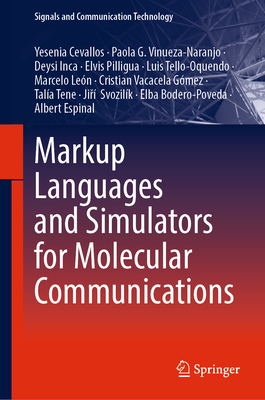
Markup Languages and Simulators for Molecular Communications
暫譯: 分子通訊的標記語言與模擬器
Cevallos, Yesenia, Vinueza-Naranjo, Paola G., Inca, Deysi
- 出版商: Springer
- 出版日期: 2026-09-22
- 售價: $6,880
- 貴賓價: 9.5 折 $6,536
- 語言: 英文
- 頁數: 342
- 裝訂: Hardcover - also called cloth, retail trade, or trade
- ISBN: 3032330394
- ISBN-13: 9783032330390
-
相關分類:
通訊系統 Communication-systems、奈米科技 Nano
海外代購書籍(需單獨結帳)
相關主題

商品描述
This book provides comprehensive coverage of Markup languages and simulators for molecular communications. The authors focus primarily on characteristics and applications with these programing tools for molecular communications. Specifically, the book emphasizes simulations with NS-3 that is simulator defined for nanocommunications (including molecular communications) with IEEE standards 1906.1 and 1906.1.1, and also simulations with MolComML (Molecular Communication Markup Language), the European version of IEEE 1906 standards. The authors discuss only the most widespread and widely used languages and simulators in molecular communications. The book starts by introducing basic elements of molecular communications systems, their main languages and simulators, as well as briefly discussing the IEEE nanocommunications standards. The authors then present the main programming languages and simulators commonly used in molecular communications. The book establishes a complete analysis regarding digital tools to learn and to study molecular communications for possible medical and biological communications systems applications. The book is intended for telecommunications and biomedical students, engineers, masters, PhDs, and researchers.
商品描述(中文翻譯)
本書全面介紹分子通訊所使用的標記語言(Markup Language)與模擬器。作者主要著重於這些程式工具在分子通訊中的特性與應用。具體而言,本書強調使用 NS-3 進行模擬;NS-3 是依據 IEEE 1906.1 與 IEEE 1906.1.1 標準所定義、用於奈米通訊(包括分子通訊)的模擬器。此外,本書也介紹使用 MolComML(Molecular Communication Markup Language,分子通訊標記語言)進行的模擬;MolComML 是 IEEE 1906 系列標準的歐洲版本。
作者僅討論分子通訊領域中最普及且最廣泛使用的語言與模擬器。本書首先介紹分子通訊系統的基本要素、主要使用的語言與模擬器,並簡要說明 IEEE 奈米通訊標準。接著,作者介紹分子通訊中常用的主要程式語言與模擬器。
本書針對學習與研究分子通訊所需的數位工具進行完整分析,並探討其在醫療與生物通訊系統中的潛在應用。本書適合電信與生醫領域的學生、工程師、碩士生、博士生及研究人員閱讀。
作者簡介
Yesenia Cevallos received the Electronic and Telecommunication Engineer Degree from Escuela Politécnica Nacional in Ecuador in 2001. She received the Information Technology Master Degree from the Universidad Técnica de Ambato in Ecuador in 2010. She received the Ph.D degree in Science and Technologies of Complex Systems from University of Calabria in Italy in 2018. She is an Associate Professor at the National University of Chimborazo, Ecuador, where she has worked since 2003. Her research area involves molecular-level Nano communications. She is a researcher for IDETIC at the Universidad de Las Palmas de Gran Canaria, Las Palmas, Spain. She is an IEEE Senior and HKN Member for the Computational Life Sciences, Young Professional, ComSoc and WIE. She is the IEEE Nanotechnology Council and EMBS vice chair for Ecuador chapter. She was member of the IEEE committee for the approval of the Nano communications standard 1096.1.1, Member of IEEE Molecular, Biological and Multi-Scale Committee. She is a reviewer for some journals in SPRINGER and IEEE. She was reviewer/editor for the journal Frontier in Bioengineering.
Paola Gabriela Vinueza Naranjo received the B.Sc. and M.Sc. degrees in Computer Science from the Universidad Nacional de Chimborazo, Riobamba, Ecuador, in 2005 and 2010, respectively, and the Ph.D degree in information Communication and Telecommunication (ICT) Engineering from the Sapienza University of Rome, Italy, in 2018. She is Senior Researcher and a Marie Curie Fellow in the ENSURE-6G Research group at the Universidad Nacional de Chimborazo-Ecuador. Her research interests include Cloud Computing, Energy-saving, Fog-based Wireless Systems, and Industry 4.0.
Deysi Inca is an Engineer in Electronics and Computing of the Polytechnic School of Chimborazo in 2010. Winner of the First Place in the call for papers made by the National Polytechnic School and Private Technical University of Loja (2010). She obtained the title of Master in Network Communication at the Pontifical Catholic University of Ecuador in 2016. Currently, she is an occasional professor with the Faculty of Engineering of the National University of Chimborazo in Ecuador. Her main research interests are in the field of Antennas, Communication Networks and Nano.
Elvis Pilligua received the Electronic and Telecommunication Engineer degree from Universidad Nacional de Chimborazo in Riobamba, Ecuador in 2024. He is a Ph.D student in the IDETIC Institute at the Universidad de Las Palmas de Gran Canaria, Las Palmas, Spain.
Luis Tello-Oquendo received the Electronic and Computer Engineering degree (Hons.) from Escuela Superior Politécnica de Chimborazo (ESPOCH), Ecuador, in 2010; the M.Sc. degree in telecommunication technologies, systems, and networks, and the Ph.D degree (Cum Laude) in Telecommunications from Universitat Politecnica de Valencia (UPV), Spain, in 2013 and 2018, respectively. From 2013 to 2018 he was Graduate Research Assistant with the Broadband Internetworking Research Group, UPV. From 2016 to 2017 he was a Research Scholar with the Broadband Wireless Networking Laboratory, Georgia Institute of Technology, Atlanta, GA, USA. He is currently an Associate Professor with the College of Engineering, Universidad Nacional de Chimborazo, Ecuador. His research interests include Wireless Communications, Software-defined Networks, 5G and beyond Cellular Systems, Internet of Things, and Machine Learning. He is a member of the IEEE and ACM. He received the Best Academic Record Award from the Escuela Técnica Superior de Ingenieros de Telecomunicación, UPV, in 2013; the IEEE ComSoc Award for attending the IEEE ComSoc Summer School at The University of New Mexico, Albuquerque, NM, USA, in 2017; the Extraordinary Doctoral Thesis Award from the Escuela de Doctorado, UPV, in 2019; and the Best Researcher Award from the Ecuadorian Corporation for the Development of Research and the Academy (CEDIA), in 2021.
Marcelo León is a Doctor in Hispanic World: Roots, Development and Projection, from the University of León; Master in Economics and Territorial Development, from the University of Huelva; Magister in Education and Social Development, from the Equinoctial Technological University; Commercial Engineer, from the National University of Loja; University Professor, Consultant, Researcher. He has participated as an exhibitor and lecturer in various international conferences and academic events. His scientific articles published in major journals, books and conference proceedings in countries such as Austria, Spain, Russia, Australia, United States, China, Italy, Portugal, Bolivia, Chile and the Czech Republic. He currently works as a professor of the Chair of Environmental Territorial Planning in the Master's program in Environmental Management Systems at the University of the Armed Forces of Ecuador.
Cristian Vacacela Gómez earned his Ph.D in Physics and Quantum Technologies from the Università della Calabria (Italy) in 2017 and a Bachelor's degree in Biophysics from the Escuela Superior Politécnica de Chimborazo (Ecuador) in 2013. He is an Associate Professor at the Escuela Superior Politécnica de Chimborazo (ESPOCH, Ecuador) and an Associated Researcher at the National Institute for Nuclear Physics (INFN, Italy) with over 12 years of experience in research and teaching. He has published more than 40 scientific works, including journal articles and chapter books, in high-impact journals covering different areas of interest such as Materials Science, Photonics, Nanosystem Simulation, Radiation Physics, and Mathematical Models for Medicine and the Environment. Throughout his career, Cristian has received various awards and recognitions. He was a SENESCYT (Ecuador) scholarship holder from 2013 to 2017 to pursue his doctoral studies and received a scholarship from the Laboratorio Nacional de Frascati (LNF-INFN, Italy) in 2022 for postdoctoral studies. He serves as a reviewer for the journal Nature Communications (Springer), an academic editor for the Journal of Nanomaterials (Hindawi), and an associate editor for Coatings (MDPI).
Talia Beatriz Tene Fernandez holds a Bachelor's degree in Bioscience from the Escuela Superior Politécnica de Chimborazo (Ecuador), which was awarded in 2013. Additionally, she obtained her Ph.D in Physics and Quantum Technologies from the Università della Calabria (Italy) in 2017. Currently, she is an Associate Professor at the Universidad Técnica Particular de Loja (UTPL, Ecuador), with over 10 years of experience in research and university teaching. She has more than 20 publications in high-impact journals covering both experimental and theoretical works. Her areas of interest include nanotechnology, quantum biology, and radiation physics. Throughout her career, Talia has received various awards and recognitions. She was a SENESCYT (Ecuador) scholarship holder from 2013 to 2017 to pursue her doctoral studies, received a scholarship from the University of Tor Vergata (Italy) in 2022 for postdoctoral studies, was awarded the merit for best researcher of 2021-2022 by the province of Loja (Ecuador), and has recently been awarded a new postdoctoral scholarship by the University of Calabria as part of the Horizon 2020-2030 program.
Jiří Svozilík is originally from the Czech Republic. In 2013, he obtained his first Ph.D in Physics with a specialization in Optics and Optoelectronics from Palacký University (Czech Republic), and in 2014 his second Ph.D in Photonics obtained at the Polytechnic University of Catalonia in Barcelona - ICFO-Institute of Sciences Photonics (Spain). His teaching career began in 2009 at the University of Palacký, but later he has also worked at the UNAM (Mexico) and Universidad de los Andes (Colombia). In 2018, he started as a professor the Yachay Tech University (Ecuador) and later also as a Dean of the School of Physical Sciences and Nanotechnology. Since May 2022 he has been working at the Higher Polytechnic School at Chimborazo (Ecuador), where he is currently working as a tenured professor and as a Coordinator of the Master degree in Physics. His research interest covers the areas of Quantum Computing and Information, Quantum Optics, Classical Optics and Quantum Field Theory. He has also directed several researcher projects.
Elba Bodero-Poveda is a member of the Board of Directors of the Ibero-American Science and Technology Education Consortium - ISTEG, researcher at the Universidad Nacional de Chimborazo and teacher of subjects in the area of computer science. She is also the Deputy Editor of the Scientific Journal Novasinergia of the same University and Editor in Chief of the Journal Esprint Investigación. She studied Computer Systems Engineering at the Escuela Superior Politécnica de Chimborazo, a Master in Information Technology and Educational Multimedia at the Universidad Técnica de Ambato, a Master Degree in Distance Education E-learning at the Caribbean International University, a Master in Scientiae in Management for Intellectual Creation at the Universidad Politécnica Territorial de Mérida and a Ph.D in Computer Science at the Universidad Nacional de La Plata. She holds more than ten international professional certifications. Her research focuses on Digital Preservation, Computer Engineering, Information and Communication Technologies, and Engineering Education. She is also the Coordinator of Evaluation and Accreditation of the Faculty of Engineering at UNACH, with experience in institutional and career evaluation according to Ecuadorian accreditation models.
Albert Espinal is a Computer Engineer, graduated from the Escuela Superior Politécnica del Litoral (ESPOL), Ecuador, in 1996. He obtained a Master's degree in Information Systems in 2000 (ESPOL), and a Master's degree in Business Administration from the University of Quebec in Montreal (UQAM), Canadá, in 2007. In 2021 he obtained his Ph.D in Engineering from the National University of Cuyo (UNCUYO), Argentina. Albert is a Professor of the Faculty of Electrical and Computer Engineering (FIEC) at ESPOL, since 1996. He has been an instructor in the CISCO Networking Academy program since 2001, where he currently coordinates the Academy Support Center and Instructor Training Center in Ecuador. He currently works for the Telematics Engineering program as a teacher in Data Networks area, and as an international accreditation coordinator, in programs such as ABET and EURACE. He also works for other universities in Ecuador and Bolivia as a visiting professor, mainly in master's programs. His research areas are linked to Data Networks, Traffic Patterns and Predictive Algorithms, Mathematical Modeling, Quality of Service, Molecular Communications, Learning Ontologies and Engineering Education.
作者簡介(中文翻譯)
Yesenia Cevallos 於 2001 年取得厄瓜多 Escuela Politécnica Nacional 電子與電信工程學位。她於 2010 年取得厄瓜多 Universidad Técnica de Ambato 資訊科技碩士學位,並於 2018 年取得義大利 University of Calabria 複雜系統科學與技術博士學位。她目前任職於厄瓜多 National University of Chimborazo,擔任副教授,自 2003 年起即於該校服務。她的研究領域涵蓋分子層級奈米通訊。她也是西班牙 Las Palmas de Gran Canaria 之 Universidad de Las Palmas de Gran Canaria 的 IDETIC 研究員。她是 IEEE Senior Member,並為 HKN、Computational Life Sciences、Young Professional、ComSoc 及 WIE 的會員。她擔任 IEEE Nanotechnology Council 與 EMBS 厄瓜多分會的副主席。她曾擔任 IEEE 1096.1.1 奈米通訊標準核准委員會的成員,以及 IEEE Molecular, Biological and Multi-Scale Committee 的成員。她是 SPRINGER 與 IEEE 部分期刊的審稿人,也曾擔任 Frontier in Bioengineering 期刊的審稿人與編輯。
Paola Gabriela Vinueza Naranjo 於 2005 年及 2010 年分別取得厄瓜多 Riobamba 之 Universidad Nacional de Chimborazo 的電腦科學學士與碩士學位,並於 2018 年取得義大利 Sapienza University of Rome 資訊、通訊與電信(ICT)工程博士學位。她是 Universidad Nacional de Chimborazo-Ecuador ENSURE-6G 研究團隊的資深研究員及 Marie Curie Fellow。她的研究興趣包括 Cloud Computing、節能、以 Fog 為基礎的無線系統,以及 Industry 4.0。
Deysi Inca 於 2010 年取得 Chimborazo Polytechnic School 電子與計算工程師學位。她在 National Polytechnic School 與 Private Technical University of Loja 於 2010 年舉辦的論文徵集活動中獲得第一名。她於 2016 年取得厄瓜多 Pontifical Catholic University of Ecuador 網路通訊碩士學位。目前,她是厄瓜多 National University of Chimborazo 工程學院的兼任教授。她的主要研究興趣為天線、通訊網路與奈米科技領域。
Elvis Pilligua 於 2024 年取得厄瓜多 Riobamba 之 Universidad Nacional de Chimborazo 電子與電信工程學位。目前,他是西班牙 Las Palmas de Gran Canaria 之 Universidad de Las Palmas de Gran Canaria IDETIC 研究所的博士生。
Luis Tello-Oquendo 於 2010 年取得厄瓜多 Escuela Superior Politécnica de Chimborazo(ESPOCH)電子與電腦工程學位(榮譽學位);並於 2013 年及 2018 年分別取得西班牙 Universitat Politecnica de Valencia(UPV)電信技術、系統與網路理學碩士學位,以及電信博士學位(優等榮譽)。2013 年至 2018 年間,他擔任 UPV Broadband Internetworking Research Group 的研究助理。2016 年至 2017 年間,他於美國喬治亞州亞特蘭大的 Georgia Institute of Technology Broadband Wireless Networking Laboratory 擔任研究學者。目前,他是厄瓜多 Universidad Nacional de Chimborazo 工程學院的副教授。他的研究興趣包括無線通訊、Software-defined Networks、5G 與後續世代行動系統、Internet of Things,以及 Machine Learning。他是 IEEE 與 ACM 會員。
2013 年,他獲得 UPV Escuela Técnica Superior de Ingenieros de Telecomunicación 頒發的最佳學業成績獎;2017 年,他獲得 IEEE ComSoc 獎助,參加於美國新墨西哥州阿布奎克 University of New Mexico 舉行的 IEEE ComSoc Summer School;2019 年,他獲得 UPV Escuela de Doctorado 頒發的傑出博士論文獎;2021 年,他獲得 Ecuadorian Corporation for the Development of Research and the Academy(CEDIA)頒發的最佳研究人員獎。
Marcelo León 取得 University of León 西語世界:根源、發展與展望博士學位;University of Huelva 經濟與地域發展碩士學位;Equinoctial Technological University 教育與社會發展碩士學位;以及 National University of Loja 商業工程師學位。他也是大學教授、顧問與研究員。他曾以展示者及講師身分參與多場國際會議與學術活動。他的科學論文發表於奧地利、西班牙、俄羅斯、澳洲、美國、中國、義大利、葡萄牙、玻利維亞、智利及捷克等國家的重要期刊、書籍與會議論文集。目前,他任職於厄瓜多 Armed Forces University 環境管理系統碩士課程,擔任環境地域規劃課程教授。
Cristian Vacacela Gómez 於 2017 年取得義大利 Università della Calabria 物理學與量子技術博士學位,並於 2013 年取得厄瓜多 Escuela Superior Politécnica de Chimborazo(ESPOCH)生物物理學學士學位。他是 Escuela Superior Politécnica de Chimborazo(ESPOCH,厄瓜多)的副教授,也是義大利 National Institute for Nuclear Physics(INFN)的合作研究員,具有超過 12 年的研究與教學經驗。他已發表超過 40 篇科學著作,包括期刊論文與書籍章節,刊登於高影響力期刊,研究主題涵蓋材料科學、光子學、奈米系統模擬、輻射物理,以及醫學與環境的數學模型等不同領域。
在其職業生涯中,Cristian 曾獲得多項獎項與肯定。2013 年至 2017 年間,他獲得 SENESCYT(厄瓜多)獎學金,以攻讀博士學位;2022 年,他獲得 Laboratorio Nacional de Frascati(LNF-INFN,義大利)獎學金,進行博士後研究。他擔任 Nature Communications(Springer)期刊審稿人、Journal of Nanomaterials(Hindawi)學術編輯,以及 Coatings(MDPI)副編輯。
Talia Beatriz Tene Fernandez 於 2013 年取得 Escuela Superior Politécnica de Chimborazo(厄瓜多)生物科學學士學位。此外,她於 2017 年取得義大利 Università della Calabria 物理學與量子技術博士學位。目前,她是 Universidad Técnica Particular de Loja(UTPL,厄瓜多)的副教授,具有超過 10 年的研究與大學教學經驗。她已在高影響力期刊發表超過 20 篇論文,涵蓋實驗與理論研究。她的研究領域包括奈米科技、量子生物學與輻射物理。
在其職業生涯中,Talia 曾獲得多項獎項與肯定。2013 年至 2017 年間,她獲得 SENESCYT(厄瓜多)獎學金,以攻讀博士學位;2022 年,她獲得 University of Tor Vergata(義大利)獎學金,進行博士後研究;她獲得厄瓜多 Loja 省頒發的 2021–2022 年度最佳研究人員功績獎;近期,她又獲得 University of Calabria 依據 Horizon 2020–2030 計畫提供的新博士後研究獎學金。
Jiří Svozilík 原籍捷克共和國。2013 年,他取得 Palacký University(捷克共和國)物理學博士學位,專長為光學與光電學;2014 年,他於西班牙巴塞隆納 Polytechnic University of Catalonia 的 ICFO-Institute of Sciences Photonics 取得第二個光子學博士學位。他於 2009 年在 University of Palacký 開始教學生涯,之後也曾任職於 UNAM(墨西哥)及 Universidad de los Andes(哥倫比亞)。2018 年,他開始擔任 Yachay Tech University(厄瓜多)教授,之後並擔任物理科學與奈米科技學院院長。
自 2022 年 5 月起,他任職於厄瓜多 Chimborazo Higher Polytechnic School,目前擔任終身教授及物理學碩士課程協調人。他的研究興趣涵蓋量子計算與資訊、量子光學、古典光學及量子場論。他也曾主持多項研究計畫。
Elba Bodero-Poveda 是 Ibero-American Science and Technology Education Consortium(ISTEG)董事會成員、Universidad Nacional de Chimborazo 研究員,以及電腦科學領域課程教師。她同時擔任該校 Scientific Journal Novasinergia 的副主編,以及 Esprint Investigación 期刊總編輯。她曾就讀 Escuela Superior Politécnica de Chimborazo 的電腦系統工程系,並取得 Universidad Técnica de Ambato 資訊科技與教育多媒體碩士學位、Caribbean International University 遠距教育與 E-learning 碩士學位、Universidad Politécnica Territorial de Mérida 智慧創作管理 Scientiae 碩士學位,以及 Universidad Nacional de La Plata 電腦科學博士學位。
她持有十多項國際專業認證。她的研究重點包括數位保存、電腦工程、資訊與通訊科技,以及工程教育。她也是 UNACH 工程學院評鑑與認證協調人,具備依據厄瓜多認證模型進行機構與學程評鑑的經驗。
Albert Espinal 是一名電腦工程師,於 1996 年畢業於厄瓜多 Escuela Superior Politécnica del Litoral(ESPOL)。他於 2000 年取得資訊系統碩士學位(ESPOL),並於 2007 年取得加拿大 University of Quebec in Montreal(UQAM)企業管理碩士學位。2021 年,他取得阿根廷 National University of Cuyo(UNCUYO)工程學博士學位。
Albert 自 1996 年起即任教於 ESPOL 電機與電腦工程學院(FIEC)。自 2001 年起,他擔任 CISCO Networking Academy 計畫講師,目前負責協調厄瓜多的 Academy Support Center 與 Instructor Training Center。他目前任教於 Telematics Engineering 學程,負責資料網路領域的教學,並擔任 ABET 與 EURACE 等計畫的國際認證協調人。他也以客座教授身分任教於厄瓜多及玻利維亞的其他大學,主要授課對象為碩士班學生。
他的研究領域與資料網路、流量模式與預測演算法、數學建模、服務品質、分子通訊、學習本體論及工程教育相關。