相關主題

商品描述
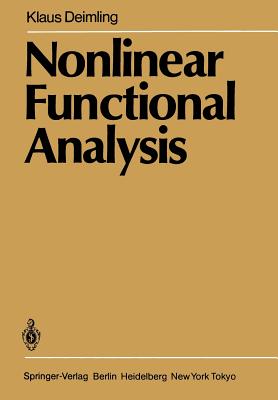
topics. However, only a modest preliminary knowledge is needed. In the first chapter, where we introduce an important topological concept, the so-called topological degree for continuous maps from subsets ofRn into Rn, you need not know anything about functional analysis. Starting with Chapter 2, where infinite dimensions first appear, one should be familiar with the essential step of consider- ing a sequence or a function of some sort as a point in the corresponding vector space of all such sequences or functions, whenever this abstraction is worthwhile. One should also work out the things which are proved in 7 and accept certain basic principles of linear functional analysis quoted there for easier references, until they are applied in later chapters. In other words, even the 'completely linear' sections which we have included for your convenience serve only as a vehicle for progress in nonlinearity. Another point that makes the text introductory is the use of an essentially uniform mathematical language and way of thinking, one which is no doubt familiar from elementary lectures in analysis that did not worry much about its connections with algebra and topology. Of course we shall use some elementary topological concepts, which may be new, but in fact only a few remarks here and there pertain to algebraic or differential topological concepts and methods.
商品描述(中文翻譯)
這些主題。不過,只需要具備適度的初步知識即可。在第一章中,我們將介紹一個重要的拓撲概念,也就是連續映射的所謂拓撲度(topological degree):其定義域是 Rn 的子集,而值域為 Rn。學習這部分不需要任何泛函分析(functional analysis)知識。
從首次出現無限維度的第二章開始,讀者應熟悉一個基本步驟:只要這種抽象化是有益的,就將某個序列或某種函數視為由所有此類序列或函數構成之相應向量空間中的一個點。此外,讀者也應自行研讀第 7 節中所證明的內容,並接受其中為了便於後續參考而引用的某些線性泛函分析基本原理,直到這些原理在後面的章節中被應用為止。換句話說,即使是我們為了方便而納入的那些「完全線性」章節,也只不過是推進非線性研究的工具而已。
使本書具有入門性質的另一項因素,是我們採用了一套基本上統一的數學語言與思考方式;這套語言與方式,讀者無疑會在基礎分析課程中感到熟悉,因為那些課程通常不太著重於分析與代數及拓撲之間的關聯。當然,我們會使用一些可能對讀者而言較為陌生的初等拓撲概念;不過,實際上只有少數零星的說明涉及代數拓撲或微分拓撲的概念與方法。