商品描述
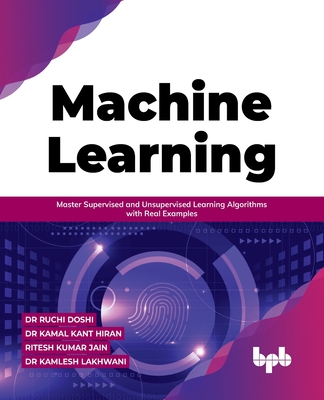
Concepts of Machine Learning with Practical Approaches.Key FeaturesIncludes real-scenario examples to explain the working of Machine Learning algorithms.Includes graphical and statistical representation to simplify modeling Machine Learning and Neural Networks.Full of Python codes, numerous exercises, and model question papers for data science students. DescriptionThe book offers the readers the fundamental concepts of Machine Learning techniques in a user-friendly language. The book aims to give in-depth knowledge of the different Machine Learning (ML) algorithms and the practical implementation of the various ML approaches.This book covers different Supervised Machine Learning algorithms such as Linear Regression Model, Na ve Bayes classifier Decision Tree, K-nearest neighbor, Logistic Regression, Support Vector Machine, Random forest algorithms, Unsupervised Machine Learning algorithms such as k-means clustering, Hierarchical Clustering, Probabilistic clustering, Association rule mining, Apriori Algorithm, f-p growth algorithm, Gaussian mixture model and Reinforcement Learning algorithm such as Markov Decision Process (MDP), Bellman equations, policy evaluation using Monte Carlo, Policy iteration and Value iteration, Q-Learning, State-Action-Reward-State-Action (SARSA). It also includes various feature extraction and feature selection techniques, the Recommender System, and a brief overview of Deep Learning.What you will learnPerform feature extraction and feature selection techniques.Learn to select the best Machine Learning algorithm for a given problem.Get a stronghold in using popular Python libraries like Scikit-learn, pandas, and matplotlib.Practice how to implement different types of Machine Learning techniques.Who this book is forThis book is designed for data science and analytics students, academicians, and researchers who want to explore the concepts of machine learning and practice the understanding of real cases. Knowing basic statistical and programming concepts would be good, although not mandatory.Table of Contents1. Introduction2. Supervised Learning Algorithms3. Unsupervised Learning4. Introduction to the Statistical Learning Theory5. Semi-Supervised Learning and Reinforcement Learning6. Recommended SystemsAbout the AuthorsDr Ruchi Doshi has more than 14 years of academic, research, and software development experience in Asia and Africa. Currently, she is working as a research supervisor at the Azteca University, Mexico, and as an adjunct faculty at the Jyoti Vidyapeeth Women's University, Jaipur, Rajasthan, India. Kamal Kant Hiran works as an Assistant Professor, School of Engineering at the Sir Padampat Singhania University (SPSU), Udaipur, Rajasthan, India as well as a Research Fellow at the Aalborg University, Copenhagen, Denmark. He is a Gold Medalist in M.Tech. (Hons.). He has more than 16 years of experience as an academic and researcher in Asia, Africa, and Europe.Ritesh Kumar Jain works as an Assistant Professor, at the Geetanjali Institute of Technical Studies, (GITS), Udaipur, Rajasthan, India. He has more than 15 years of teaching and research experience. Dr. Kamlesh Lakhwani works as an Associate Professor, in Computer Science & Engineering at JECRC University Jaipur, Rajasthan, India. He has an excellent academic background and a rich experience of 15 years as an academician and researcher in Asia.Read more
商品描述(中文翻譯)
機器學習概念與實用方法
主要特點
包含真實情境範例以解釋機器學習演算法的運作。
包含圖形和統計表示以簡化機器學習和神經網絡的建模。
充滿 Python 代碼、眾多練習題和數據科學學生的模擬考題。
描述
本書以易於理解的語言向讀者提供機器學習技術的基本概念。書中旨在深入介紹不同的機器學習(Machine Learning, ML)演算法及各種 ML 方法的實際應用。本書涵蓋了不同的監督式機器學習演算法,如線性回歸模型(Linear Regression Model)、朴素貝葉斯分類器(Naive Bayes classifier)、決策樹(Decision Tree)、K 最近鄰(K-nearest neighbor)、邏輯回歸(Logistic Regression)、支持向量機(Support Vector Machine)、隨機森林演算法(Random forest algorithms);以及無監督式機器學習演算法,如 K-means 聚類(k-means clustering)、層次聚類(Hierarchical Clustering)、概率聚類(Probabilistic clustering)、關聯規則挖掘(Association rule mining)、Apriori 演算法、f-p 增長演算法(f-p growth algorithm)、高斯混合模型(Gaussian mixture model)和強化學習演算法,如馬可夫決策過程(Markov Decision Process, MDP)、貝爾曼方程(Bellman equations)、使用蒙地卡羅的政策評估(policy evaluation using Monte Carlo)、政策迭代(Policy iteration)和價值迭代(Value iteration)、Q-學習(Q-Learning)、狀態-行動-獎勵-狀態-行動(State-Action-Reward-State-Action, SARSA)。此外,還包括各種特徵提取和特徵選擇技術、推薦系統(Recommender System)以及深度學習的簡要概述。
您將學到的內容
執行特徵提取和特徵選擇技術。
學習為特定問題選擇最佳的機器學習演算法。
熟練使用流行的 Python 函式庫,如 Scikit-learn、pandas 和 matplotlib。
練習如何實施不同類型的機器學習技術。
本書適合對象
本書專為數據科學和分析的學生、學者及研究人員設計,旨在探索機器學習的概念並實踐對真實案例的理解。了解基本的統計和程式設計概念會有幫助,但並非必要。
目錄
1. 介紹
2. 監督式學習演算法
3. 無監督式學習
4. 統計學習理論簡介
5. 半監督式學習和強化學習
6. 推薦系統
關於作者
Ruchi Doshi 博士在亞洲和非洲擁有超過 14 年的學術、研究和軟體開發經驗。目前,她在墨西哥的阿茲特克大學擔任研究主管,並在印度拉賈斯坦邦的喬提大學(Jyoti Vidyapeeth Women's University)擔任兼任教職。Kamal Kant Hiran 在印度拉賈斯坦邦烏代布爾的西爾·帕丹帕特·辛哈尼亞大學(Sir Padampat Singhania University, SPSU)擔任工程學院助理教授,同時也是丹麥奧爾堡大學的研究員。他是 M.Tech.(榮譽)金獎得主,擁有超過 16 年的學術和研究經驗,遍及亞洲、非洲和歐洲。Ritesh Kumar Jain 在印度拉賈斯坦邦烏代布爾的吉坦賈利技術學院(Geetanjali Institute of Technical Studies, GITS)擔任助理教授,擁有超過 15 年的教學和研究經驗。Kamlesh Lakhwani 博士在印度拉賈斯坦邦的 JECRC 大學擔任計算機科學與工程副教授,擁有優秀的學術背景和 15 年的學術及研究經驗。