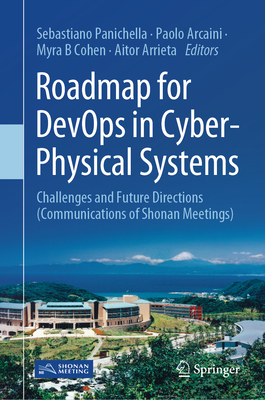
Roadmap for Devops in Cyber-Physical Systems: Challenges and Future Directions (Communications of Shonan Meetings)
暫譯: 網路物理系統中的DevOps路線圖:挑戰與未來方向(湘南會議通訊)
Panichella, Sebastiano, Arcaini, Paolo, Cohen, Myra B.
商品描述
作者簡介
Sebastiano Panichella is a Computer Science Researcher at the University of Bern, advancing cutting-edge DevOps practices and AI-driven software engineering to develop robust cyber-physical systems--from autonomous drones to smart vehicles--that address critical infrastructure challenges. His pioneering interdisciplinary vision bridges software engineering with life sciences, biopharma R&D, and urban planning to enable next-generation IoT ecosystems for sustainable smart cities.
Through flagship initiatives such as COSMOS (DevOps for CPS), InnoGuard (generative AI), and Safe2Fly/AERIALIST (UAV reliability), he embodies deep industry-academia collaboration. This synergy extends to SwarmOps and transformative biopharma projects (e.g., the BioAI4LCMS focusing on software engineering, AI, and life sciences), reflecting his commitment to tangible innovation. Author of ≈100 influential publications, his seminal EMSE journal paper in 2017 on DevOps technologies earned the prestigious 2025 ICST Most Influential Journal Paper Award. He further shapes the field through editorial leadership at ACM TOSEM and Journal of Software: Evolution and Process, conference stewardship (ICSE, ASE, FSE, ICSME, etc.), and cybersecurity contributions in Large Language Models in Cybersecurity and Cyberdefense.
Paolo Arcaini is an associate professor at the National Institute of Informatics, Japan. He received a Ph.D. in Computer Science from the University of Milan in 2013. Before joining NII, he held an assistant professor position at Charles University, Czech Republic. His current main research interests are related to testing of autonomous driving systems, testing of quantum programs, automatic repair of neural networks, and falsification of hybrid systems.
Myra Cohen is a Professor and the Lanh and Oanh Nguyen Chair in Software Engineering in the Department of Computer Science at Iowa State University. She received her PhD from the University of Auckland, New Zealand in 2004. Her research focus is on software testing and self-adaptation of complex systems such as those which are highly-configurable, embedded or cyber-physical. She also designs testing techniques for scientific and emerging disciplines such as bioinformatics software, molecular programs and quantum computing. Her research has received 4 ACM Distinguished Paper awards. She is an ACM distinguished scientist, an IEEE Senior Member, a Better Scientific Software Fellow and a Fellow of Automated Software Engineering. She received the IEEE Technical Council on Software Engineering 2025 Barbora Bühnová Leadership Award for Women in Science and Engineering. She has served on many software engineering conference program committees and was the general chair of the IEEE/ACM International Conference on Automated Software Engineering (ASE), 2015, as well as the program co-chair of ICST 2019, ESEC/FSE 2020 and ISSTA 2025.
Aitor Arrieta is a Professor at Mondragon University. He got his PhD in software engineering at Mondragon University in 2017. His research interests lie in the field of software testing (e.g., search-based software testing, test oracle problem, regression testing, debugging, and repair), especially on testing untestable systems, such as cyberphysical systems, highly configurable systems, and machine learning-based systems.
He co-leads two EU projects: InnoGuard (generative AI for trustworthy autonomous CPS) and TRUST4AI (trustable internet search). As a program committee member for ISSTA and ICST (2025), he bridges academic and industrial practices.
作者簡介(中文翻譯)
Sebastiano Panichella 是伯恩大學的計算機科學研究員,推進尖端的 DevOps 實踐和 AI 驅動的軟體工程,以開發穩健的網路物理系統——從自主無人機到智慧車輛——以應對關鍵基礎設施挑戰。他的開創性跨學科視野將軟體工程與生命科學、生物製藥研發和城市規劃相結合,促進可持續智慧城市的下一代物聯網生態系統。
透過 COSMOS(網路物理系統的 DevOps)、InnoGuard(生成式 AI)和 Safe2Fly/AERIALIST(無人機可靠性)等旗艦計畫,他體現了深度的產學合作。這種協同擴展到 SwarmOps 和變革性的生物製藥專案(例如,專注於軟體工程、AI 和生命科學的 BioAI4LCMS),反映了他對實質創新的承諾。他是約 100 篇影響力出版物的作者,2017 年在 EMSE 期刊上發表的關於 DevOps 技術的開創性論文獲得了 2025 年 ICST 最具影響力期刊論文獎。他還通過在 ACM TOSEM 和 Journal of Software: Evolution and Process 的編輯領導、會議管理(ICSE、ASE、FSE、ICSME 等)以及在大型語言模型在網路安全和網路防禦中的貢獻,進一步塑造該領域。
Paolo Arcaini 是日本國立資訊學院的副教授。他於 2013 年在米蘭大學獲得計算機科學博士學位。在加入 NII 之前,他曾在捷克的查爾斯大學擔任助理教授。他目前的主要研究興趣與自主駕駛系統的測試、量子程式的測試、自動修復神經網路以及混合系統的偽造有關。
Myra Cohen 是愛荷華州立大學計算機科學系的教授及 Lanh 和 Oanh Nguyen 軟體工程講座教授。她於 2004 年在紐西蘭奧克蘭大學獲得博士學位。她的研究重點是軟體測試和複雜系統的自我適應,這些系統通常是高度可配置的、嵌入式或網路物理的。她還設計針對科學和新興學科(如生物資訊學軟體、分子程式和量子計算)的測試技術。她的研究獲得了 4 項 ACM 傑出論文獎。她是 ACM 傑出科學家、IEEE 高級會員、Better Scientific Software Fellow 和自動化軟體工程學會的會士。她獲得了 IEEE 軟體工程技術委員會 2025 年 Barbora Bühnová 女性科學與工程領導獎。她曾在許多軟體工程會議的程序委員會中任職,並於 2015 年擔任 IEEE/ACM 自動化軟體工程國際會議(ASE)的總主席,以及 ICST 2019、ESEC/FSE 2020 和 ISSTA 2025 的程序共同主席。
Aitor Arrieta 是蒙德拉貢大學的教授。他於 2017 年在蒙德拉貢大學獲得軟體工程博士學位。他的研究興趣集中在軟體測試領域(例如,基於搜尋的軟體測試、測試預言問題、回歸測試、除錯和修復),特別是針對無法測試的系統,如網路物理系統、高度可配置系統和基於機器學習的系統。
他共同領導兩個歐盟專案:InnoGuard(用於可信自主網路物理系統的生成式 AI)和 TRUST4AI(可信的網路搜尋)。作為 ISSTA 和 ICST(2025)的程序委員會成員,他在學術和產業實踐之間架起了橋樑。