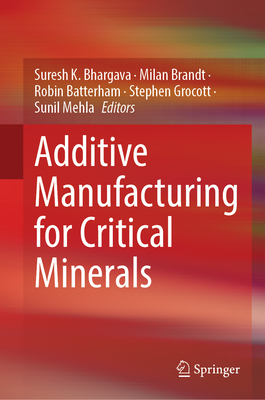
Additive Manufacturing for Critical Minerals
暫譯: 關鍵礦物的增材製造
K. Bhargava, Suresh, Brandt, Milan, Batterham, Robin
商品描述
This book highlights the challenges to their efficient and sustainable production which impact climate, habitats, human living, future minerals availability, biodiversity and working conditions. This article evaluates the role of additive manufacturing in the sustainable production of critical minerals. An essential physical technology of the fourth industrial revolution, additive manufacturing is a transformative technology capable of enabling the complete redesign and rejuvenation of critical mineral industries towards a cleaner, more affordable, and resource-abundant future. In the mining of critical minerals, additive manufacturing enables automated exploration and mapping of critical mineral reserves using innovative robot and drone designs. It also enables process-wide automation and optimization in mining operations, facilitates better understanding of geology and rock mechanics, and opens new avenues for the research and development of independent remote mining bases. In the mineralogical and metallurgical processing of critical minerals, additive manufacturing enables the manufacture of high-performance, lightweight, wear-resistant, corrosion-resistant, low-cost, and recyclable tools and equipment and capabilities for their on-site repair, remanufacture and customization. Additive manufacturing enables the development of new mineralogical and metallurgical processes through rapid prototyping and presents new opportunities for metal recycling and their re-extraction from waste streams. Thus, additive manufacturing can make critical mineral production more efficient and sustainable by improvement in overall process efficiencies, reduction in energy, and water consumption, minimization, or remediation of waste streams, and reduction in operational and maintenance costs, and greenhouse gas emissions.
商品描述(中文翻譯)
這本書突顯了影響氣候、生境、人類生活、未來礦物可用性、生物多樣性和工作條件的有效且可持續生產所面臨的挑戰。本文評估了增材製造在關鍵礦物可持續生產中的角色。增材製造作為第四次工業革命的一項基本物理技術,是一種變革性技術,能夠使關鍵礦物行業實現全面的重新設計和更新,朝向更清潔、更經濟和資源豐富的未來。在關鍵礦物的開採中,增材製造使得利用創新的機器人和無人機設計進行自動化探索和關鍵礦物儲量的繪製成為可能。它還促進了採礦作業的全過程自動化和優化,加深了對地質和岩石力學的理解,並為獨立的遠程採礦基地的研究和開發開辟了新的途徑。在關鍵礦物的礦物學和冶金加工中,增材製造使得能夠製造高性能、輕量、耐磨、耐腐蝕、低成本和可回收的工具和設備,並具備現場修理、再製造和定制的能力。增材製造通過快速原型製作促進了新礦物學和冶金過程的發展,並為金屬回收及其從廢料流中重新提取提供了新的機會。因此,增材製造可以通過提高整體過程效率、減少能源和水的消耗、最小化或修復廢料流、降低運營和維護成本以及溫室氣體排放,使關鍵礦物的生產變得更加高效和可持續。
作者簡介
Distinguished Professor Suresh K. Bhargava, AM--recipient of the Queen's Honour in 2022--is the visionary mind, idea creator, and driving force behind this book. As the founding director of RMIT University's Centre for Advanced Materials and Industrial Chemistry, he is celebrated worldwide for his rare ability to seamlessly connect science with engineering, making him one of the most influential multidisciplinary scientists of his generation. With an H-index of 93, over 750 peer-reviewed publications, 23 book chapters, and more than 30,600 citations, Professor Bhargava's pioneering contributions span chemical sciences, materials sciences, chemical engineering, catalysis, and the use of metals in medicine. He is the creator, principal author, and Editor-in-Chief of both this volume and the acclaimed Additive Manufacturing in Chemical Sciences and Engineering--already translated into German and soon to be available in other languages.
Distinguished Prof. Milan Brandt is the technical director of the Digital Manufacturing Facility and Director of the Centre for Additive Manufacturing at RMIT University. He is the lead Australian researcher in macro-machining and laser additive manufacturing and has conducted work over the last 37 years in laser cladding, cutting, drilling, welding, and additive manufacturing. This has resulted in technological advancements, patents, research papers, and commercial products, which have been recognized nationally and internationally in both scientific and industrial circles. He is a fellow of the Laser Institute of America, an honorary fellow of Weld Australia, a professorial fellow of the Department of Medicine, Melbourne University, and an adjunct professor at the University of Waterloo, Canada. In 2018, he was the President of the Laser Institute of America which is the largest international association of researchers and industry involved with lasers and laser additive technology.
Emeritus Prof. Robin Batterham, FR Egg, AO, is currently the chairman of the steering committee of the net zero Australia (NZAu) project. Formerly, he has worked in the roles of the Chief Scientist of Australia (1999-2006), Group Chief Technologist at Rio Tinto (1999-2011), President of the Australian Academy of Technological Sciences and Engineering (2007-2012), and president of the Institution of Chemical Engineers (2004-2005). He graduated from the University of Melbourne in Chemical Engineering in 1965 where he also completed his Ph.D. in 1969. He has been named in the Engineers Australia's list of the 100 most influential engineers several times. Prof. Batterham is an elected fellow of many prestigious academies around the world including the Australian academy of science, the Swiss academy of engineering sciences, and the Royal Academy of Engineering (UK).
Dr. Stephen Grocott, FRACI, is the Group Head, Processing and Closure, at Newmont Ltd, the world's largest gold producer. Prior to leading Newmont's processing and closure portfolio, he was the managing director and CEO of Queensland Pacific Metals (QPM) in Australia, bringing over 40 years of expertise in minerals processing, process development, and industrial chemistry. His career spans a wide range of commodities and technologies, including nickel laterites and sulphides, bauxite, alumina, uranium, titania, copper, cobalt, rare earths, shale oil, and biofuels. Before QPM, he served as Chief Technical Development Officer at Clean TeQ and held senior technical leadership roles at Rio Tinto and BHP Billiton in mineral processing and hydrometallurgy. Earlier roles included contributions to global projects with Alcoa, Comalco, Southern Pacific Petroleum, and Worsley Alumina. For over 30 years, Dr. Grocott has worked closely with Distinguished Professor Suresh K. Bhargava, helping to bridge academia and industry.
Dr. Sunil Mehla is a technical project manager at Scimita Innovations Group, NSW, Australia, where he leads the development of novel technologies for recovering critical metals from end-of-life lithium-ion batteries. He studied chemistry at the Indian Institute of Technology (IIT) Kanpur and chemical engineering with a specialization in catalysis at IIT Madras. From 2012 to 2018, Dr. Mehla worked as a scientist at the Hindustan Petroleum R&D Centre, developing catalysts for fluid catalytic cracking, hydroisomerization, and hydrotreating. He earned his Ph.D. at RMIT University, Melbourne, under the supervision of Distinguished Professor Suresh K. Bhargava, where he researched surface-enhanced Raman scattering. Following this, he undertook a postdoctoral fellowship in Professor Bhargava's group at the Centre for Advanced Materials and Industrial Chemistry (CAMIC), investigating the integration of additive manufacturing with critical mineral production.
作者簡介(中文翻譯)
尊敬的Suresh K. Bhargava教授,AM——2022年女王榮譽獲得者——是本書的遠見者、創意創造者和推動力。作為RMIT大學先進材料與工業化學中心的創始主任,他因能夠無縫地將科學與工程相連而在全球享有盛譽,使他成為其世代中最具影響力的多學科科學家之一。Bhargava教授擁有93的H指數,發表了超過750篇同行評審的論文,23章書籍,並且被引用超過30,600次。他在化學科學、材料科學、化學工程、催化劑以及金屬在醫學中的應用方面的開創性貢獻廣泛。他是本書及備受讚譽的《化學科學與工程中的增材製造》的創作者、主要作者和主編,該書已翻譯成德文,並將很快以其他語言出版。
尊敬的Milan Brandt教授是RMIT大學數位製造設施的技術總監及增材製造中心的主任。他是澳大利亞宏觀加工和激光增材製造的主要研究者,並在過去37年中從事激光熔覆、切割、鑽孔、焊接和增材製造的工作。這些工作促成了技術進步、專利、研究論文和商業產品,並在科學和工業界獲得了國內外的認可。他是美國激光學會的院士,澳大利亞焊接協會的榮譽院士,墨爾本大學醫學系的教授院士,以及加拿大滑鐵盧大學的兼任教授。2018年,他曾擔任美國激光學會的會長,該學會是與激光及激光增材技術相關的最大國際研究者和產業協會。
榮譽教授Robin Batterham,FR Egg,AO,目前是淨零澳大利亞(NZAu)項目指導委員會的主席。此前,他曾擔任澳大利亞首席科學家(1999-2006)、力拓集團首席技術官(1999-2011)、澳大利亞技術科學與工程學院院長(2007-2012)及化學工程師學會會長(2004-2005)。他於1965年在墨爾本大學獲得化學工程學位,並於1969年完成博士學位。他多次入選澳大利亞工程師協會的100位最具影響力工程師名單。Batterham教授是全球多個著名學院的當選院士,包括澳大利亞科學院、瑞士工程科學院和英國皇家工程院。
Stephen Grocott博士,FRACI,是全球最大金礦生產商Newmont Ltd的處理與關閉部門的集團負責人。在領導Newmont的處理與關閉業務之前,他曾擔任澳大利亞Queensland Pacific Metals(QPM)的董事總經理和首席執行官,擁有超過40年的礦物處理、工藝開發和工業化學專業知識。他的職業生涯涵蓋了多種商品和技術,包括鎳紅土和硫化物、鋁土礦、鋁、鈾、鈦、銅、鈷、稀土、頁岩油和生物燃料。在加入QPM之前,他曾擔任Clean TeQ的首席技術開發官,並在力拓和BHP Billiton擔任礦物處理和水冶金的高級技術領導職位。早期的角色包括參與與Alcoa、Comalco、Southern Pacific Petroleum和Worsley Alumina的全球項目。在過去30多年中,Grocott博士與Suresh K. Bhargava教授密切合作,幫助橋接學術界與產業界。
Sunil Mehla博士是澳大利亞新南威爾士州Scimita Innovations Group的技術項目經理,負責開發從報廢鋰離子電池中回收關鍵金屬的新技術。他在印度理工學院(IIT)坎普爾學習化學,並在IIT馬德拉斯專攻催化的化學工程。從2012年到2018年,Mehla博士在印度石油公司研發中心擔任科學家,開發流體催化裂化、氫異構化和氫處理的催化劑。他在RMIT大學墨爾本獲得博士學位,指導教授為Suresh K. Bhargava教授,研究主題為表面增強拉曼散射。隨後,他在Bhargava教授的先進材料與工業化學中心(CAMIC)進行博士後研究,調查增材製造與關鍵礦物生產的整合。