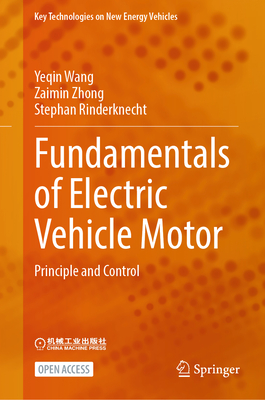
Fundamentals of Electric Vehicle Motor: Principle and Control
暫譯: 電動車馬達基礎:原理與控制
Wang, Yeqin, Zhong, Zaimin, Rinderknecht, Stephan
- 出版商: Springer
- 出版日期: 2026-05-23
- 售價: $2,780
- 貴賓價: 9.5 折 $2,641
- 語言: 英文
- 頁數: 367
- 裝訂: Hardcover - also called cloth, retail trade, or trade
- ISBN: 9819580897
- ISBN-13: 9789819580897
-
相關分類:
電機學 Electric-machinery
海外代購書籍(需單獨結帳)
商品描述
商品描述(中文翻譯)
這本「開放存取」的書系統性地介紹了汽車交流驅動馬達的基本工作原理和控制理論。書中的主要內容是從汽車電動驅動技術、電機理論和交流馬達控制中編輯而成。該書分為三個部分:電機的電磁基礎、交流機械的基本工作原理,以及汽車交流驅動馬達的向量控制理論基礎和系統整合。這本書的內容安排充分考慮了非電氣工程專業的課程,力求結構完整。這本書的特點在於:數學分析方法和物理表述儘可能保持一致,主要使用空間向量和能量方法來描述電機的電機能量轉換過程。此外,在介紹運動參考框架後,書中引入了「牽引電動勢」的概念。在此基礎上,介紹了一個四繞組原始電機(物理)模型,以統一描述電機的電機能量轉換原理。這本書可以作為非電氣工程專業本科或研究生課程的教科書,也可以作為從事交流馬達驅動技術的工程師的入門參考書。
作者簡介
Prof. Zaimin Zhong received the B.S. and Ph.D. degrees in vehicle engineering from the Beijing Institute of Technology, Beijing, China, in 1995 and 2000, respectively. In December 2005, he became an Associate Professor, and in December 2012, he became a Professor at Tongji University, Shanghai, China. Since 2025, Prof. Zhong has published over 50 well cited research papers. He published the book entitled "Distributed Parameter Model of Electric Motors for Vehicular Applications" in 2018 and the textbook "Principle and Control Fundamentals of Vehicle Drive Motor (In Chinese)", its 2nd edition in 2020 and 2024. His current research interests include automotive electric drive and transportation electrification.
Prof. Stephan Rinderknecht studied Aerospace Engineering at the University of Stuttgart from 1984 to 1990, where he subsequently received his doctorate degree in 1994. After working as a post-doc at the Institute for Statics and Dynamics of Aerospace Constructions (ISD) at the University of Stuttgart, he moved to industry in 1995. Until 2008 he worked as a development engineer and last as Vice President Research and Development at GETRAG Getriebe- und Zahnradfabrik Hermann Hagenmeyer GmbH & Cie KG in Ludwigsburg, Untergruppenbach and St. Georgen. Since 2009 he has been a professor for Mechatronic Systems in Mechanical Engineering at the TU Darmstadt. Prof. Rinderknecht is active in various program committees (e.g. CTI Symposium Automotive Drivetrains, VDI Dritev, VDI Mechatronics, SIRM - Vibrations in Rotating Machinary), as a member of the Mechatronics Technical Committee of the VDI/VDE Society for Measurement and Automation Technology (GMA) and as an editorial board member of the open access journal "vehicles" at MDPI. His current research is on architectures for hybrid and electric drives and the system development of mechatronic transmissions, the design of flywheel energy storages and control of multimodal smart grids as well as sectorial system coupling and integration.
作者簡介(中文翻譯)
王業欽博士於2009年獲得中國農業大學工程學院汽車工程學士學位,2012年獲得同濟大學汽車研究院汽車工程碩士學位,並於2019年獲得德克薩斯科技大學國立風能研究所風科學與工程博士學位。他曾獲得德克薩斯科技大學的優秀論文獎(2020年第二名)。從2019年到2021年,他擔任美國伊利諾伊州威洛布魯克的Syndem LLC技術總監。自2021年以來,他一直是同濟大學的助理教授。自2025年以來,王博士已發表超過20篇SCI期刊論文。他是2024年出版的教科書《車輛驅動電機原理與控制基礎(第二版,中文)》的共同作者。他目前的研究興趣包括電驅動系統、電力電子控制和可再生能源。
鍾在敏教授於1995年和2000年分別獲得北京理工大學車輛工程學士和博士學位。2005年12月,他成為同濟大學的副教授,並於2012年12月晉升為教授。自2025年以來,鍾教授已發表超過50篇被廣泛引用的研究論文。他於2018年出版了《車輛應用電動機的分佈參數模型》一書,並於2020年和2024年出版了教科書《車輛驅動電機原理與控制基礎(中文)》的第二版。他目前的研究興趣包括汽車電驅動和交通電氣化。
斯蒂芬·林德肯特教授於1984年至1990年在斯圖加特大學學習航空航天工程,並於1994年獲得博士學位。在斯圖加特大學航空結構靜力學與動力學研究所(ISD)擔任博士後研究員後,他於1995年進入工業界。直到2008年,他擔任GETRAG Getriebe- und Zahnradfabrik Hermann Hagenmeyer GmbH & Cie KG的開發工程師,最後擔任研究與開發副總裁。自2009年以來,他一直是達姆施塔特工業大學機械工程系的機電系統教授。林德肯特教授活躍於各種程序委員會(例如CTI汽車驅動系統研討會、VDI Dritev、VDI機電一體化、SIRM - 旋轉機械的振動),並擔任VDI/VDE計量與自動化技術學會(GMA)機電一體化技術委員會成員,以及MDPI開放存取期刊《vehicles》的編輯委員會成員。他目前的研究集中在混合動力和電動驅動的架構、機電傳動系統的系統開發、飛輪儲能的設計以及多模式智能電網的控制,以及部門系統的耦合與整合。