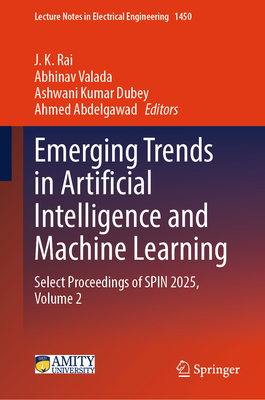
Emerging Trends in Artificial Intelligence and Machine Learning: Select Proceedings of Spin 2025, Volume 2
暫譯: 人工智慧與機器學習的新興趨勢:2025年Spin會議選輯,第二卷
Rai, J. K., Valada, Abhinav, Dubey, Ashwani Kumar
- 出版商: Springer
- 出版日期: 2025-11-16
- 售價: $12,160
- 貴賓價: 9.5 折 $11,552
- 語言: 英文
- 頁數: 515
- 裝訂: Hardcover - also called cloth, retail trade, or trade
- ISBN: 9819699703
- ISBN-13: 9789819699704
-
相關分類:
Machine Learning
海外代購書籍(需單獨結帳)
商品描述
作者簡介
J. K. Rai received his B.E. degree in Electronics Engineering from Shri Guru Gobind Singh College of Engineering and Technology, Nanded, India (1996), his M.Tech. degree in Electronics Engineering from Visvesvaraya Regional College of Engineering, Nagpur, India (1999), and his Doctoral degree from Motilal Nehru National Institute of Technology, Deemed University, Allahabad (2011). He has 26 years of teaching experience and is currently working as a Professor and Head in the Department of Electronics and Communication Engineering, Amity School of Engineering and Technology, Amity University Uttar Pradesh, Noida, India. He has published more than 40 research papers in Scopus-indexed and SCI-indexed journals and international conferences. He has been granted one patent and has successfully guided three Ph.D. research scholars. His current research interests include artificial intelligence, machine learning, robotics, and medical signal and image processing.
Abhinav Valada is a Professor at the University of Freiburg, where he directs the Robot Learning Lab. He is a member of the Department of Computer Science, the BrainLinks-BrainTools center, and a founding faculty member of the ELLIS Unit Freiburg. Abhinav is a DFG Emmy Noether AI Fellow, a Scholar of the ELLIS Society, and Chair of the IEEE Robotics and Automation Society Technical Committee on Robot Learning. He received his Ph.D. (summa cum laude) under Prof. Wolfram Burgard at the University of Freiburg in 2019, his M.S. in Robotics from Carnegie Mellon University in 2013, and his B.Tech. in Electronics and Instrumentation Engineering from VIT University in 2010. Prof. Abhinav's research lies at the intersection of robotics, machine learning, and computer vision, with a focus on tackling fundamental problems in robot perception, state estimation, and planning to enable robots to operate reliably in complex and diverse environments. The overall goal of his research is to develop scalable, lifelong robot learning systems that continuously learn multiple tasks from what they perceive and experience through real-world interaction. For his research, he has received the IEEE RAS Early Career Award in Robotics and Automation, the NVIDIA Research Award, the AutoSens Most Novel Research Award, among others.
Ashwani Kumar Dubey is a Professor in the Department of Electronics and Communication Engineering at ASET, Amity University Uttar Pradesh, Noida, India. He holds a B.E. (AMIE) in Electronics and Communication Engineering, an M.Tech. in Instrumentation and Control Engineering from Maharshi Dayanand University, Rohtak, and a Ph.D. in Electrical Engineering from Jamia Millia Islamia, New Delhi. With over two decades of academic and research experience, Dr. Dubey has held various teaching and administrative roles at leading institutions, including GD Goenka World Institute-Lancaster University (UK). He has published more than 90 research papers in reputed international and national journals and conferences. He has filed 23 patents (3 granted) and has actively contributed to organizing conferences. He has supervised over 10 Ph.D. scholars and continues to guide research in emerging technologies.
Ahmed Abdelgawad received his M.S. and Ph.D. degrees in Computer Engineering from the University of Louisiana at Lafayette in 2007 and 2011, respectively, and subsequently joined IBM as a Design Aids & Automation Engineering Professional at the Semiconductor Research and Development Center. In Fall 2012, he joined Central Michigan University as an Assistant Professor of Computer Engineering. In Fall 2017, Dr. Abdelgawad was promoted early to Associate Professor of Computer Engineering. He is a senior member of IEEE. His areas of expertise include distributed computing for Wireless Sensor Networks (WSN), the Internet of Things (IoT), Structural Health Monitoring (SHM), data fusion techniques for WSN, low-power embedded systems, video processing, digital signal processing, robotics, RFID, localization, VLSI, and FPGA design. He has published two books and more than 80 articles in related journals and conferences.
作者簡介(中文翻譯)
J. K. Rai 於 1996 年在印度南德的 Shri Guru Gobind Singh 工程與技術學院獲得電子工程學士學位,於 1999 年在印度納格浦爾的 Visvesvaraya 區域工程學院獲得電子工程碩士學位,並於 2011 年在阿拉哈巴德的 Motilal Nehru 國立技術學院(被認定為大學)獲得博士學位。他擁有 26 年的教學經驗,目前擔任印度諾伊達 Amity 大學工程與技術學院電子與通信工程系的教授及系主任。他在 Scopus 和 SCI 索引的期刊及國際會議上發表了超過 40 篇研究論文,並獲得了一項專利,成功指導了三位博士研究生。他目前的研究興趣包括人工智慧、機器學習、機器人技術以及醫療信號與影像處理。
Abhinav Valada 是弗萊堡大學的教授,負責機器人學習實驗室。他是計算機科學系、BrainLinks-BrainTools 中心的成員,也是 ELLIS Unit Freiburg 的創始教職員。Abhinav 是 DFG Emmy Noether AI Fellow、ELLIS Society 的學者,以及 IEEE 機器人與自動化學會機器人學習技術委員會的主席。他於 2019 年在弗萊堡大學在 Wolfram Burgard 教授的指導下獲得博士學位(優異),於 2013 年在卡內基梅隆大學獲得機器人碩士學位,並於 2010 年在 VIT 大學獲得電子與儀器工程學士學位。Abhinav 教授的研究位於機器人技術、機器學習和計算機視覺的交叉點,專注於解決機器人感知、狀態估計和規劃中的基本問題,以使機器人能夠在複雜和多樣的環境中可靠運作。他研究的整體目標是開發可擴展的終身機器人學習系統,這些系統能夠通過與現實世界的互動不斷學習多個任務。因其研究,他獲得了 IEEE RAS 機器人與自動化早期職業獎、NVIDIA 研究獎、AutoSens 最具創新研究獎等多項榮譽。
Ashwani Kumar Dubey 是印度諾伊達 Amity 大學 ASET 電子與通信工程系的教授。他擁有電子與通信工程的 B.E.(AMIE)學位、來自 Rohtak 的 Maharshi Dayanand 大學的儀器與控制工程碩士學位,以及來自新德里的 Jamia Millia Islamia 的電氣工程博士學位。擁有超過二十年的學術和研究經驗,Dubey 博士曾在多所知名機構擔任各種教學和行政職位,包括 GD Goenka 世界學院-蘭卡斯特大學(英國)。他在國際和國內知名期刊及會議上發表了超過 90 篇研究論文,並申請了 23 項專利(3 項已獲得),積極參與會議的組織工作。他指導了超過 10 位博士生,並持續在新興技術領域進行研究指導。
Ahmed Abdelgawad 於 2007 年和 2011 年分別在路易斯安那州立大學拉法葉校區獲得計算機工程碩士和博士學位,隨後加入 IBM 擔任半導體研究與開發中心的設計輔助與自動化工程專業人員。2012 年秋季,他加入中央密歇根大學,擔任計算機工程助理教授。2017 年秋季,Abdelgawad 博士提前晉升為計算機工程副教授。他是 IEEE 的高級會員。他的專業領域包括無線感測網路(WSN)的分散式計算、物聯網(IoT)、結構健康監測(SHM)、WSN 的數據融合技術、低功耗嵌入式系統、視頻處理、數字信號處理、機器人技術、RFID、定位、VLSI 和 FPGA 設計。他已出版兩本書籍,並在相關期刊和會議上發表了超過 80 篇文章。