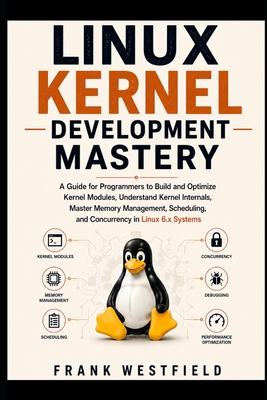
Linux Kernel Development Mastery: A Guide for Programmers to Build and Optimize Kernel Modules, Understand Kernel Internals, Master Memory Management,
暫譯: Linux 核心開發精通:程式設計師構建與優化核心模組、理解核心內部結構、掌握記憶體管理的指南
Westfield, Frank
- 出版商: Independently Published
- 出版日期: 2026-06-23
- 售價: $880
- 貴賓價: 9.5 折 $836
- 語言: 英文
- 頁數: 240
- 裝訂: Quality Paper - also called trade paper
- ISBN: 9798183816716
- ISBN-13: 9798183816716
-
相關分類:
Linux
海外代購書籍(需單獨結帳)
商品描述
This guide is designed for programmers, system developers, and engineers who want to move beyond surface level Linux usage and gain real mastery of kernel development in modern Linux 6.x systems. Instead of overwhelming theory or outdated explanations, this book focuses on practical understanding, showing you how the kernel actually behaves, how to work with it safely, and how to build real, production ready kernel components.
You will start by understanding how the Linux kernel is structured and how user space communicates with kernel space. From there, you will move into setting up a professional kernel development environment and learning how to build, configure, and compile custom Linux kernels from source.
As you progress, you will write and manage kernel modules using the Loadable Kernel Module (LKM) framework, gaining hands on experience with real kernel code patterns used in modern systems. You will also explore how the kernel handles memory, processes, and scheduling, core systems that determine performance, responsiveness, and stability.
Unlike traditional books that stop at theory, this guide goes deeper into real world engineering challenges. You will learn how to handle concurrency issues that cause race conditions, design safe synchronization strategies using mutexes, spinlocks, atomic operations, and RCU mechanisms, and understand how the kernel prevents system instability under heavy workloads.
You will also gain practical insight into memory management, including dynamic allocation, memory zones, reclaim mechanisms, and out-of-memory handling, critical knowledge for writing efficient and reliable kernel-level code. On top of that, you will explore how devices interact with the kernel and how simple drivers are structured and implemented.
Debugging and observability are treated as first-class concepts. You will learn how to trace kernel behavior, diagnose crashes, analyze performance bottlenecks, and build kernel modules that are maintainable, secure, and production ready. Every concept is tied to real engineering practices used in modern Linux environments.
Inside this book, you will discover how to:
Build and configure the Linux 6.x kernel from source with confidence
Write and manage kernel modules using modern LKM techniques
Understand kernel architecture, execution flow, and system internals
Master memory management, paging, and allocation strategies
Work with CPU scheduling and task prioritization in real systems
Handle concurrency using locks, atomic operations, and lock free techniques
Design safe communication between user space and kernel space
Develop simple device drivers for Linux systems
Debug kernel modules and analyze system crashes effectively
Optimize kernel components for performance, scalability, and stability
By the end of this book, you will no longer see Linux as a black box. You will understand how it makes decisions, how it manages resources, and how you can extend it safely and professionally. More importantly, you will develop the ability to design kernel-level solutions that are stable under pressure, efficient under load, and suitable for real-world deployment.
商品描述(中文翻譯)
Linux 是現代計算的核心,驅動著從雲端基礎設施和嵌入式設備到企業伺服器和高效能系統的一切。然而對於大多數程式設計師來說,Linux 核心仍然是一個複雜且不透明的層次,雖然每天都在使用,但很少能在深層次上理解。Linux Kernel Development Mastery 橋接了這個鴻溝。
本指南專為希望超越表面 Linux 使用,並在現代 Linux 6.x 系統中獲得真正核心開發精通的程式設計師、系統開發者和工程師而設計。這本書不會淹沒於繁瑣的理論或過時的解釋,而是專注於實際理解,向您展示核心實際的行為、如何安全地與其互動,以及如何構建真正的、可投入生產的核心組件。
您將首先了解 Linux 核心的結構以及用戶空間如何與核心空間通信。接著,您將設置專業的核心開發環境,學習如何從源碼構建、配置和編譯自定義的 Linux 核心。
隨著進展,您將使用可加載核心模組(Loadable Kernel Module, LKM)框架編寫和管理核心模組,獲得與現代系統中使用的真實核心代碼模式的實踐經驗。您還將探索核心如何處理記憶體、進程和排程,這些是決定性能、響應性和穩定性的核心系統。
與傳統書籍僅停留於理論不同,本指南深入探討現實世界的工程挑戰。您將學習如何處理導致競爭條件的並發問題,設計安全的同步策略,使用互斥鎖、旋轉鎖、原子操作和 RCU 機制,並理解核心如何在重負載下防止系統不穩定。
您還將獲得有關記憶體管理的實用見解,包括動態分配、記憶體區域、回收機制和內存不足處理,這是編寫高效且可靠的核心級代碼的關鍵知識。此外,您將探索設備如何與核心互動,以及簡單驅動程式的結構和實現。
除錯和可觀察性被視為一級概念。您將學習如何追蹤核心行為、診斷崩潰、分析性能瓶頸,並構建可維護、安全且可投入生產的核心模組。每個概念都與現代 Linux 環境中使用的真實工程實踐相連結。
在這本書中,您將發現如何:
- 自信地從源碼構建和配置 Linux 6.x 核心
- 使用現代 LKM 技術編寫和管理核心模組
- 理解核心架構、執行流程和系統內部
- 精通記憶體管理、分頁和分配策略
- 在真實系統中處理 CPU 排程和任務優先級
- 使用鎖、原子操作和無鎖技術處理並發
- 設計用戶空間和核心空間之間的安全通信
- 為 Linux 系統開發簡單的設備驅動程式
- 有效地除錯核心模組和分析系統崩潰
- 優化核心組件以提高性能、可擴展性和穩定性
在本書結束時,您將不再將 Linux 視為黑箱。您將理解它如何做出決策、如何管理資源,以及如何安全且專業地擴展它。更重要的是,您將培養設計在壓力下穩定、在負載下高效且適合實際部署的核心級解決方案的能力。