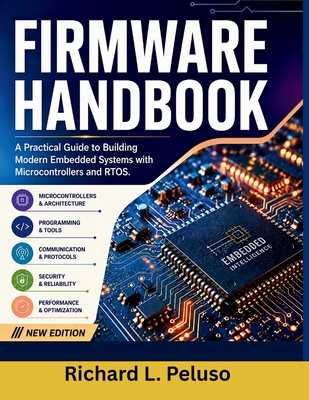
Firmware Handbook: A Practical Guide to Building Modern Embedded Systems with Microcontrollers and RTOS
暫譯: 韌體手冊:現代嵌入式系統與微控制器及即時作業系統的實用指南
Peluso, Richard L.
- 出版商: Independently Published
- 出版日期: 2026-07-28
- 售價: $2,320
- 貴賓價: 9.5 折 $2,204
- 語言: 英文
- 頁數: 318
- 裝訂: Quality Paper - also called trade paper
- ISBN: 9798189618154
- ISBN-13: 9798189618154
-
相關分類:
ARM
海外代購書籍(需單獨結帳)
商品描述
- Understand microcontroller architecture, memory systems, buses, peripherals, and startup behaviour
- Configure GPIO, timers, interrupts, ADCs, DACs, UART, SPI, I C, CAN, USB, and other common interfaces
- Write efficient, maintainable, and portable embedded C firmware
- Design deterministic real-time applications using RTOS tasks, scheduling, queues, semaphores, mutexes, event flags, and timers
- Manage memory safely and avoid fragmentation, stack overflow, and hard-to-find runtime faults
- Implement low-power techniques for battery-powered and energy-efficient devices
- Use debugging tools such as SWD/JTAG, breakpoints, watchpoints, trace, logic analysers, and oscilloscopes
- Develop reliable bootloaders and firmware update mechanisms
- Build interrupt-driven and event-driven systems with predictable timing
- Apply defensive programming, fault handling, watchdog recovery, and safety-oriented design practices
- Test firmware effectively using unit testing, integration testing, hardware-in-the-loop methods, and continuous integration workflows
- Organise firmware projects for scalability, teamwork, version control, documentation, and long-term maintenance.
商品描述(中文翻譯)
現代產品——從智慧家庭設備和醫療儀器到工業控制器、汽車電子和物聯網系統——依賴於穩健的韌體。然而,許多工程師在將理論與實際實施相連接時面臨困難。《韌體手冊》填補了這一空白,提供了一本清晰、實用的指南,幫助設計、開發、除錯和維護使用現代微控制器和即時作業系統(RTOS)的嵌入式系統。
本書是為那些希望獲得實用知識而不僅僅是學術理論的讀者而寫的。它用簡單的語言解釋複雜的概念,並展示韌體組件如何在實際項目中協同工作。
在這本全面的手冊中,您將學到如何:
- 理解微控制器架構、記憶體系統、匯流排、外圍設備和啟動行為
- 配置 GPIO、計時器、中斷、ADC、DAC、UART、SPI、I²C、CAN、USB 和其他常見介面
- 編寫高效、可維護和可攜帶的嵌入式 C 韌體
- 使用 RTOS 任務、排程、佇列、信號量、互斥鎖、事件標誌和計時器設計確定性即時應用程式
- 安全地管理記憶體,避免碎片化、堆疊溢出和難以發現的執行時錯誤
- 為電池供電和節能設備實施低功耗技術
- 使用調試工具,如 SWD/JTAG、斷點、觀察點、追蹤、邏輯分析儀和示波器
- 開發可靠的引導程式和韌體更新機制
- 構建具有可預測時序的中斷驅動和事件驅動系統
- 應用防禦性編程、錯誤處理、看門狗恢復和安全導向的設計實踐
- 使用單元測試、整合測試、硬體在環路方法和持續整合工作流程有效測試韌體
- 組織韌體項目以便於擴展、團隊合作、版本控制、文檔和長期維護。
...還有更多。
這本書有什麼不同之處?
與許多重點放在數學或特定供應商細節的嵌入式書籍不同,《韌體手冊》強調實用的工程決策。每個主題都以現實世界的背景、實施指導、設計權衡和專業嵌入式開發中使用的最佳實踐呈現。
無論您是創建您的第一個微控制器項目,還是開發複雜的基於 RTOS 的產品,這本手冊提供了一條從基礎到高級韌體工程的結構化路徑。
如果您想要一本可以放在開發板旁邊並在整個職業生涯中隨時查閱的實用參考書,《韌體手冊》就是您一直在尋找的資源。