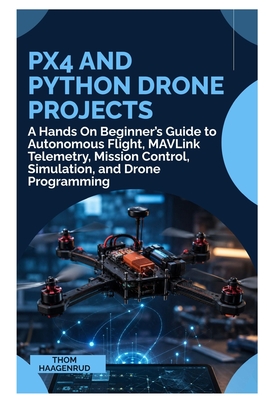
PX4 and Python Drone Projects: A Hands On Beginner's Guide to Autonomous Flight, MAVLink Telemetry, Mission Control, Simulation, and Drone Programming
暫譯: PX4 與 Python 無人機專案:自動飛行、MAVLink 遙測、任務控制、模擬及無人機程式設計的實作入門指南
Haagenrud, Thom
- 出版商: Independently Published
- 出版日期: 2026-08-19
- 售價: $970
- 貴賓價: 9.5 折 $921
- 語言: 英文
- 頁數: 218
- 裝訂: Quality Paper - also called trade paper
- ISBN: 9798193619970
- ISBN-13: 9798193619970
-
相關分類:
無人機
海外代購書籍(需單獨結帳)
商品描述
Move beyond isolated drone scripts and start building complete UAV applications.
Connecting a few lines of code to an aircraft is easy. Building software that understands vehicle state, handles rejected commands, records useful data, survives communication problems, and behaves predictably when conditions change requires a much stronger engineering foundation.
PX4 and Python Drone Projects gives beginning and early intermediate developers a structured, project driven path into modern UAV software development.
Instead of treating the autopilot, communication layer, ground station, simulator, and application code as unrelated tools, this book shows how they fit together as one complete system. You will learn where high level application logic belongs, what the autopilot should remain responsible for, and how to diagnose problems by identifying the layer where they actually occur.
The learning path begins with architecture and environment preparation before any aircraft is commanded. You then progress through vehicle state, sensors, coordinate frames, flight modes, health checks, failsafes, simulation, vehicle connectivity, data monitoring, navigation, external movement, logging, deployment, and recovery behavior.
Inside, you will learn how to:
- Understand the architecture of a programmable unmanned aircraft
- Build a reproducible development environment
- Understand vehicle state, attitude, position, coordinate frames, arming, and failsafes
- Work safely with virtual multicopters before using physical hardware
- Use a ground station to inspect vehicle status and navigation behavior
- Establish reliable application connections
- Work with asynchronous vehicle data streams
- Monitor position, attitude, velocity, battery condition, GPS status, and operating mode
The larger projects are a major strength of the manuscript. Readers build a telemetry recorder, create an autonomous survey application, generate waypoints from a defined survey area, validate navigation conditions, record data during operation, handle interruptions, and define a safe recovery process.
The book also covers the transition from a development laptop to a companion computer. Readers learn how configuration, process supervision, logging, connection recovery, graceful shutdown, serial links, and onboard Linux applications fit into a maintainable vehicle architecture.
Safety is treated as part of software engineering rather than an afterthought. The manuscript emphasizes preflight validation, failsafes, geofencing, command timeouts, connection recovery, application logs, repeatable testing, and controlled progression from virtual testing toward real hardware.
No autopilot development experience or advanced mathematics is required. The book is written for students, hobbyists, developers, robotics learners, career switchers, researchers, and engineers with basic Python familiarity.
By the end, readers have moved from simple application scripts toward an architecture in which application logic, communication interfaces, autopilot responsibilities, testing, logging, and recovery behavior are clearly separated.
For anyone ready to turn Python knowledge into working UAV software, this book provides a practical path from the first connection to complete, maintainable aerial robotics applications.