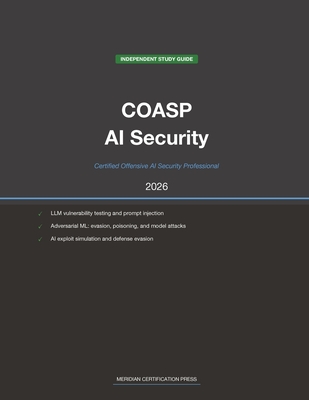
EC-Council COASP Exam Study Guide 2026: Certified Offensive AI Security Professional: Complete Exam Prep with Practice Questions, Detailed Explanation (Paperback)
暫譯: EC-Council COASP 考試研讀指南 2026:Certified Offensive AI Security Professional 認證考試完整準備,附練習題與詳細解析(平裝本)
Meridian Certification Press
- 出版商: Meridian Certification Press
- 出版日期: 2026-05-19
- 售價: $1,740
- 貴賓價: 9.5 折 $1,653
- 語言: 英文
- 頁數: 160
- 裝訂: Quality Paper - also called trade paper
- ISBN: 9798259500051
- ISBN-13: 9798259500051
-
相關分類:
Large language model、Machine Learning、Penetration-test
海外代購書籍(需單獨結帳)
買這商品的人也買了...


相關主題


商品描述
The EC-Council Certified Offensive AI Security Professional credential establishes that the holder can identify, exploit, document, and recommend remediation for vulnerabilities specific to artificial intelligence systems, with particular emphasis on large language model deployments, machine learning pipelines, and the supporting infrastructure that surrounds them. Holders typically work as AI red teamers, penetration testers expanding their coverage into machine learning targets, application security engineers, ML platform security specialists, and offensive security consultants serving AI-heavy clients in regulated industries.
The exam covers the full attack surface of modern AI systems. Adversarial machine learning content addresses evasion attacks against image classifiers and natural language models, poisoning attacks on training data and fine-tuning corpora, model inversion attacks that recover training examples, membership inference that determines whether a record was in the training set, and model extraction through carefully crafted query budgets that reconstruct functional copies of a target model. Defenses, detection strategies, and the practical limits of robustness training and differential privacy are examined alongside the attacks themselves.
Large language model security is treated with the depth the current threat model demands: direct and indirect prompt injection, jailbreaks and persona overrides, system prompt extraction, training data extraction through divergent attacks, tool-use exploitation in agentic systems where the model is given write access to external services, retrieval augmented generation poisoning through corpus injection, and the supply chain risks associated with model hubs, parameter-efficient adapters, and open weight releases. The OWASP Top 10 for LLM Applications and the MITRE ATLAS knowledge base are used as organizing frameworks, with mapped scenarios for each technique.
AI infrastructure hardening covers the security posture of inference endpoints, vector databases, embedding services, fine-tuning APIs, training clusters, and the data labeling pipelines that feed them. Topics include authentication and rate limiting on model APIs, isolation between tenant workloads on shared GPU pools, secure handling of model artifacts, signed model provenance, and the detection of model theft through watermarking and behavioral fingerprinting.
Red team methodology content addresses scoping engagements where the target is an AI feature rather than a traditional application, designing test plans that probe both the model and the surrounding application plumbing, evidence collection that withstands engineering review, and reporting that translates probabilistic findings into actionable severity ratings stakeholders will accept and act on.
The volume includes 120 practice questions covering each exam domain, with detailed answer explanations that walk through the technique, the underlying weakness it exploits, and the controls that mitigate it.
Intended readers include penetration testers adding AI to their service offering, ML engineers responsible for production security, application security teams whose products now embed LLMs, and security researchers preparing for the credential. Familiarity with at least one ML framework and standard web application security is assumed.
Format: 8.5x11 perfect-bound, large-format study layout with attack-defense pairs, scenario walkthroughs, and labeled diagrams of representative system topologies.
Drafted with frontier large language models and adversarially verified for technical accuracy. This is an independent publication and is not affiliated with, endorsed by, or sponsored by EC-Council; all trademarks are property of their respective owners.
商品描述(中文翻譯)
EC-Council Certified Offensive AI Security Professional 認證資格證明持證者能夠識別、利用並記錄人工智慧系統特有的漏洞,並提出修補建議;其中特別著重於大型語言模型部署、機器學習管線,以及其周邊支援基礎架構。持證者通常擔任 AI 紅隊人員、將測試範圍擴展至機器學習目標的滲透測試人員、應用程式安全工程師、ML 平台安全專家,以及服務於高度採用 AI 且受監管產業客戶的進攻性安全顧問。
本考試涵蓋現代 AI 系統的完整攻擊面。對抗式機器學習內容涵蓋:針對影像分類器與自然語言模型的規避攻擊、針對訓練資料與微調語料庫的資料中毒攻擊、可還原訓練範例的模型反演攻擊、用來判斷某筆記錄是否存在於訓練集中的成員推論,以及透過精心設計的查詢額度重建目標模型功能複本的模型擷取攻擊。課程也會探討防禦措施、偵測策略,以及穩健性訓練與差分隱私在實務上的限制,並將其與各類攻擊一併說明。
大型語言模型安全性將依照目前威脅模型所要求的深度進行探討,包括直接與間接提示注入、越獄與角色覆寫、系統提示擷取、透過偏離式攻擊擷取訓練資料、在模型獲得外部服務寫入權限的代理式系統中利用工具的攻擊、透過語料庫注入造成的檢索增強生成(RAG)中毒,以及與模型中心、參數高效能適配器和開放權重發布相關的供應鏈風險。課程以 OWASP Top 10 for LLM Applications 與 MITRE ATLAS 知識庫作為組織架構,並為每項技術提供對應的情境。
AI 基礎架構強化涵蓋推論端點、向量資料庫、嵌入服務、微調 API、訓練叢集,以及供應資料的資料標註管線之安全性態勢。主題包括模型 API 的身分驗證與速率限制、共用 GPU 資源池中不同租戶工作負載之間的隔離、模型成品的安全處理、經簽署的模型來源證明,以及透過浮水印與行為指紋識別模型竊取行為。
紅隊方法論內容探討以下主題:當目標是 AI 功能而非傳統應用程式時,如何界定測試範圍;如何設計同時檢驗模型與周邊應用程式串接層的測試計畫;如何蒐集足以通過工程審查的證據;以及如何將機率性發現轉化為利害關係人能夠接受並採取行動的具體嚴重性評級。
本書包含 120 道涵蓋各項考試領域的練習題,並提供詳盡的答案解析,逐步說明相關技術、其所利用的底層弱點,以及可降低風險的控制措施。
目標讀者包括:將 AI 納入服務內容的滲透測試人員、負責正式環境安全性的 ML 工程師、產品如今已嵌入 LLM 的應用程式安全團隊,以及準備取得此認證資格的安全性研究人員。讀者應至少熟悉一種 ML framework,以及標準的 Web 應用程式安全性。
格式:8.5 × 11 英吋膠裝,大開本研讀版面,包含攻擊—防禦對照、情境解析,以及標示清楚的代表性系統拓撲圖。
本書使用前沿大型語言模型撰寫,並經過對抗式驗證以確認技術準確性。本書為獨立出版品,與 EC-Council 無關,亦未獲其認可或贊助;所有商標均為其各自所有者的財產。