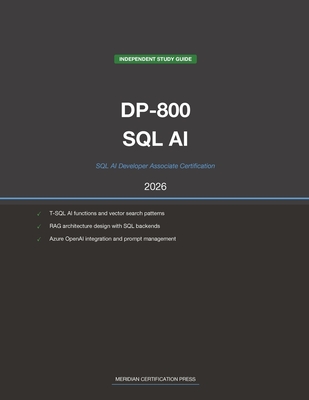
Microsoft DP-800 Exam Study Guide 2026: SQL AI Developer Associate: Complete Exam Prep with Practice Questions, Detailed Explanations, and T-SQL AI In
暫譯: 微軟 DP-800 考試學習指南 2026:SQL AI 開發者助理:完整考試準備,包含練習題、詳細解釋及 T-SQL AI 內容
Meridian Certification Press
- 出版商: Meridian Certification Press
- 出版日期: 2026-05-26
- 售價: $1,790
- 貴賓價: 9.5 折 $1,700
- 語言: 英文
- 頁數: 138
- 裝訂: Quality Paper - also called trade paper
- ISBN: 9798259500075
- ISBN-13: 9798259500075
-
相關分類:
SQL
海外代購書籍(需單獨結帳)
相關主題


商品描述
The Microsoft DP-800 credential establishes that the holder can build SQL-centric AI applications on Azure SQL Database, SQL Server 2025, and Microsoft Fabric, integrating large language models, embeddings, vector search, and retrieval augmented generation directly into T-SQL workflows. Holders typically work as database developers, data engineers, analytics engineers, AI application developers, and platform specialists who need to operationalize AI features without rewriting their data layer in a new language or fragmenting state across half a dozen specialty stores.
The exam covers T-SQL native AI integration in detail, including the AI_GENERATE_EMBEDDINGS family of functions, vector data types and the cosine, dot product, and L2 distance operators, the syntax for declaring vector indexes, and the optimizer behavior that determines when an index is used versus a full scan. Semantic search content addresses the difference between lexical and semantic ranking, hybrid retrieval that combines BM25 with vector similarity, reciprocal rank fusion, and the design of result sets that surface both exact matches and conceptual neighbors.
Retrieval augmented generation is treated end to end: chunking strategies for source documents, choice of embedding model and its impact on recall and dimensionality, vector store layout in SQL versus external services, prompt construction that grounds the model in retrieved context, citation handling that preserves provenance through the response, and the evaluation harness needed to measure faithfulness and answer relevance over time. Azure OpenAI Service integration covers authentication via managed identity, content filtering policies, quota management across deployment regions, deployment of fine-tuned models, and the cost model that governs token-billed workloads.
Microsoft Fabric topics include the lakehouse architecture, OneLake as the unified storage layer, the relationship between Fabric and Azure SQL, mirroring of operational databases into the lakehouse without a separate ETL pipeline, and the use of Fabric notebooks alongside T-SQL for AI feature engineering. Performance optimization addresses index design for vector columns, partitioning strategies for high-cardinality embedding tables, batching of embedding generation calls, caching of frequent queries at multiple layers, and the monitoring needed to detect drift in embedding distributions as upstream content evolves.
Security and governance content covers row-level security for tenant isolation in shared vector stores, classification and masking of sensitive content before it reaches the model, audit trails for AI-generated outputs that satisfy regulator and customer review, and the responsible AI controls that pass enterprise compliance and procurement reviews without exception requests.
The volume includes 120 practice questions covering each exam domain, with detailed answer explanations that include T-SQL snippets, query plans, and pseudocode for the surrounding application logic.
Intended readers include database developers extending into AI features, data engineers consolidating on the SQL stack rather than fragmenting across specialty stores, and application developers who want to keep state, retrieval, and generation in one transactional system. Working knowledge of T-SQL is assumed throughout.
Format: 8.5x11 perfect-bound, large-format study layout with code listings, architecture diagrams, and exam-domain headers mapped to the DP-800 skills outline.
Drafted with frontier large language models and adversarially verified for technical accuracy. This is an independent publication and is not affiliated with, endorsed by, or sponsored by Microsoft Corporation; all trademarks are property of their respective owners.
商品描述(中文翻譯)
微軟 DP-800 認證證明持有者能夠在 Azure SQL Database、SQL Server 2025 和 Microsoft Fabric 上構建以 SQL 為中心的 AI 應用程式,將大型語言模型、嵌入、向量搜尋和增強生成直接整合到 T-SQL 工作流程中。持有者通常擔任資料庫開發人員、資料工程師、分析工程師、AI 應用程式開發人員和平台專家,這些角色需要在不重寫資料層或在多個專業商店之間分散狀態的情況下,將 AI 功能實現為可操作的。
考試詳細涵蓋 T-SQL 原生 AI 整合,包括 AI_GENERATE_EMBEDDINGS 函數系列、向量資料類型以及餘弦、點積和 L2 距離運算子、聲明向量索引的語法,以及決定何時使用索引與全掃描的優化器行為。語義搜尋內容探討詞彙排名與語義排名之間的差異、結合 BM25 與向量相似度的混合檢索、互惠排名融合,以及設計結果集以顯示精確匹配和概念鄰近的方式。
增強生成的處理涵蓋從頭到尾:來源文件的分塊策略、嵌入模型的選擇及其對召回率和維度的影響、SQL 中的向量存儲佈局與外部服務的比較、將模型基於檢索上下文的提示構建、保留來源的引用處理,以及評估工具以測量隨時間推移的忠實度和答案相關性。Azure OpenAI 服務整合涵蓋通過受管身份進行身份驗證、內容過濾政策、跨部署區域的配額管理、微調模型的部署,以及管理基於令牌計費工作負載的成本模型。
微軟 Fabric 主題包括湖屋架構、OneLake 作為統一存儲層、Fabric 與 Azure SQL 之間的關係、將操作資料庫鏡像到湖屋而不需要單獨的 ETL 管道,以及在 T-SQL 旁邊使用 Fabric 筆記本進行 AI 功能工程。性能優化涉及向量列的索引設計、高基數嵌入表的分區策略、嵌入生成調用的批處理、在多個層級緩存頻繁查詢,以及檢測隨著上游內容演變而出現的嵌入分佈漂移所需的監控。
安全性和治理內容涵蓋共享向量存儲中的租戶隔離的行級安全性、在內容到達模型之前對敏感內容的分類和遮蔽、滿足監管機構和客戶審查的 AI 生成輸出的審計追蹤,以及通過企業合規和採購審查的負責任 AI 控制,無需例外請求。
本書包含 120 道涵蓋每個考試領域的練習題,並提供詳細的答案解釋,包括 T-SQL 片段、查詢計劃和周邊應用邏輯的偽代碼。
預期讀者包括擴展 AI 功能的資料庫開發人員、在 SQL 堆疊上整合而非在專業商店之間分散的資料工程師,以及希望將狀態、檢索和生成保持在一個事務系統中的應用程式開發人員。全書假設讀者具備 T-SQL 的工作知識。
格式:8.5x11 完美裝訂,大型格式學習佈局,包含程式碼清單、架構圖和與 DP-800 技能大綱對應的考試領域標題。
本書草擬使用前沿大型語言模型,並經過對抗性驗證以確保技術準確性。這是一本獨立出版物,與微軟公司無關,未經其認可或贊助;所有商標均為其各自所有者的財產。