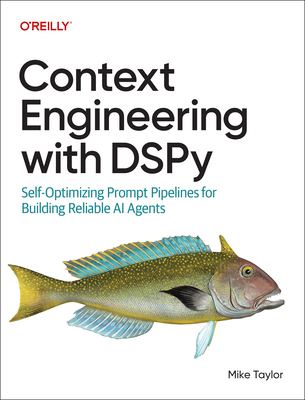
Context Engineering with Dspy: Self-Optimizing Prompt Pipelines for Building Reliable AI Agents
暫譯: 使用 DSPy 進行 Context Engineering:打造可靠 AI Agents 的自我最佳化 Prompt Pipeline
Taylor, Mike
- 出版商: O'Reilly
- 出版日期: 2026-11-10
- 售價: $2,780
- 貴賓價: 9.5 折 $2,641
- 語言: 英文
- 頁數: 344
- 裝訂: Quality Paper - also called trade paper
- ISBN: 9798341671263
- ISBN-13: 9798341671263
-
相關分類:
Large language model、Prompt Engineering
海外代購書籍(需單獨結帳)
相關主題


商品描述
AI agents need the right context at the right time to do a good job. Too much input increases cost and harms accuracy, while too little causes instability and hallucinations. Context Engineering with DSPy introduces a practical, evaluation-driven way to design AI systems that remain reliable, predictable, and easy to maintain as they grow.
AI engineer and educator Mike Taylor explains DSPy in a clear, approachable style, showing how its modular structure, portable programs, and built-in optimizers help teams move beyond guesswork. Through real examples and step-by-step guidance, you'll learn how DSPy's signatures, modules, datasets, and metrics work together to solve context engineering problems that evolve as models change and workloads scale.
This book supports AI engineers, data scientists, machine learning practitioners, and software developers building AI agents, retrieval-augmented generation (RAG) systems, and multistep reasoning workflows that hold up in production.
- Understand the core ideas behind context engineering and why they matter
- Structure LLM pipelines with DSPy's maintainable, reusable components
- Apply evaluation-driven optimizers like GEPA and MIPROv2 for measurable improvements
- Create reproducible RAG and agentic workflows with clear metrics
- Develop AI systems that stay robust across providers, model updates, and real-world constraints
商品描述(中文翻譯)
AI 代理需要在適當的時間取得適當的上下文,才能發揮良好效能。輸入內容過多會增加成本並降低準確度,而輸入過少則可能導致系統不穩定與產生幻覺。《使用 DSPy 進行上下文工程》介紹一種實務導向、以評估為驅動的方法,協助設計出可靠、可預測,並能隨著規模擴大而易於維護的 AI 系統。
AI 工程師兼教育工作者 Mike Taylor 以清楚易懂的方式介紹 DSPy,說明其模組化結構、可攜式程式與內建最佳化器如何協助團隊擺脫憑猜測開發。透過實際範例與逐步指引,你將學會 DSPy 的 signatures、modules、datasets 與 metrics 如何協同運作,以解決會隨模型變動與工作負載擴展而演進的上下文工程問題。
本書適合建構 AI 代理、檢索增強生成(retrieval-augmented generation,RAG)系統,以及能在正式環境中穩定運作的多步驟推理工作流程之 AI 工程師、資料科學家、機器學習實務工作者與軟體開發人員。
• 了解上下文工程背後的核心概念,以及其重要性
• 使用 DSPy 易於維護且可重複使用的元件來建構 LLM 管線
• 應用 GEPA 與 MIPROv2 等以評估為驅動的最佳化器,獲得可量化的改善
• 建立具備明確 metrics、可重現的 RAG 與 agentic 工作流程
• 開發能因應不同服務供應商、模型更新與現實世界限制,持續保持穩健的 AI 系統