-
出版商:
Independently Published
-
出版日期:
2021-05-26
-
售價:
$1,300
-
貴賓價:
9.5 折
$1,235
-
語言:
英文
-
頁數:
288
-
裝訂:
Quality Paper - also called trade paper
-
ISBN:
9798508489441
-
ISBN-13:
9798508489441
-
相關分類:
Machine Learning
-
相關翻譯:
商用機器學習(原書第3版) (簡中版)
商品描述
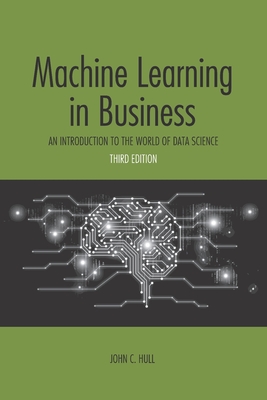
THIRD EDITION OF MACHINE LEARNING IN BUSINESSThis book is for business executives and students who want to learn about the tools used in machine learning. In creating the third edition, John Hull has continued to improve his material. He has added new case studies and new material on the applications of neural networks. The book explains the most popular algorithms clearly and succinctly without using calculus or matrix/vector algebra. The focus is on business applications. There are many illustrative examples throughout the book. These include assessing the risk of a country for international investment, predicting the value of real estate, classifying retail loans as acceptable or unacceptable, understanding the behavior of interest rates, using neural networks to understand volatility surface movements, and using reinforcement learning for optimal trade execution. Data, worksheets, and Python code for the examples is on the author's website. A complete set of PowerPoint slides that can be used by instructors is also on the website. The opening chapter reviews different types of machine learning models. It explains the role of the training data set, the validation data set, and the test data set. It also explains the issues involved in cleaning data and covers Bayes' theorem. Chapter 2 is devoted to unsupervised learning. It explains the k-means algorithm and alternative approaches to clustering. It also covers principal components analysis. Chapter 3 explains linear and logistic regression. It covers regularization using Ridge, Lasso, and Elastic Net. Chapter 4 covers decision trees. It includes a discussion of the naive Bayes classifier, random forests, and other ensemble methods. Chapter 5, explains how the SVM approach can be used for both linear and non-linear classification as well as for the prediction of a continuous variable. Chapter 6 is devoted to neural networks. It includes a discussion of the gradient descent algorithm and stopping rules. Chapter 7 covers autoencoders, variational autoencoders, generative adversarial networks, convolutional neural networks, and recurrent neural networks. Chapter 8 explains reinforcement learning using two games as examples. It covers Q-learning and deep Q-learning, and discusses applications. Chapter 9 covers natural language processing. It discusses how the algorithms introduced in the book can be used for sentiment analysis, language translation, and information retrieval. Chapter 10 is concerned with model interpretability. It discusses the importance of making models understandable and the procedures that can be used for both white-box and black-box models. The final chapter focuses on issues for society. The topics covered include data privacy, biases, ethical considerations, legal issues, and adversarial machine learning. At the ends of chapters there are short concept questions to test the readers understanding of the material and longer exercises. Answers are at the end of the book. The book includes a glossary of terms and an index.
商品描述(中文翻譯)
第三版商業中的機器學習本書適合希望了解機器學習工具的商業高管和學生。在創作第三版時,John Hull 持續改進他的內容。他新增了案例研究和有關神經網絡應用的新材料。本書清晰且簡潔地解釋了最受歡迎的算法,並未使用微積分或矩陣/向量代數。重點在於商業應用。全書包含許多示例,包括評估一個國家的國際投資風險、預測房地產價值、將零售貸款分類為可接受或不可接受、理解利率行為、使用神經網絡理解波動率曲面變化,以及使用強化學習進行最佳交易執行。數據、工作表和示例的 Python 代碼可在作者的網站上找到。網站上還提供了一整套可供講師使用的 PowerPoint 幻燈片。開篇章節回顧了不同類型的機器學習模型,解釋了訓練數據集、驗證數據集和測試數據集的角色,並說明了數據清理中涉及的問題,涵蓋了貝葉斯定理。第二章專注於無監督學習,解釋了 k-means 算法和聚類的替代方法,並涵蓋了主成分分析。第三章解釋了線性回歸和邏輯回歸,涵蓋了使用 Ridge、Lasso 和 Elastic Net 的正則化。第四章介紹了決策樹,並討論了天真貝葉斯分類器、隨機森林和其他集成方法。第五章解釋了 SVM 方法如何用於線性和非線性分類以及連續變量的預測。第六章專注於神經網絡,討論了梯度下降算法和停止規則。第七章涵蓋了自編碼器、變分自編碼器、生成對抗網絡、卷積神經網絡和循環神經網絡。第八章使用兩個遊戲作為示例解釋強化學習,涵蓋了 Q-learning 和深度 Q-learning,並討論了應用。第九章涵蓋了自然語言處理,討論了書中介紹的算法如何用於情感分析、語言翻譯和信息檢索。第十章關注模型可解釋性,討論了使模型可理解的重要性以及可用於白盒和黑盒模型的程序。最後一章專注於社會問題,涵蓋的主題包括數據隱私、偏見、倫理考量、法律問題和對抗性機器學習。在每章結尾有簡短的概念問題以測試讀者對材料的理解,以及較長的練習題。答案位於書末。本書還包括術語表和索引。