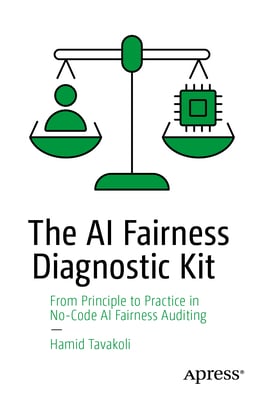
The AI Fairness Diagnostic Kit: From Principle to Practice in No-Code AI Fairness Auditing
暫譯: AI 公平性診斷工具包:從原則到實務的免寫程式 AI 公平性稽核
Tavakoli, Hamid
相關主題


商品描述
This book is a comprehensive, six-part guide that turns fairness in artificial intelligence from theory into an operational discipline. Drawing on validated metrics and seven domain modules like education, finance and housing, this book provides clear explanations, decision frameworks, professional workflows, and governance artefacts that enable non-technical stakeholders to interpret fairness risk, document accountability, and meet emerging regulatory expectations. Case studies--including hiring filters, and public-service eligibility systems--demonstrate real-world, high-stakes consequences of unfair AI and how accessible auditing can prevent them.
Written for a cross-disciplinary readership, this work connects public rights, professional responsibility, and regulatory mandates into a unified reference for fairness diagnostics. It offers a rigorous, repeatable framework for testing and improving AI accountability--supporting practitioners and affected communities alike in ensuring that intelligence remains both powerful and just. The book explains why fairness diagnostics are necessary, and maps ethical principles, human risks, and domain failures that demand practical testing. It introduces the diagnostic blueprint, fairness metric families and selection, governance and accountability roles, and the system architecture--including a universal baseline, sector-specific modules, and a no-code interface. We apply these methods across seven domains: Justice, Employment, Education, Finance, Health Settings, Business Services, and Public Governance--showing how to assess risks and run fairness audits in each high-impact context. It demonstrates clinical implementation, including end-to-end workflow examples, healthcare scenarios, and a complete case application. It explores scaling the toolkit across geographies and regulatory environments, aligning with MLOps/LLMOps ecosystems, meeting professional standards, and democratising fairness literacy. It also provides step-by-step audit workflows, interpretable reporting, fairness API libraries, case studies, exercises, self-assessment tools, and comprehensive reference tables for 89 fairness metrics and their domain applicability.
WHAT READERS WILL LEARN
- Understand where and how algorithmic unfairness emerges across sectors and populations.
- Translate ethical fairness principles into measurable and repeatable audit criteria.
- Select and apply appropriate fairness metrics from 89 validated measures, including group, individual, and causal methods.
- Run complete fairness audits through a no-code workflow, without programming or statistical expertise.
- Produce transparent governance artefacts, including audit reports, evidence packs, and escalation pathways..
- Support regulatory compliance and alignment with policies such as GDPR, the EU AI Act, and global standards frameworks.
- Build fairness literacy within organizations and among affected groups to democratize oversight.
- Embed fairness evaluation into procurement, deployment, and lifecycle governance of AI systems.
WHO THIS BOOK IS FOR
This book is for anyone affected by AI-driven decisions and anyone responsible for ensuring those decisions are fair. It is written for non-technical readers with no computer science background, including students, patients, consumers, job applicants, and citizens interacting with AI systems in everyday life.
商品描述(中文翻譯)
這本書是一部完整的六大部分指南,將人工智慧中的公平性從理論轉化為可實際運作的專業領域。本書以經過驗證的衡量指標,以及涵蓋教育、金融與住房等領域的七個模組為基礎,提供清楚的說明、決策架構、專業工作流程與治理文件,協助非技術利害關係人解讀公平性風險、記錄問責責任,並符合新興的法規期待。書中的案例研究包括招募篩選機制與公共服務資格判定系統,展示不公平 AI 在真實世界的高風險後果,以及可近用的稽核如何預防這些問題。
本書面向跨領域讀者,將公共權利、專業責任與法規要求整合為一套公平性診斷的統一參考架構。它提供嚴謹且可重複執行的框架,用於測試與改善 AI 問責性,協助實務工作者與受影響的社群共同確保智慧既強大又公正。
本書說明公平性診斷為何不可或缺,並整理出需要實務測試的倫理原則、人類風險與領域失效情境。書中介紹診斷藍圖、公平性指標族群及其選擇方式、治理與問責角色,以及系統架構,包括通用基準、產業專用模組與免寫程式介面。
本書將這些方法應用於七大領域:司法、就業、教育、金融、醫療場域、商業服務與公共治理,說明如何在每個高影響情境中評估風險並執行公平性稽核。內容也示範臨床實作,包括端到端工作流程範例、醫療情境與完整案例應用。
本書進一步探討如何跨越不同地理區域與法規環境擴充這套工具包、與 MLOps/LLMOps 生態系整合、符合專業標準,並普及公平性素養。此外,書中也提供逐步的稽核工作流程、可解讀的報告、公平性 API 程式庫、案例研究、練習、自我評量工具,以及涵蓋 89 項公平性指標及其領域適用性的完整參考表。
讀者將學到什麼
• 了解演算法不公平性在不同產業與族群中於何處以及如何產生。
• 將倫理公平性原則轉化為可衡量且可重複執行的稽核標準。
• 從 89 項經過驗證的衡量方法中,選擇並套用適當的公平性指標,包括群體、個人與因果方法。
• 透過免寫程式的工作流程執行完整的公平性稽核,不需要程式設計或統計專業。
• 產出透明的治理文件,包括稽核報告、證據資料包與升級處理途徑。
• 支援法規遵循,並與 GDPR、EU AI Act 及全球標準架構等政策保持一致。
• 在組織內部及受影響的群體之間建立公平性素養,實現監督機制的普及化。
• 將公平性評估納入 AI 系統的採購、部署與生命週期治理。
本書適合哪些讀者
本書適合所有受到 AI 驅動決策影響的人,以及所有負責確保這些決策公平的人。本書是為不具備電腦科學背景的非技術讀者撰寫,包括學生、病患、消費者、求職者,以及日常生活中與 AI 系統互動的公民。
作者簡介
Hamid Tavakoli is a London-based Artificial Intelligence researcher specialising in algorithmic fairness, governance, and clinical decision systems. As Managing Director of Optics AI Ltd, he leads applied research on the impact of AI in healthcare and public-facing services, ensuring transparent, human-centred implementation.
His professional background spans AI development, data ethics, and regulatory-aligned diagnostics across health, education, housing, and employment sectors. He works closely with domain experts -- clinicians, HR specialists, educators, and auditors -- to ensure fairness becomes a measurable and operational aspect of AI adoption.
Hamid is also the author of the forthcoming Apress title "Prompt Engineering for Everyone", which equips non-specialists to leverage modern AI through practical natural-language design. His cross-disciplinary experience uniquely positions him to translate fairness theory into accessible, no-code practice for global professional communities.
作者簡介(中文翻譯)
Hamid Tavakoli 是一位常駐倫敦的人工智慧研究人員,專長於演算法公平性、治理,以及臨床決策系統。身為 Optics AI Ltd 的董事總經理,他帶領應用研究,探討 AI 對醫療保健與面向公眾服務的影響,確保 AI 的導入透明且以人為本。
他的專業背景涵蓋 AI 開發、資料倫理,以及符合監管要求的診斷系統,應用領域遍及醫療保健、教育、住宅與就業。他與臨床醫師、人力資源專家、教育工作者及稽核人員等領域專家密切合作,確保公平性成為 AI 採用過程中可衡量且可實際執行的一環。
Hamid 也是 Apress 即將出版的《Prompt Engineering for Everyone》一書的作者。本書透過實用的自然語言設計,協助非專業人士運用現代 AI。他跨領域的經驗,使他能將公平性理論轉化為全球專業社群易於理解且無需撰寫程式碼即可實踐的方法。