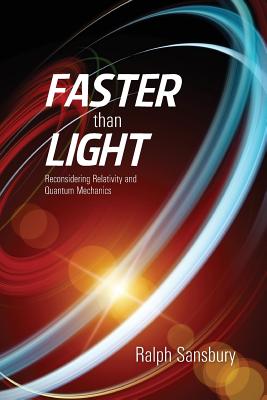
Faster Than Light: Quantum Mechanics And Relativity Reconsidered
Sansbury, Ralph
- 出版商: Createspace Independent Publishing Platform
- 出版日期: 2012-10-03
- 售價: $630
- 貴賓價: 9.5 折 $598
- 語言: 英文
- 頁數: 198
- 裝訂: Quality Paper - also called trade paper
- ISBN: 1477584587
- ISBN-13: 9781477584583
-
相關分類:
量子 Quantum
海外代購書籍(需單獨結帳)
商品描述
SANSBURY SHOWS HOW SUPERLUMINAL ORBITAL SYSTEMS INSIDE ATOMIC NUCLEI CAN ACCOUNT FOR THE SPACE TIME DISTORTIONS OFRELATIVITY AND THE DISCONTINUITIES OF QUANTUM MECHANICS ¬2011 Cern discovery of a faster than light neutrino was followed by a disclaimer showing neutrinos traveling at the speed of light but with no increase of mass to infinity. ¬These results indicate the possibility of superluminal orbital systems inside electrons and atomic nuclei. Such orbital systems can explain the conundrums of relativity, quantum mechanics and string theory. ¬The apparent increase of electron mass to in finity at the speed of light and interconvertibility of mass energy is explained in terms of changes in these nuclear superluminal orbital systems. Discrete orbits and energy levels of atomic electrons are explained by being in synch with inner orbital electrons and orbital charge inside nuclei and energy transitions between discrete orbits/energy levels are continuous. Relativistic light bending is attributable to changes in atomic nuclei facing the Sun, influencing light reception delay. Increasing amplitude, weak, charge oscillations inside atomic nuclei, before light is detectable, explain the delay in light, calibrated so that the source receiver distance divided by delay time equals, c. ¬ is explains the Michelson-Morley experiment without relativistic time dilation and circumvents the need for probabilistic photons to explain double slit distraction. The magnetic attraction of parallel current carrying wires is caused by similarly oriented, transverse electric dipoles, proportional to their distance apart, inside free electrons and lattice nuclei. In adjacent ferromagnetic atoms, normally, oppositely oriented electric dipoles in pairs of orbiting atomic electrons are made to be similarly oriented. Electric dipoles in atomic nuclei of planets and stars, transverse to their spinning and orbital motions, explain their gravitational and magnetic fields.
作者簡介
Ralph Sansbury BS and postgraduate work at the University of Chicago. Instructor at the University of Illinois and Polytechnic Institute of Brooklyn, Researcher at the MIT Magnet Lab; Editor, The Journal of Classical Physics; Holder of several patents and author of numerous books and articles.