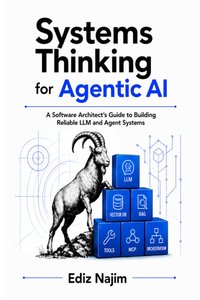
Systems Thinking for Agentic AI: Design reliable LLM and agentic AI systems with RAG, MCP, guardrails, evaluation, and observability
暫譯: Agentic AI 的系統思維:運用 RAG、MCP、護欄、評估與可觀測性設計可靠的 LLM 與 Agentic AI 系統
Najim, Ediz

- 出版商: Packt Publishing
- 出版日期: 2026-09-28
- 售價: $1,710
- 貴賓價: 9.5 折 $1,624
- 語言: 英文
- 頁數: 364
- 裝訂: Quality Paper - also called trade paper
- ISBN: 1808828496
- ISBN-13: 9781808828492
-
相關分類:
Large language model、Prompt Engineering、AI Coding
海外代購書籍(需單獨結帳)
相關主題

商品描述
Apply systems thinking to build production-ready LLM and agentic AI systems using RAG, MCP, tools, memory, guardrails, evaluation, observability, and practical architecture patterns
Key Features:
- Architect reliable AI agent systems beyond prototypes and demos
- Build with RAG, MCP, tool calling, memory, and agent orchestration
- Engineer for safety, evaluation, observability, cost, and failure handling
Book Description:
Engineering a reliable AI system isn't as easy as calling an API. As AI applications move from prototypes to production, you must solve system-level problems the model alone cannot solve: retrieval quality, tool execution, hallucinations, validation, latency, cost, failures, observability, and operational control.
Systems Thinking for Agentic AI gives engineers and architects a practical framework for tackling these challenges. You'll first understand how LLMs work through tokens, embeddings, and transformers, then learn to control their behavior with prompting, structured outputs, and decoding strategies. You'll connect models to real systems using function calling, tools, and MCP, and build grounded RAG pipelines with embeddings and vector databases.
As you progress, you'll design agentic workflows with planning, memory, orchestration, and controlled execution. You'll implement guardrails, permissions, validation, human approval, evaluation, regression testing, and observability through logs, metrics, and traces. You'll also address production concerns including scaling, performance, cost, timeouts, retries, and fallbacks.
Finally, you'll bring these principles together by building an end-to-end Code Review Agent with Spring Boot, giving you a practical blueprint for engineering AI systems you can confidently operate in production.
What You Will Learn:
- Understand how tokens, embeddings, and transformers power LLMs
- Control LLM behavior with prompts and structured outputs
- Connect AI systems to tools using function calling and MCP
- Build grounded RAG pipelines with embeddings and vector databases
- Design agents using planning, memory, and orchestration
- Apply guardrails, validation, permissions, and human approval
- Evaluate and debug AI systems with tests, metrics, and traces
- Engineer for latency, cost, scaling, retries, and failures
Who this book is for:
This book is for technical leads, software architects, software engineers, and backend developers who want to move beyond AI prototypes and build reliable LLM and agentic AI systems for production. No machine learning background is required. Readers should be comfortable with backend development concepts such as APIs, distributed systems, and system design. Java and Spring Boot developers will also benefit from the end-to-end Code Review Agent implementation.
Table of Contents
- From AI to Agent Systems
- LLM Internals and Output Generation
- Prompt Engineering in LLM Systems
- LLMs as System Components
- RAG Systems (Retrieval Augmented Generation)
- Agent Fundamentals and Behavior
- Tool Orchestration and MCP
- Planning and Execution Control
- Memory in Agent Systems
- Agent System Architecture
- Reliability and Safety in AI Systems
- Performance and Cost Optimization
- Multi-Agent Systems
- Evaluation in Agent Systems
- Observability in AI Systems (Logs, Metrics, and Traces)
- End-to-End Agent System Design
- Implementing the Code Review Agent
- The Future of Agent Systems
商品描述(中文翻譯)
運用系統思維,使用 RAG、MCP、工具、記憶、護欄、評估、可觀測性,以及實用的架構模式,打造可投入正式環境的 LLM 與代理式 AI 系統
主要特色:
- 設計超越原型與展示的可靠 AI 代理系統
- 使用 RAG、MCP、工具呼叫、記憶與代理編排進行建置
- 針對安全性、評估、可觀測性、成本與故障處理進行工程設計
書籍介紹:
工程化打造可靠的 AI 系統,並不只是呼叫 API 那麼簡單。當 AI 應用程式從原型邁向正式環境時,您必須解決許多單靠模型無法處理的系統層級問題,包括檢索品質、工具執行、幻覺、驗證、延遲、成本、故障、可觀測性與營運控制。
《Systems Thinking for Agentic AI》為工程師與架構師提供一套實用框架,協助處理這些挑戰。您將先透過 tokens、embeddings 與 transformers,了解 LLM 的運作方式,接著學習使用提示(prompting)、結構化輸出(structured outputs)與解碼策略(decoding strategies)來控制其行為。您將透過 function calling、工具與 MCP,將模型連接至真實系統,並使用 embeddings 與向量資料庫,建立具備依據的 RAG 管線。
隨著學習深入,您將使用規劃、記憶、編排與受控執行來設計代理式工作流程。您將實作護欄、權限、驗證、人員核准、評估、回歸測試,以及透過日誌、指標與追蹤記錄實現的可觀測性。此外,您也將處理正式環境中的各項考量,包括擴充、效能、成本、逾時、重試與備援機制。
最後,您將透過使用 Spring Boot 建置端對端的 Code Review Agent,整合這些原則,取得一套實用藍圖,學習如何工程化打造能夠放心在正式環境中運作的 AI 系統。
您將學到:
- 了解 tokens、embeddings 與 transformers 如何驅動 LLM
- 使用 prompts 與結構化輸出控制 LLM 行為
- 透過 function calling 與 MCP 將 AI 系統連接至工具
- 使用 embeddings 與向量資料庫建立具備依據的 RAG 管線
- 運用規劃、記憶與編排來設計代理
- 應用護欄、驗證、權限與人員核准機制
- 使用測試、指標與追蹤記錄評估及除錯 AI 系統
- 針對延遲、成本、擴充、重試與故障進行工程設計
適合對象:
本書適合想超越 AI 原型,並為正式環境打造可靠 LLM 與代理式 AI 系統的技術主管、軟體架構師、軟體工程師與後端開發人員。不需要具備機器學習背景。讀者應熟悉 API、分散式系統與系統設計等後端開發概念。Java 與 Spring Boot 開發人員也能從端對端的 Code Review Agent 實作中獲益。
目錄
- 從 AI 到代理系統
- LLM 內部機制與輸出生成
- LLM 系統中的提示工程
- 作為系統元件的 LLM
- RAG 系統(檢索增強生成,Retrieval Augmented Generation)
- 代理基礎與行為
- 工具編排與 MCP
- 規劃與執行控制
- 代理系統中的記憶
- 代理系統架構
- AI 系統的可靠性與安全性
- 效能與成本最佳化
- 多代理系統
- 代理系統中的評估
- AI 系統中的可觀測性(日誌、指標與追蹤記錄)
- 端對端代理系統設計
- 實作 Code Review Agent
- 代理系統的未來