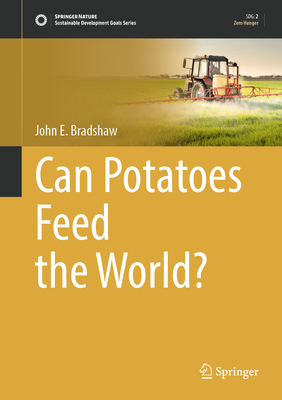
Can Potatoes Feed the World?
暫譯: 馬鈴薯能養活世界嗎?
Bradshaw, John E.
- 出版商: Springer
- 出版日期: 2025-07-03
- 售價: $7,130
- 貴賓價: 9.5 折 $6,773
- 語言: 英文
- 頁數: 208
- 裝訂: Hardcover - also called cloth, retail trade, or trade
- ISBN: 303192889X
- ISBN-13: 9783031928895
海外代購書籍(需單獨結帳)
相關主題


商品描述
By 2050 the United Nations (UN) predicts a world population of 9.7 billion compared with 8 billion in 2022. Increases in food and energy production and the supply of fresh water will be needed to sustain this population, whilst reducing greenhouse gas emissions to limit global warming. The average global temperature is likely to be 2 to 3 degrees Celsius above that in pre-industrial times, unless there is a greater sense of urgency following the UN Climate Change Conference (COP26) in Glasgow in 2021, which still wanted to limit the rise to 1.5 degrees. There is also increasing concern about the loss of biodiversity on Earth from human activity, including farming, as seen in the outcomes of the UN Biodiversity Conference (COP15) in Montreal in 2022. More encouragingly, on 1 December 2023, 134 countries at COP28 in Dubai endorsed the landmark sustainable agriculture, resilient food systems and climate action declaration which put food systems transformation on the global climate agenda. "While food systems are vital for meeting societal needs and enabling adaptation to climate impacts, they are also responsible for as much as a third of global greenhouse gas emissions." A warmer climate and loss of biodiversity will make life more difficult for humankind; but can potatoes at least help with food security? It is a scientific and technological question set in a political, economic and societal context. It has arisen because potatoes have made the journey from wild species to global food crop. The contribution of the potato to the United Nations Millennium Development Goals of providing food security and eradicating poverty was recognized when an International Year of the Potato 2008 (IYP 2008) was officially launched at the United Nations (UN) headquarters in New York on 18 October 2007 by the Director-General of FAO (Food and Agriculture Organization of the United Nations).
Today the importance of potatoes can be seen in the context of the United Nations "2030 Agenda for Sustainable Development" which was adopted in 2015 and started on 1 January 2016. The agenda has 17 goals, the second of which (SDG2) is to end hunger, achieve food security and improved nutrition, and promote sustainable agriculture. By 2030, the aim of the agenda is to 'ensure access by all people, in particular the poor and people in vulnerable situations, including infants, to safe, nutritious and sufficient food all year round'. However, the projection in the 2023 Sustainable Development Goals Report was not zero-hunger but 600 million people still facing hunger. Hence a greater sense of urgency is required and also a need to look beyond 2030 to 2050. This book explores how potatoes can contribute to SDG2 by increasing potato production and improving the nutritional value of potatoes, in particular to alleviate micronutrient deficiencies ('hidden hunger'), having first explained how potatoes became a major food crop and the lessons to be learnt from a major crop failure and resulting famine.
商品描述(中文翻譯)
根據聯合國(UN)的預測,到2050年全球人口將達到97億,而2022年為80億。為了維持這個人口,將需要增加食品和能源的生產以及淡水的供應,同時減少溫室氣體排放以限制全球變暖。除非在2021年格拉斯哥舉行的聯合國氣候變化大會(COP26)之後,對此有更強烈的緊迫感,否則全球平均氣溫可能會比工業化前的時期高出2到3攝氏度,而該會議仍希望將氣溫上升限制在1.5度。人類活動,包括農業,對地球生物多樣性的損失也引起了越來越多的關注,這在2022年蒙特利爾舉行的聯合國生物多樣性大會(COP15)的結果中得以體現。更令人鼓舞的是,在2023年12月1日,134個國家在迪拜的COP28上支持了一項具有里程碑意義的可持續農業、韌性食品系統和氣候行動宣言,將食品系統轉型納入全球氣候議程。“食品系統對滿足社會需求和適應氣候影響至關重要,但它們也負責全球溫室氣體排放的三分之一。”氣候變暖和生物多樣性的喪失將使人類生活更加困難;但馬鈴薯至少能在食品安全方面提供幫助嗎?這是一個在政治、經濟和社會背景下的科學和技術問題。這個問題的產生是因為馬鈴薯已經從野生物種轉變為全球食品作物。馬鈴薯對聯合國千年發展目標(Millennium Development Goals)中提供食品安全和消除貧困的貢獻在2007年10月18日於紐約聯合國總部正式啟動的2008年國際馬鈴薯年(IYP 2008)時得到了認可,該活動由聯合國糧食及農業組織(FAO)總幹事主持。
今天,馬鈴薯的重要性可以在聯合國於2015年通過的“2030可持續發展議程”中看到,該議程於2016年1月1日開始實施。該議程有17個目標,其中第二個目標(SDG2)是結束飢餓,實現食品安全和改善營養,並促進可持續農業。到2030年,該議程的目標是“確保所有人,特別是貧困和脆弱情況下的人,包括嬰兒,全年都能獲得安全、營養和足夠的食物”。然而,2023年可持續發展目標報告中的預測並非零飢餓,而是仍有6億人面臨飢餓。因此,需要更強烈的緊迫感,並且需要超越2030年展望2050年。本書探討了馬鈴薯如何通過增加馬鈴薯產量和改善馬鈴薯的營養價值來貢獻於SDG2,特別是為了緩解微量營養素缺乏(“隱性飢餓”),在此之前,首先解釋了馬鈴薯如何成為主要食品作物以及從一次重大作物失敗和隨之而來的饑荒中可以學到的教訓。
作者簡介
Dr John E. Bradshaw spent his 34-year career (1975-2009) as a plant breeder and geneticist at what is now the James Hutton Institute in Dundee, Scotland; having studied genetics and applied genetics in England at the Universities of Cambridge (BA), Birmingham (MSc) and East Anglia (PhD). He worked on barley, brassicas (kale, swedes and turnips) and potatoes; doing research on the applications of genetics to plant breeding as well as breeding finished cultivars. In potatoes he was particularly interested in the theory and practice of quantitative trait locus analysis in tetraploid potatoes and breeding for quantitative resistance to diseases and pests (late blight and cyst nematodes). He has written extensively on plant breeding and genetics, including two books, one on Plant Breeding: Past, Present and Future (Springer Nature, 2016) and the other on Potato Breeding: Theory and Practice (Springer Nature, 2021). He has also co-edited books on Potato Genetics (1994), Potato Biology and Biotechnology (2007) and Approaches for Potato Crop Improvement and Stress Management (2024), and edited one on Root and Tuber Crops (2010). He has been an Honorary Fellow of the Indian Potato Association since 2008. In 2010 he received the British Potato Industry Award in recognition of his contribution to potato research and knowledge transfer. Throughout his career he was a member of EUCARPIA, the European Association for Research on Plant Breeding, and having served as Chairperson of the Section Potatoes from 2000 to 2009 was made an honorary member in May 2012. He is a member of the Genetical Society of Great Britain and served on the Editorial Board of their journal Heredity as Plant Breeding Subject Editor from 2010 to 2017. He is a member of EAPR, the European Association for Potato Research, and served as Co-ordinating Editor of their journal Potato Research from December 2017 to December 2021.
作者簡介(中文翻譯)
約翰·E·布拉德肖博士(Dr John E. Bradshaw)在蘇格蘭鄧迪的詹姆斯·哈頓研究所(James Hutton Institute)度過了34年的職業生涯(1975-2009),擔任植物育種學家和遺傳學家。他在英國劍橋大學(University of Cambridge,學士)、伯明翰大學(University of Birmingham,碩士)和東安格利亞大學(University of East Anglia,博士)學習遺傳學和應用遺傳學。他的研究對象包括大麥、十字花科植物(羽衣甘藍、瑞典蘿蔔和蘿蔔)以及馬鈴薯;進行遺傳學在植物育種中的應用研究,以及育成成品品種。在馬鈴薯方面,他特別關注四倍體馬鈴薯的定量性狀位點分析的理論與實踐,以及針對疾病和害蟲(如晚疫病和囊腫線蟲)的定量抗性育種。他在植物育種和遺傳學方面撰寫了大量著作,包括兩本書,一本是《植物育種:過去、現在與未來》(Plant Breeding: Past, Present and Future,Springer Nature,2016年),另一本是《馬鈴薯育種:理論與實踐》(Potato Breeding: Theory and Practice,Springer Nature,2021年)。他還共同編輯了《馬鈴薯遺傳學》(Potato Genetics,1994年)、《馬鈴薯生物學與生物技術》(Potato Biology and Biotechnology,2007年)以及《馬鈴薯作物改良與壓力管理的方法》(Approaches for Potato Crop Improvement and Stress Management,2024年)的書籍,並編輯了《根莖作物》(Root and Tuber Crops,2010年)。自2008年以來,他一直是印度馬鈴薯協會的名譽會員。2010年,他因對馬鈴薯研究和知識轉移的貢獻而獲得英國馬鈴薯產業獎(British Potato Industry Award)。在他的職業生涯中,他是EUCARPIA(歐洲植物育種研究協會)的成員,並於2000年至2009年擔任馬鈴薯分會的主席,於2012年5月被授予名譽會員。他是英國遺傳學會(Genetical Society of Great Britain)的成員,並於2010年至2017年擔任其期刊《遺傳學》(Heredity)的植物育種主編。他是EAPR(歐洲馬鈴薯研究協會)的成員,並於2017年12月至2021年12月擔任其期刊《馬鈴薯研究》(Potato Research)的協調編輯。