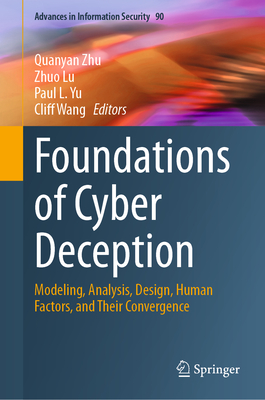
Foundations of Cyber Deception: Modeling, Analysis, Design, Human Factors, and Their Convergence
暫譯: 網路欺騙基礎:建模、分析、設計、人因因素及其融合
Zhu, Quanyan, Lu, Zhuo, Yu, Paul L.
相關主題


商品描述
This book, structured as an edited volume, consists of 12 chapters organized into four key themes: Theoretical Foundations, Human Factors, Application Domains, and Future Challenges. It highlights the dynamic and interdisciplinary nature of cyber deception research, offering insights into diverse application areas such as industrial control systems and AI security.
Cyber deception has emerged as a critical strategy for defending digital assets across academia, industry, and government. By creating false information, deceptive environments, or misleading signals, it aims to confuse, delay, or misdirect adversaries while simultaneously gathering intelligence on their tactics. This proactive approach shifts the traditional information advantage from attackers to defenders, strengthening cybersecurity resilience.
Designed as a foundational resource, this book is particularly valuable for students and early-career researchers seeking to understand cyber deception and identify pressing research challenges. It emphasizes the need for context-aware and adaptive strategies to counter the ever-evolving tactics of cyber adversaries. Furthermore, this book advocates for leveraging emerging technologies and interdisciplinary approaches to advance deception techniques. By addressing both current and future challenges, this volume provides a comprehensive roadmap for enhancing cyber deception strategies and fostering the development of more robust and resilient cybersecurity defences.
商品描述(中文翻譯)
本書以編輯卷的形式結構,共包含12章,分為四個主要主題:理論基礎、人因因素、應用領域和未來挑戰。它突顯了網路欺騙研究的動態和跨學科特性,並提供了對工業控制系統和人工智慧安全等多樣應用領域的見解。
網路欺騙已成為學術界、產業界和政府防禦數位資產的重要策略。透過創造虛假資訊、欺騙環境或誤導信號,旨在混淆、延遲或誤導對手,同時收集有關其戰術的情報。這種主動的方式將傳統的信息優勢從攻擊者轉移到防禦者,增強了網路安全的韌性。
本書作為一個基礎資源,對於希望理解網路欺騙並識別迫切研究挑戰的學生和早期研究人員特別有價值。它強調了需要具備情境感知和自適應策略,以應對不斷演變的網路對手戰術。此外,本書提倡利用新興技術和跨學科方法來推進欺騙技術。通過解決當前和未來的挑戰,本卷提供了一個全面的路線圖,以增強網路欺騙策略並促進更強大和韌性的網路安全防禦的發展。
作者簡介
Quanyan Zhu is an Associate Professor in the Department of Electrical and Computer Engineering at New York University (NYU). He is also the director of the Laboratory for Agile and Resilient Complex Systems (LARX), which focuses on addressing security and resilience challenges in robotics, industrial control systems, manufacturing systems, Internet of Things (IoT), cyber-physical systems, and critical infrastructures. Dr. Zhu earned his Ph.D. in Electrical and Computer Engineering from the University of Illinois at Urbana-Champaign in 2013, a Master's degree from the University of Toronto, and a Bachelor's degree in Electrical Engineering from McGill University.
He has held positions as a Postdoctoral Research Associate at Princeton University and Visiting Researcher roles at institutions such as INRIA, the University of Houston, and the University of Waterloo. His research interests span optimal control, game theory, reinforcement learning, network security/privacy, and resilient control systems. Dr. Zhu has received multiple best paper awards and a National Science Foundation (NSF) CAREER Award. He has published extensively and is actively involved in advancing cybersecurity and complex systems research.
Dr. Zhuo Lu is an Associate Professor in the Department of Electrical Engineering at the University of South Florida (USF) and leads the Communications, Security, and Analytics (CSA) Lab. He is also affiliated with CyberFlorida and holds a courtesy appointment with USF's Department of Computer Science and Engineering. Dr. Lu earned his Ph.D. from North Carolina State University in 2013. His research focuses on wireless mobile design/security, IoT, cyber-physical systems, and secure AI systems. His work has been supported by prominent organizations like NSF, ARO, ONR, DOE, and CyberFlorida. Dr. Lu has received several prestigious awards, including the NSF CISE CRII Award (2016), IEEE GlobalSIP Best Paper Award (2019), and NSF CAREER Award (2021). He is a Senior Member of IEEE and serves as an Associate Editor for IEEE Transactions on Dependable and Secure Computing. Additionally, he actively teaches courses related to computer networks, cryptography, and wireless security at USF.
Paul L. Yu received a Ph.D. degree in electrical engineering from the University of Maryland at College Park. He is the Program Manager for Information Assurance at the U.S. Army Combat Capabilities Development Command Army Research Laboratory (DEVCOM ARL) Army Research Office (ARO). This research program concentrates on funding cutting edge research in several domains, primarily conducted at U.S. universities, that enables complex systems to survive and recover from sophisticated adversarial disruption while accomplishing their missions. He has held technical leadership roles in several programs such as Cyber Security Collaborative Research Alliance and The Technical Cooperation Program. His work advances cyber security and signal processing for secure tactical networks, and he holds several patents in these areas.
Dr. Cliff Wang graduated from North Carolina State University with a PhD in computer engineering. He has been carrying out research in the area of computer vision, medical imaging analysis, high speed networks, and most recently cyber security. He has authored technical papers on these areas in refereed journal, conferences, and symposiums and gave several keynote speeches. Dr. Wang authored/edited more than 20 books in the area of cyber security and holds 4 US patents on network security system development. Since 2003, Dr. Wang has been managing extramural research portfolio and leading cyber security research at funding agencies. Dr. Wang holds appointment at both Department of Computer Science and Department of Electrical and Computer Engineering at North Carolina State University. Dr. Wang is a Fellow of IEEE and AAAS.
作者簡介(中文翻譯)
全言朱(Quanyan Zhu)是紐約大學(NYU)電機與計算機工程系的副教授。他同時也是敏捷與韌性複雜系統實驗室(LARX)的主任,該實驗室專注於解決機器人、工業控制系統、製造系統、物聯網(IoT)、網路物理系統及關鍵基礎設施中的安全性和韌性挑戰。朱博士於2013年在伊利諾伊大學香檳分校獲得電機與計算機工程博士學位,並在多倫多大學獲得碩士學位,在麥吉爾大學獲得電機工程學士學位。
他曾擔任普林斯頓大學的博士後研究助理,並在INRIA、休斯頓大學和滑鐵盧大學等機構擔任訪問研究員。他的研究興趣涵蓋最佳控制、博弈論、強化學習、網路安全/隱私及韌性控制系統。朱博士獲得多項最佳論文獎和國家科學基金會(NSF)CAREER獎。他發表了大量論文,並積極參與推進網路安全和複雜系統的研究。
羅克博士(Dr. Zhuo Lu)是南佛羅里達大學(USF)電機工程系的副教授,並領導通訊、安全與分析(CSA)實驗室。他同時與CyberFlorida有關聯,並在USF的計算機科學與工程系擔任兼任職位。羅博士於2013年在北卡羅來納州立大學獲得博士學位。他的研究專注於無線移動設計/安全、物聯網、網路物理系統及安全的人工智慧系統。他的工作得到了國家科學基金會(NSF)、美國陸軍研究辦公室(ARO)、海軍研究辦公室(ONR)、能源部(DOE)和CyberFlorida等知名機構的支持。羅博士獲得多項著名獎項,包括NSF CISE CRII獎(2016年)、IEEE GlobalSIP最佳論文獎(2019年)和NSF CAREER獎(2021年)。他是IEEE的資深會員,並擔任IEEE可靠與安全計算期刊的副編輯。此外,他在USF教授與計算機網路、密碼學和無線安全相關的課程。
保羅·L·余(Paul L. Yu)在馬里蘭大學(University of Maryland at College Park)獲得電機工程博士學位。他是美國陸軍作戰能力發展指揮部陸軍研究實驗室(DEVCOM ARL)陸軍研究辦公室(ARO)資訊保障的計畫經理。該研究計畫專注於資助多個領域的前沿研究,主要在美國大學進行,旨在使複雜系統能夠在完成任務的同時,從複雜的對抗性干擾中生存和恢復。他在多個計畫中擔任技術領導角色,如網路安全合作研究聯盟和技術合作計畫。他的工作推進了安全戰術網路的網路安全和信號處理,並在這些領域擁有多項專利。
王克夫博士(Dr. Cliff Wang)畢業於北卡羅來納州立大學,獲得計算機工程博士學位。他一直在計算機視覺、醫學影像分析、高速網路以及最近的網路安全領域進行研究。他在這些領域發表了多篇技術論文,並在多個期刊、會議和研討會上發表了幾次主題演講。王博士著作/編輯了20多本有關網路安全的書籍,並擁有4項美國網路安全系統開發的專利。自2003年以來,王博士一直管理外部研究投資組合,並在資助機構領導網路安全研究。王博士在北卡羅來納州立大學的計算機科學系和電機與計算機工程系均有任職。他是IEEE和美國科學促進會(AAAS)的會士。